


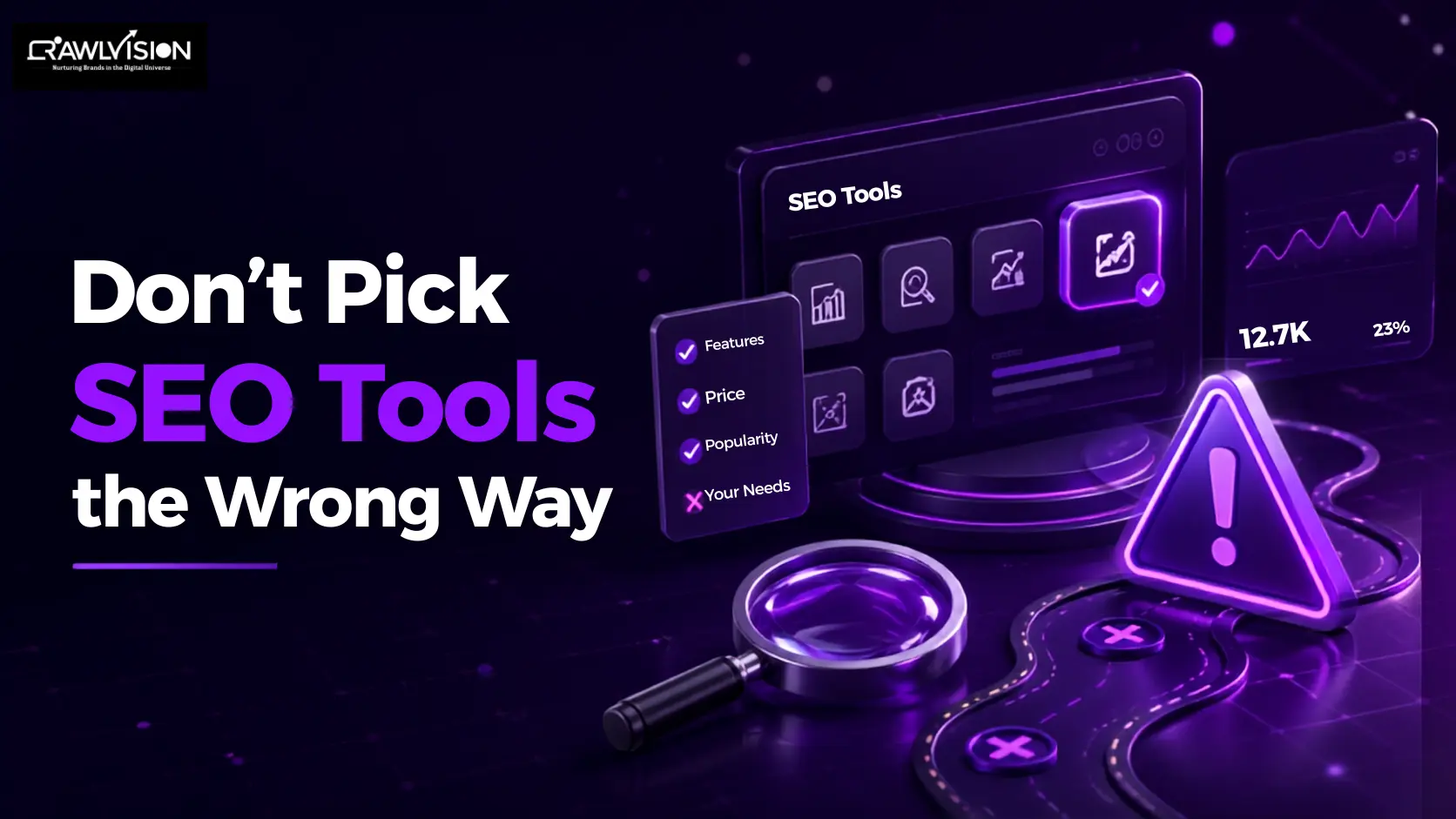
Choosing an SEO tool can feel like comparing smartphones: every platform promises powerful features, smarter insights, automation, and better results.
But the tool with the longest feature list is not automatically the best choice. The right platform should help you solve a specific SEO problem, make better decisions, and fit your budget, website, team, and workflow.
The biggest mistake is chasing features instead of starting with your SEO goals. In this guide, we’ll break down that mistake, five more traps to watch for, and a step-by-step framework to choose the right tool with confidence.
The Biggest Mistake: Chasing Features Instead of Your SEO Goals
The number one mistake people make is choosing an SEO tool because it looks advanced, popular, or packed with features before deciding what they actually need.
A tool may offer keyword research, backlink analysis, technical audits, AI content suggestions, competitor tracking, rank monitoring, reporting, and automation. But if your main problem is local visibility, you may not need all those capabilities.
Why this mistake is costly
Choosing features first can lead to:
- Paying for tools your team rarely uses.
- Spending more time learning dashboards than improving the website.
- Following irrelevant recommendations.
- Comparing too many metrics without clear priorities.
- Creating reports that look impressive but do not support business decisions.
- Switching between tools before building a consistent SEO process.
For example, a local dental clinic may mainly need local rank tracking, Google Business Profile insights, review monitoring, and location-based keyword research. An international e-commerce website may need large-scale crawling, product keyword analysis, technical monitoring, and competitor research.
Both businesses need SEO tools, but they do not need the same SEO tools.
Why Choosing the Right SEO Tools Is Crucial
An SEO tool is not a replacement for research, experience, or judgment. It is a lens you’ll use to find patterns, monitor changes, and make decisions about content, rankings, and traffic for months or years.
Pick the wrong one, and you don’t just lose money. You lose time re-learning a new platform, trust in data that doesn’t match reality, and momentum while your competitors keep moving.
With organic search accounting for 53.3% of trackable website traffic in BrightEdge’s research, the tools you use to understand and improve search performance deserve careful consideration. But adding another SEO platform to your stack does not automatically make your strategy better.
The right tool, on the other hand, becomes something your team actually opens every day, not a dashboard you dread logging into.
5 Other Common Mistakes People Make When Choosing SEO Tools in 2026
Beyond chasing features, several other mistakes can lead businesses to choose an SEO tool that doesn’t fit their needs, budget, or workflow:
1. Ignoring your team’s actual skill level
A powerful tool nobody on your team can use is worthless. Advanced platforms built for SEO specialists often sit untouched when the person managing them is a generalist or business owner wearing multiple hats.
2. Not verifying data accuracy
Keyword volumes, backlink counts, and ranking data can vary significantly between tools. Where possible, cross-check Google Search performance data against Google Search Console. For keyword, backlink, and competitor estimates, compare multiple sources and treat the numbers as directional rather than absolute.
3. Choosing on price alone (too cheap or too expensive)
A rock-bottom tool that gives inaccurate data can cost more in bad decisions than a mid-tier tool that’s simply reliable. On the flip side, overpaying for enterprise features you’ll never use is just a slower form of waste.
4. Overlooking scalability
A tool that works fine at 50 keywords might buckle or force an expensive upgrade at 5,000. Map your growth over the next 12 months before committing to a plan.
5. Skipping the free trial
Many major SEO tools offer a free trial, limited free plan, or demo. Skipping it means learning about a clunky interface or missing feature after you’ve already paid, not before.
| Mistake | Quick Fix |
| Chasing features over goals | Define your use case first, then evaluate tools against it |
| Ignoring team skill level | Match tool complexity to who will actually use it |
| Not checking data accuracy | Cross-check sample data against Google Search Console |
| Pricing extremes | Judge value by reliability, not just cost |
| Skipping scalability check | Map 12-month growth against pricing tiers |
| Skipping the trial | Test with real project data before buying |
How to Choose the Right SEO Tool
Step 1: Define your primary SEO goal
Are you tracking rankings, running audits, researching content, or building links? Get specific before you look at a single tool.
Step 2: Identify your website’s biggest bottleneck
Look at what’s actually holding your traffic back right now; that’s what the tool needs to solve first, not everything at once.
Step 3: Create a must-have feature list
Write down 3-5 non-negotiable features based on Steps 1 and 2. Anything beyond that list is a nice-to-have, not a deciding factor.
Step 4: Check data quality and coverage
Cross-check a sample of the tool’s data against Google Search Console. Inaccurate rankings or keyword volumes lead to wrong decisions, no matter how good the interface looks.
Step 5: Test the tool with a real project
Run it on your actual website during the free trial, not a demo account. That’s the only way to see how it fits your real workflow.
Step 6: Compare total cost and workflow fit
Factor in the subscription price, any add-ons you’ll need, and how well it integrates with your existing stack, not just the sticker price.
Ask These 5 Questions Before Buying an SEO Tool
Before you commit, run your shortlist back through these five checks, a condensed version of the steps above:
- What specific SEO problem will this tool solve?
If you cannot answer this clearly, you may be shopping for features rather than solving a real SEO need.
- Does the tool support my website type and market?
Check whether it works well for your industry, website size, country, language, locations, and search visibility goals.
- Can I understand and act on its data?
A useful report should help you decide what to investigate, improve, publish, monitor, or stop doing.
- What is the total cost at my expected usage?
Review limits for users, projects, keywords, crawls, exports, historical data, integrations, and future upgrades.
- Can I test it with my own website?
A real trial reveals more than a feature page. Test the platform using the tasks you will perform every week or month.
Conclusion
The biggest mistake people make when choosing an SEO tool is chasing features instead of defining their SEO goals. Popularity, advanced dashboards, and impressive automation do not guarantee that a platform will improve your results.
Start with your website’s main bottleneck, compare tools against clear requirements, validate important data, and test the workflow before committing to a subscription.
SEO tools should support clear goals, not create unnecessary data. As search expands into answer engines and AI-generated results, the businesses that adapt fastest are the ones treating strong content and trusted brand signals as seriously as traditional rankings, something more SEO and AI-search-focused agencies, including Crawl Vision, have started building into how they advise clients. The right tool should fit naturally into your weekly workflow. If it helps your team find issues, prioritise actions, and report progress without unnecessary effort, it is more likely to deliver lasting value.
The best SEO tool is not the one with the most features. It is the one that helps you make better decisions consistently.

