
Anthropic is adding invisible, machine-readable watermarks to Claude-generated text, making AI-generated content easier to identify without adding a visible label to the output.
The company says the marking system is being introduced worldwide for new Claude models launched from August 2, 2026. The move is tied to new transparency requirements under the European Union’s AI Act.
Claude’s AI Watermark Is Invisible to Users
Anthropic is adding an invisible watermark directly to Claude-generated text. You won’t see it, and it is designed not to change the meaning, quality, or readability of the text.
The watermark is intended to help identify whether content was generated through Claude.ai, the API, Claude Code, or supported cloud deployments. It can also persist when text is copied, pasted, or lightly edited.
For supported files such as PNG, JPG, and SVG, Claude attaches signed C2PA provenance metadata that can indicate the file was processed by Claude and provide information about its provenance.
Why Is Anthropic Adding Watermarks Now?
The timing is closely connected to the EU AI Act’s transparency requirements, which became applicable on August 2, 2026.
Anthropic says Claude models launched in the European Union on or after that date will support machine-readable marking from launch. The company is also applying the technology globally to supported models rather than limiting it to European users.
The move reflects a broader industry push toward content provenance, giving platforms and other organizations additional ways to establish whether digital content originated from an AI system.
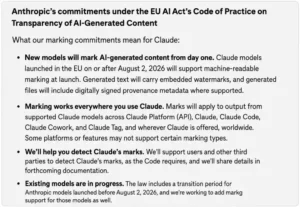
Screenshot: Anthropic’s official Claude support page.
SEO Impact: Could AI Detection Flag Claude Content?
Claude’s watermark could make its AI-generated content easier to identify. However, that does not mean Google or every AI detector will automatically flag the content.
There is currently no evidence that Google uses Anthropic’s watermark as a ranking signal. The watermark is a provenance mechanism, not a Google quality or spam score.
For publishers and SEOs, understanding how content is evaluated across traditional and AI search is becoming increasingly important.
More broadly, AI-generated content is becoming increasingly traceable through provenance signals. That does not mean AI-assisted content will automatically perform poorly in search. Content still needs to be useful, accurate, original, and genuinely helpful to users.
A detected watermark only indicates that Claude may have processed the text. It does not prove that Claude wrote the entire piece or identify the author.
The Bottom Line
Anthropic’s watermark gives Claude-generated content a hidden signal that can potentially identify its origin.
It does not create a new Google ranking factor, but it represents another step toward a web where AI-generated content can be identified more easily.
For SEOs and publishers, the takeaway is simple: AI can assist with content creation, but accuracy, human review, originality, and genuine value still matter.
