



Find low-competition keywords by starting with relevant seed topics, expanding them into specific and long-tail queries, filtering by keyword difficulty, and manually analyzing the SERP. Prioritize keywords where search intent matches your content, weaker websites already rank, and the competition leaves room for a better result.
What Are Low-Competition Keywords?
Low-competition keywords are search terms that have a realistic chance of ranking without requiring the same authority, backlinks, or resources needed for highly competitive queries.
They often have lower keyword difficulty, specific search intent, fewer strong competitors, or clear weaknesses in the current search results.
However, low keyword difficulty does not automatically mean easy ranking. A keyword tool provides an estimate, but ranking ultimately depends on how well your page satisfies the query and performs against the other results.
The goal is not simply to find the lowest KD number. It is to find a keyword where competition, search intent, content opportunity, and business value work in your favor.
How to Find Low-Competition Keywords: 7 Easy Steps
You can find low-competition keywords by starting with broad topics, expanding them into specific queries, filtering by difficulty, and validating the actual SERP.
1. Start With Seed Keywords
Begin with broad topics directly related to your website, products, services, or audience. If you run a website about SEO, possible seed keywords could include:
Start with broad topics that are directly related to your website, products, services, or audience. These topics become your seed keywords, which you can expand into more specific opportunities.
If you run a website about “SEO”, possible seed keywords could include:
- Keyword research
- SEO tools
- Link building
- Technical SEO
- Local SEO
Your seed keyword is only the starting point. The objective is to expand it into more specific searches that reveal less competitive opportunities.
Think about the questions customers ask, problems they need to solve, and specific situations they search for.
Your existing website content, sales conversations, support questions, and competitor pages can all provide useful seed ideas. You can also use competitor keyword gap analysis to uncover topics competitors are already targeting.
2. Find Long-Tail and Specific Keyword Variations
Turn each seed keyword into specific, long-tail, and question-based variations. These variations often reveal more focused search intent and potentially less competitive opportunities.
For example: Seed keyword = keyword research
Possible variations include:
- How to do keyword research for a new website
- Low-competition keywords for small businesses
- How to find keywords with low search volume
- Best keyword research method for beginners
Long-tail keywords often have more specific intent and can face less competition. However, do not assume that every long-tail keyword is easy to rank for.
3. Filter Keywords by Keyword Difficulty
Good SEO tools provide accurate keyword difficulty scores that can help you narrow a large list into more manageable opportunities.
As a starting framework, you can use:
| Difficulty | What It Indicates |
| 0-14 | Very Easy |
| 15-29 | Easy |
| 30-49 | Moderate |
| 50-69 | Difficult |
| 70+ | Highly Competitive |
Note: These ranges should not be treated as universal ranking rules. Different SEO platforms calculate keyword difficulty differently, so use the score to shortlist keywords rather than make the final decision.
4. Check Search Intent Before Choosing the Keyword
Choose keywords where the search intent closely matches the type of content you plan to create. Check whether Google is primarily showing informational guides, product pages, comparison articles, tutorials, category pages, or local results.
Look at the current results and identify whether Google is primarily showing:
- Informational guides
- Product or service pages
- Comparison articles
- Tutorials
- Category pages
- Local results
Suppose you find a low-KD keyword that looks attractive, but Google primarily ranks product pages while you plan to publish an informational article. That may not be a good opportunity.
5. Analyze the Top 10 Results Manually
This is where keyword research becomes more than a numbers exercise. Open the current search results and examine the pages ranking on page one. Look for weaknesses such as:
- Outdated information
- Thin or incomplete content
- Poorly answered search intent
- Weak page structure
- Few relevant backlinks
- Generic content that lacks practical examples
- Pages that do not directly address the query
Also check whether forums, smaller websites, or relatively weak pages appear among the top results.
6. Look for Keywords Where Smaller Websites Already Rank
Prioritize keywords where smaller or less authoritative websites already rank on page one. Their presence can indicate that the SERP may be more accessible than the keyword difficulty score alone suggests.
If the first page is dominated by major brands, highly authoritative publishers, and websites with thousands of relevant backlinks, competing may require significant effort.
But if smaller websites are already ranking, that can be an encouraging signal.
Look at the authority and backlink profiles of several ranking pages. You do not need to beat the strongest website in the industry. You need to determine whether your site can realistically create a better result for that particular query.
This is especially useful when building a keyword strategy for a newer website.
7. Check Traffic Potential, Not Just Search Volume
Search volume tells you how often people search for a term. It does not tell you how much useful traffic your page could receive.
A keyword with 300 monthly searches may be more valuable than one with 5,000 searches if it has stronger intent and can attract visitors who are more likely to become customers.
Also consider related searches and variations that your page could rank for. One well-focused article can potentially appear for many closely related queries.
Before choosing a keyword, consider:
Search volume + intent + ranking opportunity + business value + traffic potential.
Example: Finding a Low-Competition Keyword
The best low-competition keyword is not necessarily the one with the lowest search volume or KD. Compare search demand with ranking difficulty to identify more realistic opportunities.
For example, consider these three keywords related to SEO tools: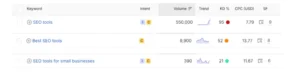
Source: The Crawl Vision team collected this data through keyword research using Semrush.
| Keyword | Search Volume (SV) | Keyword Difficulty (KD) | Potential Opportunity |
| SEO tools | 550,000 | 95 | Very Difficult |
| Best SEO tools | 9,900 | 52 | Difficult |
| SEO tools for small businesses | 390 | 21 | More achievable |
- While “SEO tools” has the highest search volume at 550,000, its KD of 95 makes it extremely competitive.
- “Best SEO tools” has 9,900 searches with a KD of 52, making it competitive but less difficult.
- “SEO tools for small businesses” has only 390 searches but a KD of 21, making it the more promising starting point out of the three.
What Should You Learn From This Example?
Don’t look for the keyword with the lowest KD. Look for the SERP where your website has a realistic opportunity to compete.
A lower-volume keyword with substantially lower competition can be a better starting point than a high-volume keyword that is extremely difficult to rank for.
How to Identify a True Low-Competition Keyword
A true low-competition keyword combines manageable difficulty with relevant search intent, a relatively weak SERP, realistic ranking competitors, and clear business value. Use the following framework before adding a keyword to your content plan:
| Factor | What to Look For |
| Keyword difficulty | Low or moderate |
| Search intent | Strong match with your content |
| SERP strength | Weak or outdated results |
| Ranking sites | Smaller or less authoritative sites |
| Backlinks | Few referring domains |
| Business value | Relevant to your audience |
The strongest opportunities usually satisfy several of these conditions at once.
For example, a keyword with moderate KD can still be attractive if smaller sites rank, the existing content is outdated, and the search intent closely matches your expertise.
The same approach can support AI search visibility because specific, useful, well-structured content gives search systems clearer context about your expertise and its relevance to a query.
Best Tools for Finding Low-Competition Keywords
The best keyword research workflow combines SEO tools with Google Search and Search Console. Tools such as Semrush and Ahrefs provide keyword and competition data, while Google reveals the actual SERP and existing search opportunities.
- Semrush: Use Keyword Magic Tool, keyword difficulty, and Keyword Gap to discover and compare keyword opportunities.
- Ahrefs: Keywords Explorer, keyword difficulty, and SERP analysis can help evaluate competition and ranking pages.
- Google Search: Autocomplete, related searches, People Also Ask, and the live SERP can reveal questions and content patterns that keyword tools may not fully capture.
- Google Search Console: Existing queries can uncover keywords where your pages already receive impressions but rank below the first page. Google Search Console documentation says these can be valuable optimization opportunities because your site already has some relevance for them.
The best workflow combines keyword data with actual search-result analysis rather than relying on one tool or metric.
Common Keyword Selection Mistakes to Avoid
The biggest keyword research mistakes are relying only on KD or search volume, ignoring search intent, and failing to analyze the websites already ranking.
- Choosing keywords based only on KD: A low score does not guarantee an easy ranking.
- Ignoring search intent: Your content must satisfy what searchers expect to find.
- Choosing keywords with zero business relevance: Traffic has limited value if it cannot support your goals.
- Assuming every long-tail keyword is easy: Specific queries can still have strong competition.
- Ignoring who currently ranks: SERP strength can reveal more than a difficulty score.
- Focusing only on search volume: High volume does not always mean high-value traffic.
Conclusion
Finding low-competition keywords is less about discovering a magic KD number and more about identifying realistic gaps in the search results.
Start with relevant topics, expand them into specific queries, use keyword difficulty to narrow your list, and then manually evaluate the SERP. Prioritize keywords where your content can genuinely satisfy the search intent better than the pages already ranking.
Over time, consistently targeting these realistic opportunities can help your website build organic visibility, topical relevance, and the authority needed to compete for more difficult keywords.