


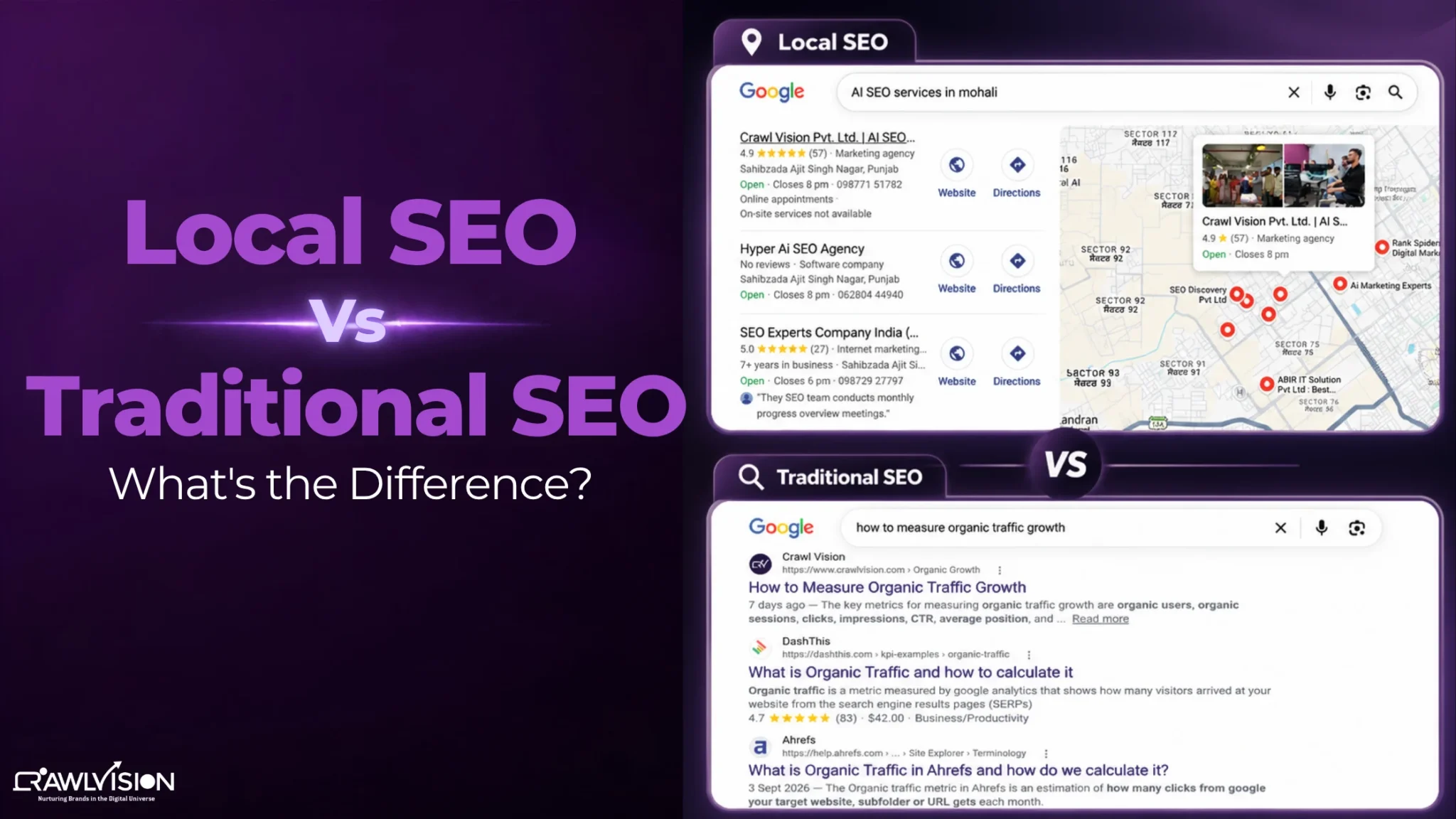
Local SEO and traditional SEO share core practices such as useful content, technical optimization, links, and relevant keywords, but they target different search needs. Traditional SEO aims to improve a website’s visibility in organic search results, while local SEO focuses on searches where a business’s location matters, including local results and Google Maps.
What Is Traditional SEO?
Traditional SEO is the process of improving a website so its pages can appear more prominently for relevant organic searches. It is useful when people search for information, products, services, or solutions without a strong need for a nearby business.
A traditional SEO strategy can include:
- Keyword and search intent research
- Helpful, relevant content
- On-page optimization
- Internal linking
- Technical SEO and website structure
What Is Local SEO?
Local SEO focuses on improving a business’s visibility when search results are influenced by location. This includes local searches on Google Search and Google Maps.
Google says local results are primarily based on relevance, distance, and prominence. It also recommends keeping Business Profile information complete and accurate, and managing reviews and other business details.
Local SEO commonly involves:
- Optimizing the Google Business Profile
- Creating useful location and service pages
- Maintaining accurate business information across relevant directories
- Earning locally relevant links and mentions
- Managing customer reviews
- Using location-related keywords naturally
What Is the Difference Between Local SEO and Traditional SEO?
The main difference is search context. Traditional SEO is generally focused on organic visibility for a topic, product, or service, while local SEO adds geographic relevance to help a business reach customers in a particular area.
1. Search Intent
Traditional SEO:
Traditional SEO targets searches where the answer does not necessarily depend on where the searcher is located. A user searching for “best accounting software” may want to compare products available across a broad market.
Local SEO:
Local SEO targets searches where location can influence which businesses are useful. Someone searching for “accountant near me” is looking for a service provider within a relevant geographic area. That’s why optimizing for near me searches becomes a necessary local SEO practice.
2. Ranking Factors
Traditional SEO:
Traditional SEO looks at how relevant, useful, accessible, and technically sound a webpage is for a search query. Technical health, content, internal links, and external links can all be part of a broader SEO strategy.
Local SEO:
Local SEO includes many of the same website fundamentals, but local visibility also depends on signals connected to the business and its location. Google specifically identifies relevance, distance, and prominence as the main factors for local results.
3. Google Business Profile
Traditional SEO:
A Google Business Profile is not normally the central component of a national or purely informational SEO strategy. A website can rank organically without depending on a Business Profile.
Local SEO:
Optimizing a Google Business Profile is a key part of local search visibility for eligible businesses. Accurate information helps Google understand what the business offers and where it operates. Google advises businesses to keep details such as address, hours, category, and attributes up to date.
4. Keywords
Traditional SEO:
Traditional SEO often targets broad or topic-focused keywords such as “email marketing tools,” “running shoes,” or “technical SEO.”
Local SEO:
Local SEO can target location-specific searches such as “email marketing agency in Chandigarh,” “running shoes store near me,” or “technical SEO consultant in Mohali.”
However, adding a city name to every page is not a local SEO strategy by itself. Location should be included where it genuinely helps describe the service, audience, or business area.
5. Backlinks and Citations
Traditional SEO:
Backlinks can help search engines understand relationships between websites and signals of authority and relevance. A traditional SEO campaign may focus on earning relevant links from useful, credible websites.
Local SEO:
Local SEO can also benefit from a good backlink strategy, but businesses may additionally need consistent business information and relevant mentions across directories and other local sources. Google notes that information from across the web, including links and directories, can contribute to local prominence.
Local SEO vs Traditional SEO: Practical Example
The difference becomes easier to understand when you look at how the same type of business can approach search visibility through traditional SEO and local SEO.
Traditional SEO Example
A digital marketing company could create a detailed guide targeting “how to measure organic traffic growth.” It could then use traditional SEO practices such as search intent research, on-page optimization, internal linking, and relevant backlinks to improve the page’s visibility in organic search results.

Note: Image showing real organic search results for “how to measure organic traffic growth.”
Local SEO Example
Now consider an AI SEO company that serves businesses in Mohali. Someone searching for “AI SEO services” may have broad intent, while searches such as “AI SEO services in Mohali” or “AI SEO services near me” show stronger local intent.
The company could support this local visibility by optimizing its Google Business Profile, maintaining accurate business information, creating a useful location-relevant service page, and building relevant local citations and mentions.
Note: Image showing local map results for “AI SEO services in Mohali.”
Do You Need Local SEO or Traditional SEO?
Most local businesses benefit from both local SEO and traditional SEO because customers can discover them through organic website results and location-based search experiences.
| Business Type | Main SEO Focus |
| Local restaurant | Local SEO + traditional SEO |
| Dental clinic | Local SEO + traditional SEO |
| Local law firm | Local SEO + traditional SEO |
| Multi-location retailer | Local SEO + traditional SEO |
| National SaaS company | Traditional SEO |
| National e-commerce brand | Traditional SEO + local SEO where location influences demand |
The right balance depends on how customers search. A restaurant needs strong local visibility because proximity can affect a customer’s choice. A SaaS company serving customers nationally may place more emphasis on topic-focused organic search.
For a local business, ignoring traditional SEO can also create gaps. Service pages, useful content, technical SEO, and internal linking still help the website perform in organic search.
Crawl Vision research: Our analysis of 500+ websites found that local businesses often have SEO gaps across both local search visibility and broader organic performance.
This shows why combining local SEO with traditional SEO can help businesses cover more ways customers discover them.
Conclusion
Local SEO and traditional SEO are not competing versions of the same strategy. They share many fundamentals, but local SEO adds a stronger focus on geographic relevance, business information, local prominence, and location-based search behavior.
If customers need to find a business in a specific area, local SEO deserves dedicated attention. If the business also wants broader informational or service-related searches, traditional SEO should remain part of the strategy.