


An AI search readiness audit helps you identify whether your website is accessible to search crawlers, provides clear and useful answers, uses structured content, and communicates your brand’s expertise. In 30 minutes, you can run five initial checks to identify potential barriers to visibility in ChatGPT, Google AI search, and other AI-powered platforms.
What Is an AI Search Audit?
An AI search audit evaluates how easily AI-powered search systems can access, understand, and potentially reference your website when answering users’ questions. It examines technical accessibility, content quality, page structure, structured data, and your brand’s visibility in AI-generated answers.
Traditional SEO remains an important foundation, but ranking in Google does not guarantee visibility in AI-generated responses. Different platforms use different systems to discover information, retrieve sources, and generate answers.
A quick audit helps you find problems worth investigating before investing time in more extensive optimization. It is a preliminary assessment, not a guarantee of AI visibility.
How to Audit Your Website for AI Search in 30 Minutes
You can perform a first-pass AI search audit in 30 minutes by checking your brand’s visibility, crawler accessibility, page structure, content clarity, and schema markup.
Focus on your homepage and a few important service or informational pages rather than trying to inspect your entire website.
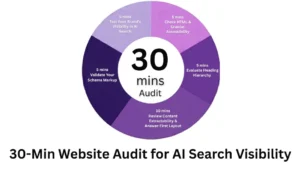
Step 1: test your brand’s visibility in AI search (5 minutes)
Why It Matters: If AI platforms do not mention your business when users ask relevant questions, you may have a visibility gap worth investigating. This test establishes a baseline, although one missing mention does not prove that your website has a problem.
How To Do This:
Open ChatGPT, Perplexity, and Google’s AI search experiences where available. Ask questions your potential customers might use, such as:
- Which [products/services] are best for [use case]?
- What should I look for when choosing a [product/service]?
- Which [products/services] specialize in [specific feature]?
Record whether your brand appears, whether the description is accurate, and which websites are cited as sources. Repeat the test with a few relevant prompts before concluding.
Tracking brand mentions across AI platforms can reveal where your business appears and where competitors receive more attention. Regularly monitoring AI search visibility and brand mentions helps you establish a baseline and identify changes worth investigating.
Pro Tip: Save your prompts and results. Repeating the same tests later makes it easier to compare visibility over time, although AI responses can vary between sessions.
Step 2: check html & crawler accessibility (5 minutes)
Why It Matters: AI search visibility depends partly on whether the relevant systems can access your content. Google’s guidance confirms that pages must meet its normal technical requirements to be eligible for links in AI Overviews and AI Mode.
How To Do This:
Start with your homepage and two important pages.
- Open yourdomain.com/robots.txt and check whether important content is unintentionally blocked.
- Use Google Search Console’s URL Inspection tool to review indexing status and the page Google received.
- Check for accidental noindex directives, access restrictions, or pages returning errors.
- Confirm that important content is available in the rendered page, particularly if your website relies heavily on JavaScript.
When these checks reveal crawlability or indexing problems, investigate their underlying causes rather than treating each error separately. Understanding how to find technical SEO issues on your website can help you identify problems affecting multiple important pages.
Remember that different AI platforms use different crawlers and access requirements. Check the documentation for the specific platforms you want to reach rather than assuming Googlebot access guarantees access everywhere.
Pro Tip: Prioritize pages that drive leads, explain your services, or answer important customer questions. Crawlability problems on these pages deserve attention before minor formatting issues.
Step 3: evaluate heading hierarchy and page structure (5 minutes)
Why It Matters: A logical page structure helps readers navigate content and makes relationships between topics clearer. Google’s guidance for generative AI search also emphasizes organizing pages with useful paragraphs and headings.
How To Do This:
Review the heading hierarchy on one key service page and one blog post.
- Does the H1 clearly describe the page’s main topic?
- Do H2 headings introduce distinct sections?
- Are H3 headings used to organize related subtopics?
- Can visitors understand the page by scanning its headings?
- Are important sections connected through relevant internal links?
Example:
Generic Heading: “Our Approach” – provides less context on its own.
Good Heading: “How Our Technical SEO Audit Identifies Crawl Issues” – tells readers much more about the section’s purpose.
Clear headings are only one part of a well-organized website. A logical internal linking strategy also helps visitors navigate related pages and gives search engines additional context about how your content connects.
Pro Tip: Do not restructure every page simply to achieve a perfect heading sequence. Focus on clarity, logical organization, and making important information easy to find.
Step 4: review content extractability & answer-first layout (10 minutes)
Why It Matters: Clear, useful content gives readers and search systems a better understanding of what your page answers. Google recommends creating original, people-first content rather than relying on generic information or writing solely to influence AI responses.
How To Do This:
Choose one important service page and one blog post. Check whether each page answers its main question early, explains key terms, and supports important claims with evidence.
Look for these content issues:
- Long introductions that delay the main answer.
- Vague statements without examples or supporting evidence.
- Service pages that describe features but do not explain customer benefits.
- Claims about results without relevant proof.
- Missing author details or first-hand experience where they would help establish credibility.
For example, instead of writing, “We use advanced strategies to improve online visibility,” explain which problems you address, how your process works, and what evidence supports your approach.
A practical way to improve your content is to answer the main question directly, then add context, examples, and useful details. This makes the page more helpful without forcing every section into a rigid answer format.
Pro Tip: Review how to write AI-friendly content that ranks for ideas on improving clarity while keeping content useful for human readers.
Step 5: validate your schema markup (5 minutes)
Why It Matters:
Schema markup helps search engines interpret information about a page and can make eligible pages suitable for supported rich results. However, Google does not require special schema markup for AI Overviews or AI Mode.
How To Do This:
- Open Google’s Rich Results Test to check supported Google search features.
- Use the Schema Markup Validator to inspect Schema.org markup more broadly.
- Check for syntax errors and confirm that the markup matches the content visitors can actually see.
- Review relevant types, such as Organization, Article, or LocalBusiness, where appropriate for your website.
Do not add every schema type simply because it exists. Use markup that accurately describes your page and business.
Pro Tip: Fix incorrect or misleading structured data before adding more. Valid schema improves clarity, but it does not guarantee rankings, AI citations, or rich results.
How to Prioritize the Issues You Find
Prioritize issues that prevent important pages from being accessed, followed by problems that make your content difficult to understand or trust. Use your 30-minute audit to create a focused action list.
| Issue found | Recommended action | Priority |
| Important pages blocked or not indexable | Investigate crawler rules and indexing directives | High |
| Main answers are vague or buried | Rewrite key sections for clarity and completeness | High |
| Important pages lack logical headings or internal links | Improve structure and navigation | Medium |
| Schema contains errors or inaccurate details | Validate and correct structured data | Medium |
| Brand does not appear in initial AI tests | Investigate content relevance and external source coverage | Further review |
These priorities are a starting point, not a universal ranking system. For example, a schema error affecting a key business page may deserve attention before a minor content issue.
In 500+ website audits at Crawl Vision, we have found that 90% showed gaps in AI search readiness, including technical accessibility issues, unclear content structure, or insufficient signals to help search systems understand a brand. This suggests that many businesses may be unaware of foundational website issues that could limit their visibility in AI-powered search.
Conclusion
A 30-minute AI search readiness audit helps you identify technical barriers, content gaps, and opportunities to improve your website’s visibility. Start with the most important issues, fix them, and repeat your checks periodically.
AI visibility cannot be guaranteed, but a technically accessible website with clear, credible content gives you a stronger foundation.