


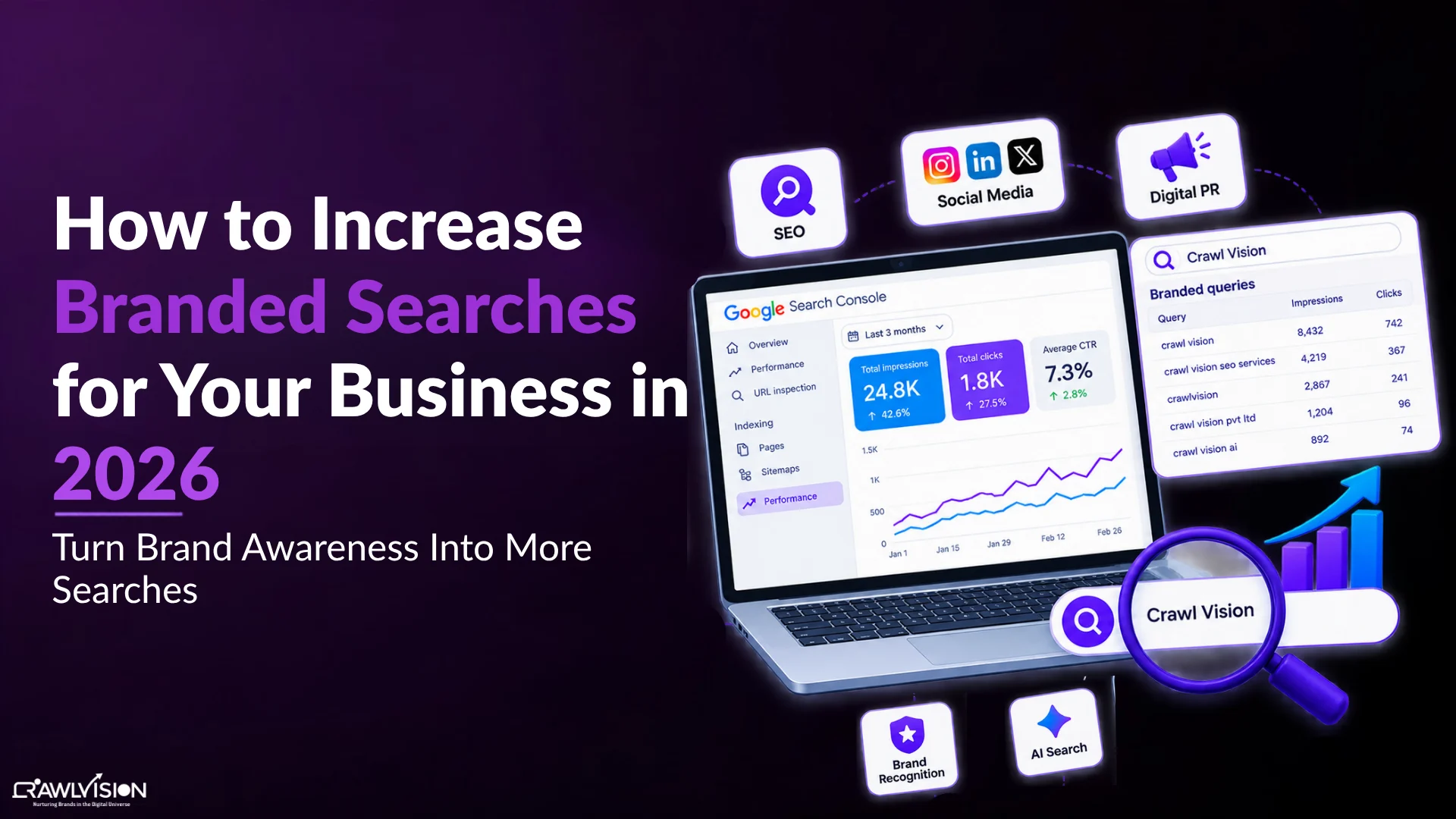
To increase branded searches, make your business memorable through valuable content, consistent social media, digital PR, strong SEO, AI search optimization, and positive customer experiences. Track branded impressions and clicks in Google Search Console to measure whether more people are actively searching for your brand.
What Are Branded Searches, and Why Do They Matter?
Branded searches are search queries that include a company’s name, product name, or other terms specifically associated with its brand.
Example:
Brand name: Crawl Vision
Brand + service: Crawl Vision SEO services
Brand + solution: Crawl Vision AI search optimization
Brand variations: CrawlVision, CrawlVision Pvt Ltd, etc
Common misspellings or alternative spellings are also considered.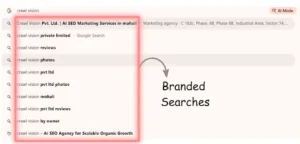
Branded searches matter because they help businesses understand whether people recognize their name and actively seek them out.
Why branded searches matter for businesses:
- Brand recognition: More branded queries can indicate that more people remember your business.
- Demand measurement: Tracking branded search volume helps you evaluate changes in interest following marketing campaigns.
- Customer acquisition: People searching for a business by name may already be familiar with its offerings, although a branded query does not guarantee purchase intent.
- Marketing insights: Comparing branded and non-branded searches helps distinguish existing brand demand from discovery through general searches.
Google Search Central explains that branded and non-branded queries provide different perspectives on website performance. However, branded search growth alone does not prove that a marketing campaign caused the increase.
7 Ways to Increase Branded Searches for Your Business
Increasing branded searches requires more than ranking for your company name. You need to reach relevant audiences, give them something valuable to remember, and create reasons for them to search for your business later.
1. Build a recognizable brand identity
A recognizable brand gives people a clear reason to remember your business. When your name, messaging, and expertise remain consistent, audiences can more easily associate your company with a particular need.
Why it matters: If people cannot remember what your business does or how it differs from competitors, your marketing may generate exposure without generating branded searches.
Best practices:
- Define a clear value proposition that explains who you help and what problem you solve.
- Maintain consistent brand messaging, visual identity, and business information across relevant channels.
- Associate your brand with a specific area of expertise instead of trying to communicate everything at once.
Expert Tip: Ask someone unfamiliar with your business to describe what you do after viewing your homepage. If they cannot explain it clearly, simplify your positioning.
2. Create original and valuable content
Original content gives people a reason to discover, remember, and revisit your business. Publish valuable, AI-friendly content that solves real problems instead of repeating advice already available across competing websites.
Why it matters: Useful guides, original research, and practical case studies can introduce your brand to new audiences and give others a reason to reference your work.
Best practices:
- Create detailed resources that answer questions your target audience regularly asks.
- Share original research, expert insights, and documented case studies where genuine evidence is available.
- Develop recognizable content series that audiences can associate with your brand.
Expert Tip: Include a distinctive framework, original example, or useful resource in important articles. Give readers a reason to remember who published the information, not just the answer itself.
3. Build a consistent social media presence
Social media helps businesses introduce their brand to audiences who may never have visited their website. Consistent, useful content can increase familiarity and encourage people to look up the company independently.
Why it matters: Repeated exposure across relevant platforms can help audiences recognize your brand when they encounter it elsewhere.
Best practices:
- Prioritize platforms where your target customers already spend time.
- Publish useful short videos, expert commentary, and recurring content formats.
- Participate in relevant conversations instead of using every post as a sales pitch.
Expert Tip: Use a consistent name and clear brand identity across platforms. Review profile visits, referral traffic, and branded search trends together to identify possible relationships between social activity and search demand.
4. Earn brand mentions through digital pr
Digital PR introduces your business to new audiences through relevant publications, industry websites, podcasts, and expert discussions. These mentions can help people discover your brand outside your owned channels.
Why it matters: A credible mention in a relevant publication can expose your expertise to people who might later search for your company by name.
Building website credibility and trust also helps establish a stronger foundation for your online presence.
Best practices:
- Offer journalists and publishers useful expert commentary on relevant industry topics.
- Publish original research or findings that provide a genuine reason for others to cite your business.
- Build relationships with relevant publications, creators, and industry communities.
Expert Tip: Prioritize relevant exposure over the number of mentions. A mention that reaches your target audience may be more valuable than dozens of references on unrelated websites.
5. Use SEO to strengthen brand discovery
SEO helps potential customers discover your business while researching a problem, comparing solutions, or looking for expert advice. Strong non-branded visibility can introduce your company before people know its name.
Why it matters: People cannot search for your brand if they have never encountered it. Organic search creates opportunities to introduce your expertise to relevant audiences.
Best practices:
- Target relevant non-branded keywords that match your audience’s needs.
- Create useful service pages that clearly explain your expertise and solutions.
- Connect related articles and service pages through relevant internal links.
Expert Tip: Measure discovery and brand demand separately. A page can attract substantial non-branded traffic without generating more branded searches, so assess both outcomes rather than treating them as interchangeable.
6. Improve your visibility in AI search
AI search visibility helps your business appear in relevant AI-generated answers and recommendations. When people encounter your brand while researching a solution, they may later search for your company directly.
Why it matters: AI search platforms create additional opportunities for audiences to discover businesses, although brand mentions in AI answers do not guarantee subsequent searches.
Best practices:
- Publish clear, evidence-based content that answers specific questions in your area of expertise.
- Demonstrate experience through original examples, documented results, and credible expert contributions.
- Build relevant brand mentions across trustworthy third-party sources.
Expert Tip: Regularly monitor brand mentions across AI search platforms alongside branded search trends. Treat them as separate indicators and avoid assuming that increased AI visibility automatically causes search growth.
7. Turn customer experiences into brand advocacy
Positive customer experiences can encourage people to recommend your business, mention it in conversations, and look for it again when they need another solution.
Why it matters: Recommendations from existing customers can introduce your brand to audiences who may not encounter your marketing directly.
Best practices:
- Deliver reliable service and communicate clearly throughout the customer journey.
- Invite genuine customer reviews and referrals without offering incentives for positive ratings.
- Share customer stories and testimonials with permission, using accurate details.
Expert Tip: Look for recurring questions from new customers about how they discovered your business. Their answers can reveal whether referrals, communities, content, or other channels are introducing your brand to potential buyers.
How to Measure Branded Search Growth in Google Search Console
Google Search Console helps you measure branded search performance through clicks, impressions, click-through rate (CTR), and average position. Its branded queries filter can separate branded searches from non-branded searches on eligible properties.
- Open the Performance report: In Google Search Console, navigate to Performance and select Search results.
- Apply the branded queries filter: Choose the branded query option if it is available for your property.
- Review key metrics: Examine branded clicks, impressions, CTR, and average position.
- Compare equivalent periods: Compare similar time frames and account for seasonality, promotions, and changes in demand.
Image showing branded and non-branded query filter under Google Search Console: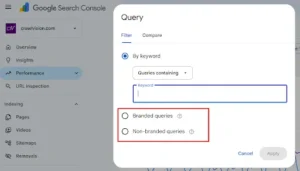
Look for sustained changes instead of judging results from a single week. Branded impressions may rise before clicks, while CTR can fluctuate with search intent and changes in search results.
At Crawl Vision, we assess SEO performance by comparing trends across relevant metrics rather than concluding a single data point. Apply the same approach to branded searches by comparing search trends with campaign activity, referral traffic, and conversions.
Google’s branded queries filter is not available for every property and may occasionally misclassify queries. In that case, use Search Console’s query filters to identify your brand name, common misspellings, and brand-plus-service searches. Treat this manual method as an estimate, not a complete classification.
What If You Get More Brand Mentions but Fewer Searches?
More brand mentions do not always lead to more branded searches. People may see your business mentioned online without remembering its name or having a reason to look it up.
For example, your business might receive mentions in industry blogs or social media posts, but those mentions may not reach potential customers who need your services.
To understand the gap, check whether the mentions reach your target audience and clearly communicate what your business offers. Then compare branded impressions and clicks in Google Search Console with referral traffic and conversions in GA4.
Do not judge a campaign by mentions alone. Track these metrics over time to understand whether increased exposure is translating into brand recognition, website visits, or business enquiries.
Conclusion
Increasing branded searches starts with giving people reasons to remember and seek out your business. Combine recognizable positioning, useful content, social media, digital PR, SEO, AI search visibility, and positive customer experiences.
Then use Google Search Console to measure branded search trends and evaluate them alongside other marketing outcomes. The goal is not simply to generate more searches, but to build lasting recognition among the people your business wants to reach.