


Yes, AI can save time on SEO by automating repetitive tasks such as keyword clustering, content briefing, metadata drafting, technical issue classification, and reporting.
However, the actual time saved depends on the output accuracy of AI and the time required for human review, editing, and verification.
AI SEO tools work best as an assistant for repetitive SEO work, while SEO professionals retain responsibility for strategy, quality control, and implementation decisions.
The goal is not simply to produce more work faster, but to improve efficiency without sacrificing accuracy or search performance.
Where Does AI Actually Save Time in SEO?
AI saves time on SEO tasks that involve processing large amounts of information, identifying patterns, and producing initial drafts. Common examples include keyword clustering, content planning, on-page optimization, technical issue analysis, reporting, and content ideation.
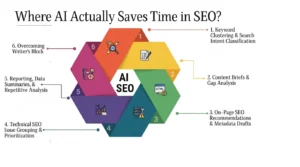
1. Keyword clustering and search intent classification
AI can group related keywords and suggest likely search intent, reducing manual sorting for large keyword lists.
How to cluster keywords using AI:
- Export keyword data, including search volume and keyword difficulty where available, from an SEO research tool.
- Ask an AI assistant to group the supplied keywords by topic and likely search intent.
- Review search engine results pages to confirm intent and determine whether each group deserves a separate page.
Best tools: Semrush and Ahrefs.
2. Content briefs, outlines, and content gap analysis
AI can turn keyword research and competitor observations into initial content briefs, outlines, and lists of missing subtopics.
How to do it:
- Provide the target keyword, audience, search intent, and competitor pages.
- Ask AI to suggest an outline and relevant questions.
- Validate the suggestions against search results and audience needs.
Best tools: ChatGPT, Gemini, Semrush.
3. On-page SEO recommendations and metadata drafts
AI can draft title tags, meta descriptions, and heading improvements, giving writers a starting point rather than a blank page.
How to do it:
- Supply the page content, target query, and relevant search data.
- Generate alternative titles, descriptions, and improvement suggestions.
- Check accuracy, relevance, and keyword overlap before implementation.
Best tools: ChatGPT, Semrush, Surfer SEO.
4. Technical SEO issue grouping and prioritization
AI can group crawl errors and explain potential causes, helping SEO teams organize technical findings. It cannot reliably diagnose every issue from an error label alone.
How to do it:
- Export crawl findings from Screaming Frog.
- Ask AI to group similar issues and affected URLs.
- Verify the causes and prioritize fixes by severity and business impact.
Best tools: Screaming Frog, ChatGPT, Gemini.
5. Reporting, data summaries, and repetitive analysis
AI can summarize SEO reports and identify patterns worth investigating, provided the underlying data is accurate.
How to do it:
- Export relevant Google Search Console or GA4 data.
- Ask AI to summarize changes and notable patterns.
- Verify the figures and investigate possible causes before presenting recommendations.
Best tools: ChatGPT, Gemini, Looker Studio.
6. Overcoming writer’s block
AI can suggest article angles, examples, and opening paragraphs when you know the topic but struggle to develop it.
How to do it:
- Share the topic, audience, and main argument.
- Request alternative angles or outlines.
- Develop the strongest idea with original insights and evidence.
Best tools: ChatGPT, Claude, Gemini.
How Much Time Can AI Save on SEO Tasks?
AI can save several hours per week on repetitive SEO work, but actual savings vary by task and workflow. Measure total time spent on prompting, editing, verification, and rework rather than counting generation time alone.
Keyword.com’s State of AI and Automation in SEO 2026 found that 89% of the 92 respondents answering its time-savings question reported saving at least four hours weekly. This is survey evidence, not a guarantee for every team.
Measure the complete workflow to understand the actual benefit.
| SEO task | Manual workflow | AI-assisted workflow | What to verify |
| Keyword clustering | Manually group and review queries | AI proposes topic clusters | Search intent and page overlap |
| Content briefs | Research topics and draft an outline | AI prepares an initial brief | Search demand and content gaps |
| Metadata drafting | Write and revise each title and description | AI generates alternatives | Accuracy and page relevance |
| Technical SEO | Review and categorize crawl findings | AI groups similar issues | Root cause and severity |
| SEO reporting | Summarize exported performance data | AI drafts a performance summary | Figures, trends, and explanations |
Note: Compare the time spent before and after introducing AI, including prompting, editing, verification, and rework. Do not present estimated savings as measured results.
Where Does AI Still Fall Short in SEO?
AI SEO tools can produce inaccurate information, generic content, unsuitable optimization recommendations, and incorrect interpretations of website data. Human review is necessary to verify facts, assess business context, and prevent avoidable SEO mistakes.
1. Incorrect or fabricated information
AI may invent facts, misinterpret metrics, or suggest unsuitable technical fixes. Verify claims against reliable sources and actual website data.
2. Getting stuck in the editing trap
A quick first draft can require extensive rewriting. When correcting errors takes longer than creating the work manually, the time savings disappear.
3. Over-optimization risks
AI may suggest repetitive keywords, unnatural headings, or excessive internal links. Review recommendations in context instead of following optimization scores blindly.
4. Unoriginal and generic content
AI can repeat familiar explanations without adding useful insight. Google’s guidance on helpful, people-first content emphasizes originality, usefulness, and first-hand expertise.
5. Missing context and business understanding
AI may overlook customer priorities, conversion goals, and technical constraints. Supply relevant context and keep strategic decisions with someone who understands the business.
The Best AI SEO Tools to Use in 2026
The best AI SEO tools depend on the task. ChatGPT supports general analysis and drafting, Semrush and Ahrefs provide SEO research capabilities, Screaming Frog supports technical crawling, and Surfer SEO helps with content optimization.
- ChatGPT: Keyword clustering, content briefs, data interpretation, and drafting.
- Semrush: Keyword research, competitor analysis, and content optimization.
- Ahrefs: Keyword research, backlink analysis, and content opportunities.
- Screaming Frog SEO Spider: Website crawling and technical SEO analysis.
- Surfer SEO: Content optimization and search-result comparisons.
Note: Features and pricing change. Choose tools according to your workflow and data requirements, not simply the number of AI features available.
How to Use AI for SEO Without Wasting More Time
To use AI for SEO efficiently, define a specific task, provide reliable data, automate repetitive work, verify the output, and measure the total time saved. This process reduces unnecessary revisions and keeps important decisions grounded in evidence.
- Define the task: Decide whether you need keyword clustering, crawl analysis, or reporting.
- Provide real data: Include relevant URLs, business goals, and reliable exports.
- Automate repetitive work: Use AI for sorting, summarizing, and drafting.
- Verify the output: Check facts, search intent, and technical recommendations before implementation.
- Measure the results: Compare total time, output quality, rework, and relevant SEO outcomes.
At Crawl Vision, we approach AI-assisted SEO as a way to speed up repetitive work, not replace analysis. Reviewing crawl data, validating search intent, and checking recommendations against actual website performance helps ensure that faster workflows still support the right SEO priorities.
Conclusion
AI can save time on SEO when it reduces repetitive work without creating more editing or verification. Start with tasks that have clear inputs and measurable outputs, then expand as your review process improves.
The real benefit is giving SEO professionals more time for research, prioritization, original thinking, and decisions that improve search performance.