


Below are the biggest announcements Google made in 2025, grouped by what they actually change for brands, with clear action steps after each section.
1) Search becomes conversational with AI Mode
Google introduced AI Mode as a deeper, end-to-end AI search experience that supports follow-up questions and “go deeper” journeys (not just a single query → 10 blue links). Google said it began testing AI Mode in Labs earlier in the year and started rolling it out more broadly in the U.S. starting May 20, 2025.
Why it matters
AI Mode shifts search from click-first to answer-first. Users can stay in a conversation, ask refinements, and rely on summaries plus links, which changes:
- How many clicks do your pages get?
- What content gets cited/featured?
- Which brands become “default recommendations”?
What to do
- Build pages that answer the next 3–5 follow-up questions on the same URL (FAQ blocks, comparison sections, constraints, edge cases).
- Add “decision support” content: trade-offs, “best for” scenarios, and clear next steps.
- Structure content for machine reading (clean headings, lists, definitions, tables).
If you’re building for this shift, your team will also benefit from having a clear GEO/AEO approach (generative visibility, not just rankings). Here’s a good starting point: GEO vs AEO: What’s the Difference?
2) AI Overviews scale up (and get smarter via Gemini)
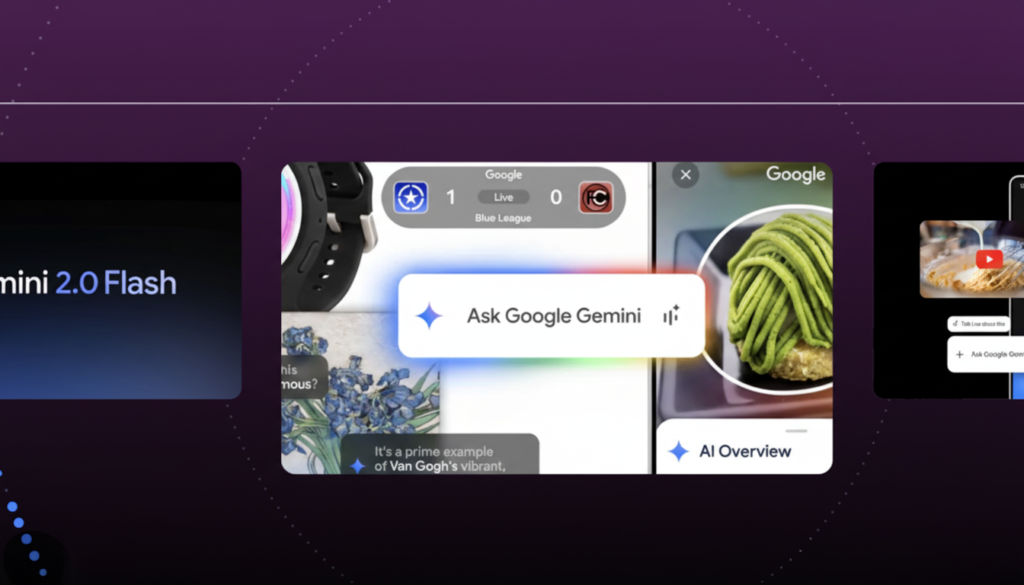
Google’s AI Overviews continued expanding and, around I/O 2025, Google highlighted momentum and scale (1.5B+ monthly users, 200+ countries/territories) and noted an upgrade bringing a version of Gemini 2.5 into Search for AI Overviews.
Why it matters
AI Overviews affect:
- top-of-SERP real estate,
- which sources get cited,
- how users interpret authority (the “summary” becomes the first impression, not your meta description).
What to do
- Update key pages with tight definitions (what it is, what it isn’t), and cite credible sources where relevant.
- Add “entity clarity”: consistent naming, about sections, author signals, schema, and internal linking.
- Create “citation-friendly” blocks: short, factual paragraphs and bullet lists that are easy to lift into summaries.
3) Gemini 2.5 Pro: “thinking” models go mainstream
In March 2025, Google announced Gemini 2.5 (including 2.5 Pro) with a stronger reasoning and coding focus, and availability in Google AI Studio and the Gemini app for Gemini Advanced users.
Then, during I/O season, Google reinforced that Gemini became the core layer across products, and developer tooling increasingly assumed Gemini-powered workflows.
Why it matters
This is bigger than “a model got better.” It means:
- More users rely on AI to research, compare, summarize, and decide,
- More Google products become AI-mediated discovery layers,
- More content gets consumed indirectly through AI.
What to do
- Build “AI-readable” pages that can be accurately summarized without losing nuance.
- Publish original insights (frameworks, checklists, benchmark comparisons) so AI has something unique to cite.
- Refresh pages with outdated assumptions; AI systems amplify stale info fast.
4) Gemini app upgrades: Live camera, Deep Research, Canvas, and Gemini in Chrome
At Google I/O (May 20, 2025), Google announced major Gemini app updates, including:
- Gemini Live with camera + screen sharing is becoming available for free on Android and iOS.
- Deep Research updates (including using your own sources like PDFs),
- Canvas updates for creating and “vibe coding” websites/apps,
- And Gemini is coming to Chrome, so you can ask questions while browsing.
Why it matters
When AI is embedded inside the browser, the web becomes a layer AI interprets in real time. That changes how users:
- Read long articles,
- Evaluate trust signals,
- Compare products/services.
What to do
- Make your pages skimmable and “extractable” (clear sections, strong summaries, visual hierarchy).
- Add comparison content that users would otherwise ask Gemini (pricing logic, use cases, limitations).
- Ensure your brand facts are consistent across the site + profiles + citations.
5) New generative media: Veo 3, Imagen 4, Flow (AI filmmaking)
Google announced new generative media capabilities at I/O 2025, including:
- Veo 3 (video generation),
- Imagen 4 (image generation),
- And Flow (an AI filmmaking tool).
Why it matters
Creative production costs drop, content velocity increases, and competition for attention spikes. The advantage shifts from “who can create” to:
- who can create with strategy,
- who can distribute effectively,
- who can build trust and differentiation.
What to do
- Don’t just publish more — publish sharper: POV-led content, real examples, real constraints, real outcomes.
- Build a repeatable creative system: 1 pillar → 6 cutdowns → 12 derivatives → 1 landing page.
- Add proof: screenshots, mini case studies, process transparency.
6) Learning becomes a product focus: LearnLM infused into Gemini
Google announced it was infusing LearnLM directly into Gemini 2.5 and shared additional learning-focused updates at I/O 2025.
Why it matters
Users increasingly use Google’s AI layer to learn before they buy, especially for high-consideration products/services. If your content teaches well, you become the “default trusted source.”
What to do
- Create learning paths (Beginner → Intermediate → Advanced) instead of scattered posts.
- Add “check your understanding” blocks: quick quizzes, common mistakes, mini scenarios.
- Make an internal linking map of the learning journey (not just topical clusters).
7) Google’s 2025 algorithm updates: 3 core updates + 1 spam update
Google’s Search Status Dashboard lists major ranking incidents in 2025:
- March 2025 core update (started March 13, 2025)
- June 2025 core update (started June 30, 2025)
- December 2025 core update (started Dec 11, 2025)
- August 2025 spam update (started Aug 26, 2025)
Why it matters
2025 reinforced a simple truth: there’s no “one fix.” Core updates reward overall quality signals; spam updates punish manipulation. If you’re building long-term traffic, you need resilient fundamentals.
What to do
- Audit content for: originality, depth, expert POV, helpful formatting, and intent match.
- Improve internal linking and topical authority (not just publishing new pages).
- Remove/merge thin pages that dilute trust.
8) A meta-signal: Google itself summarized “the biggest AI announcements of 2025.”
In late 2025, Google published a recap of “60 of our biggest AI announcements in 2025,” pointing to the scope of releases across Search, Gemini, and hardware.
Why it matters
Even Google is telling you the same thing: AI isn’t a feature category — it’s the platform direction. Your marketing strategy must assume AI-mediated discovery is normal.
What to do
Treat content updates as a growth lever (refreshing winners often beats publishing net-new).
Track visibility in AI answers, not just rankings.
Create “best answer assets”: pages engineered to be summarized accurately and cited.