


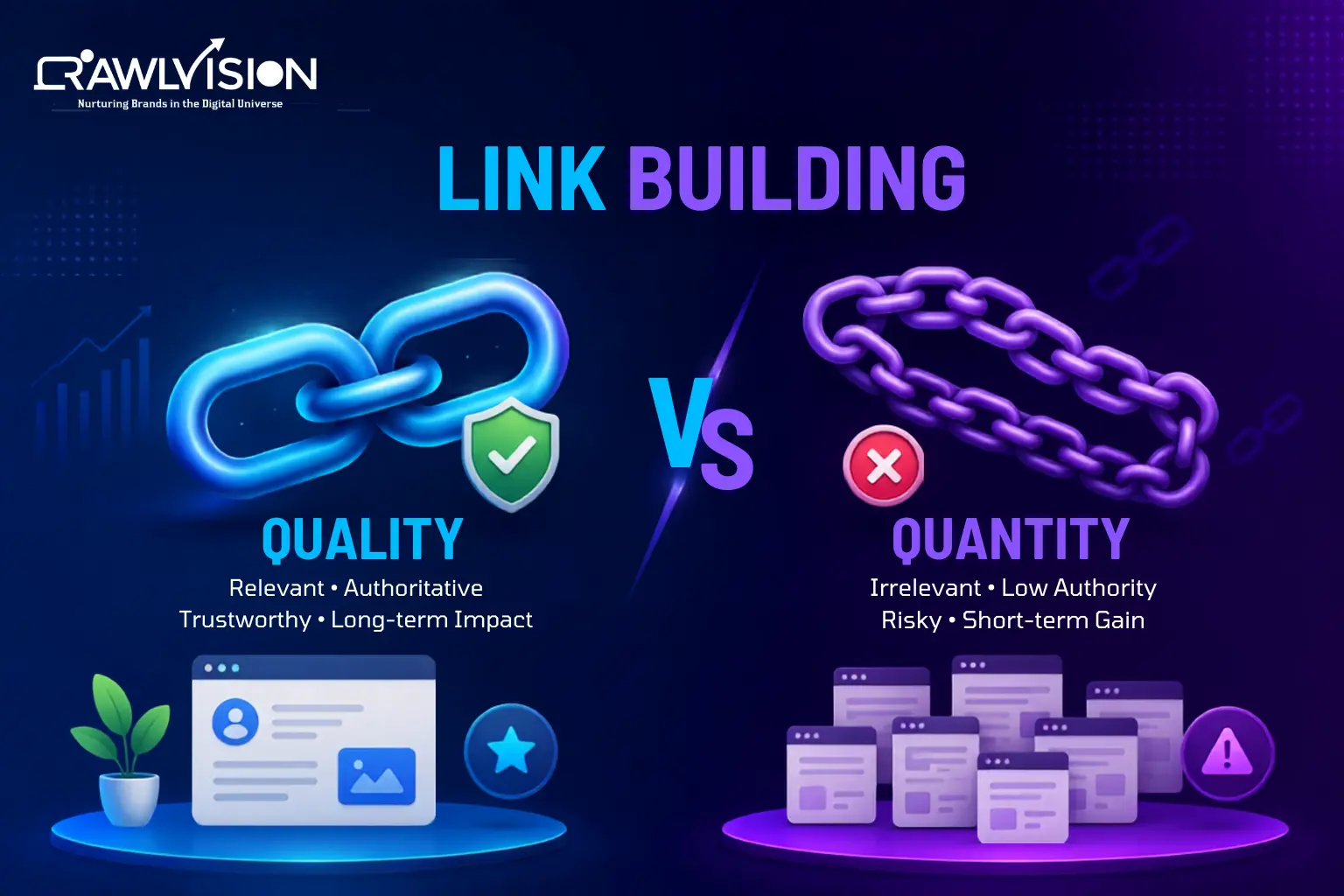
Link Building Strategy in 2026 is firmly about quality over quantity. This comprehensive guide explains how Google evaluates link quality, which link types provide the most SEO value, and how to build a high-authority link-building strategy profile through legitimate, sustainable strategies.
The evolution of link building: why quality now completely dominates
In the early era of SEO, the rule was simple: more links meant higher rankings. Marketers responded by building links at scale through directory submissions, comment spam, private blog networks, and link exchanges. Google’s response to Penguin algorithm updates and increasingly sophisticated link quality evaluation, has made high-volume, low-quality link building not just ineffective but actively dangerous to your rankings.
In 2026, Google’s link evaluation algorithms are sophisticated enough to distinguish genuine editorial links from manipulated ones with remarkable accuracy. The quality of your Link Building profile, not the quantity, is what determines its ranking value. One link from a highly relevant, high-authority publication provides more SEO value than 100 links from low-quality directories.
How Google evaluates link quality in 2026
- Source authority: The domain authority and trustworthiness of the linking site, a link from a major national newspaper is worth far more than a link from a new blog with no audience
- Topical relevance: How closely related the linking site’s topic is to yours. A digital marketing agency getting a link from an SEO publication is more valuable than a link from an unrelated niche
- Editorial nature: Whether the link was placed editorially (the author chose to link because your content was genuinely valuable) vs. artificially placed through schemes or payments
- Anchor text: Whether the anchor text is natural and descriptive vs. aggressively keyword-optimised (over-optimised anchor text is a manipulation signal)
- Link placement: Links in the main body content of an article are more valuable than links in footers, sidebars, or author bios
- Link velocity: Sudden spikes in link acquisition can signal manipulation. Natural link profiles grow at a consistent, organic pace
- Referring domain diversity: Links from many different domains are more valuable than many links from the same domain
The most valuable link types in 2026
1. Editorial links from high-authority publications
These are links earned because a journalist, blogger, or editor found your content genuinely valuable and chose to link to it. These are the highest-value links available and are earned through digital PR, original research, linkable assets, and consistently high-quality content creation.
2. Expert roundup and contributor links
Contributing expert quotes, data, or insights to industry roundups and research reports earns contextual links from respected publications. These links come with author attribution and typically appear in highly relevant industry content.
3. Resource page links
Many authoritative websites maintain resource pages that curate the best tools, guides, and resources in a particular field. Getting your content listed on relevant resource pages earns highly relevant, editorial links that typically remain stable for years.
4. Podcast and interview links
Appearing as a guest on industry podcasts and in interview-format articles earns links from the show notes or article itself. These links also build E-E-A-T signals by demonstrating that recognized media platforms value your expertise.
5. Strategic guest posts on tier-one publications
High-quality guest posting, contributing genuinely valuable long-form content to respected industry publications, remains a legitimate and valuable link-building strategy. The key qualifiers: the publication must be genuinely authoritative, the content must be original and excellent, and the link must be contextually relevant. Volume-based guest posting on low-quality sites is still manipulative.
Link building tactics to completely avoid in 2026
- Private Blog Networks (PBNs): Networks of sites created purely to pass link equity, easily detected and severely penalised
- Paid links: Buying links violates Google’s Webmaster Guidelines and can result in manual actions
- Link exchanges: ‘I’ll link to you if you link to me’ schemes are manipulations, regardless of how they are disguised
- Automated link-building tools: Any tool that automatically creates links at scale is building manipulative links
- Forum and comment spam: Dropping links in comments, forum threads, or Q&A sites at scale provides no SEO value and risks penalties
- Low-quality directory submissions: Bulk directory submissions to irrelevant, low-authority directories are worthless and potentially harmful
How to measure your backlink strategy’s effectiveness
- Track referring domain count growth, focus on new unique domains, not total link count
- Monitor domain authority/rating trends over time using Ahrefs or Semrush
- Audit anchor text distribution to ensure you have a natural mix without over-optimisation
- Track rankings for target keywords as link acquisition accumulates
- Review your toxic backlink profile quarterly and disavow genuinely harmful links
- Compare referring domain growth to competitor profiles to assess relative progress