


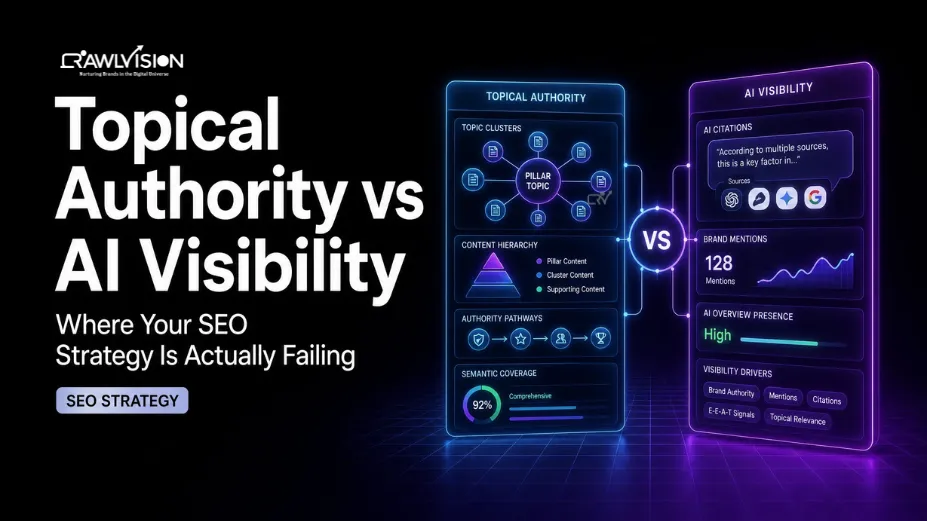
You have spent months, maybe years, building topical authority. You have written dozens of blog posts, created content clusters, and covered every subtopic imaginable. Your rankings look decent. But here’s the uncomfortable truth: topical authority alone is no longer enough to win in search.
In 2026, the game has fundamentally shifted. Google’s AI Overviews, ChatGPT, Perplexity, and Google AI Mode are reshaping how users discover information. And here’s what most SEOs are missing: the signals that get your content cited in AI-generated answers are not the same signals that rank you on page one.
This is the core tension between topical authority vs AI visibility, and understanding this gap is exactly where most SEO strategies are quietly failing.
What is topical authority? (and why it still matters)
topical authority is your website’s demonstrated depth and breadth of coverage on a specific subject. When Google’s algorithm recognizes that your site covers a topic comprehensively through content clusters, semantic relationships, and internal linking it signals that your domain is a trusted expert on that subject.
Traditionally, building topical authority meant:
- Creating pillar pages and supporting cluster content
- Covering every subtopic related to your core niche
- Building internal links that map your content hierarchy
- Earning backlinks from authoritative sites in your industry
This strategy works well for traditional Google search rankings and it still does. But topical authority vs AI visibility is a completely different equation when it comes to AI-powered search results.
The rise of AI visibility: a new layer of search
AI visibility refers to how frequently and favourably your brand, content, or website appears inside AI-generated answers, whether that’s Google’s AI Overviews, ChatGPT Search, Perplexity, or Google AI Mode.
Unlike traditional rankings, AI systems don’t just look at your content depth. They evaluate:
- Entity recognition: Is your brand a clearly defined entity in the knowledge graph?
- Citation worthiness: Does your content directly answer conversational questions?
- E-E-A-T signals: Is there demonstrated first-hand experience and expertise behind your content?
- Freshness: Is your content up to date and regularly maintained?
- Source diversity: Is your brand mentioned across third-party sites, Reddit, YouTube, and industry publications?
You can have strong topical authority and still have zero AI visibility. That’s the gap that is quietly costing brands traffic in 2026.
Topical authority vs AI visibility: key differences
|
Factor |
Topical Authority | AI Visibility |
| Primary Goal | Rank on SERP page one |
Get cited in AI-generated answers |
|
Key Signals |
Content depth, internal links, backlinks | E-E-A-T, entity clarity, citation patterns |
| Measurement | Keyword rankings, organic traffic |
AI mentions tracking, citation frequency |
|
Content Style |
Comprehensive cluster coverage | Direct, conversational, answer-first |
| Brand Focus | Domain authority |
Entity recognition across the web |
Where most SEO strategies are actually fAIling
Here are the most common failure points in the topical authority vs AI visibility battle that we’re seeing in 2026:
1. Content is broad but not answer-first
Traditional SEO encourages long-form content that covers a topic from every angle. But AI models prioritize content that directly and concisely answers a specific question. If your 3,000-word article buries the answer in paragraph seven, AI systems may skip it entirely even if you rank #1 on Google.
Fix: Structure every piece of content with a direct answer in the first 100 words. Use question-based H2S and H3S that mirror how users actually ask questions to AI assistants.
2. Brand entity is weak or unclear
AI models work with entities clearly defined subjects with verified attributes. If your brand isn’t strongly represented as an entity in Google’s Knowledge Graph or across third-party publications, your topical authority vs AI visibility gap grows wider.
Fix: Claim and optimize your Google Business Profile, ensure consistent brand mentions across authoritative sites, and add structured data (Organization schema) to your website.
3. No community or third-party presence
LLMs heavily cite Reddit, YouTube, Wikipedia, and industry forums. If your brand or content only lives on your own website, AI systems have fewer signals to pull from. Brands with active community presence get cited significantly more often in AI-generated answers.
Fix: Engage with Reddit threads in your niche, create YouTube content, contribute to industry publications, and build a presence on platforms that LLMs trust as sources.
4. Stale content that hasn’t been refreshed
AI systems weigh content freshness. An article written in 2022 that hasn’t been updated since is less likely to be cited in 2026, regardless of how good it was when published. Topical authority vs AI visibility requires ongoing maintenance, not just initial publication.
Fix: Audit your top content annually. Update statistics, refresh examples, and add new sections that address current trends. Add a visible “Last Updated” date to every post.
Building a strategy that wins both games
The good news is that topical authority and AI visibility are not mutually exclusive. The best-performing brands in 2026 are building strategies that intentionally address both. Here is how to bridge the gap:
Optimize for semantic structure
Use clear heading hierarchies that signal intent. Write FAQ sections at the end of every article using natural language questions. This helps both Google’s crawlers understand your content and AI models extract direct answers.
Build your brand as a trusted entity
Think beyond your website. Publish guest articles on authoritative industry blogs. Get interviewed on podcasts. Ensure your brand’s name, expertise, and niche are consistently described across the web. This cross-platform presence is what makes AI models trust and cite your brand.
Measure AI visibility separately
Traditional rank tracking tools won’t show you your AI visibility. Manually query ChatGPT, Perplexity, and Google AI Mode with questions your customers would ask. Note when your brand appears and when competitors appear instead. This gap is your opportunity.
Write for both the algorithm and the AI model
Every piece of content should serve dual purposes: ranking for traditional search while being citation-worthy for AI systems. This means combining semantic SEO depth with a clear, conversational tone that answers questions directly and definitively.