


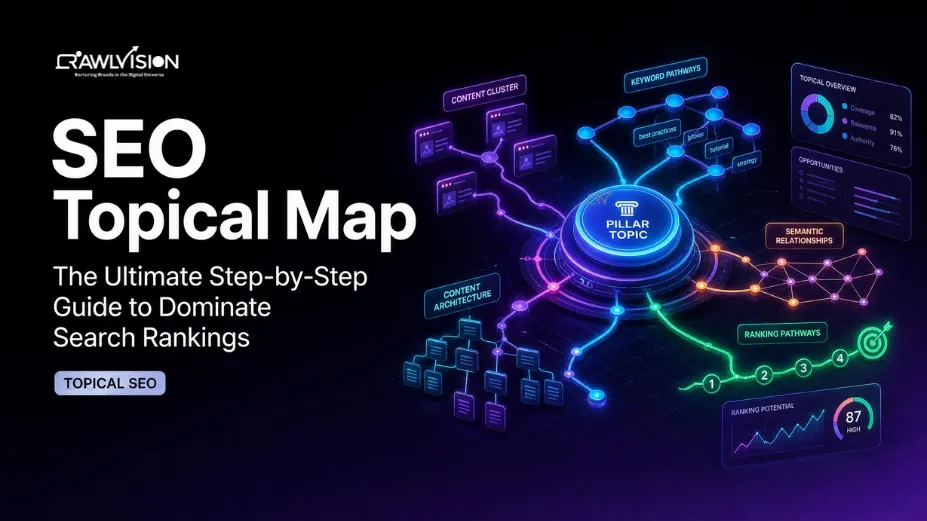
What is an SEO topical map: and why does it matter in 2025?
If you want to rank consistently and dominate your niche on Google, building an SEO topical map is no longer optional; it is essential. An SEO topical map is a structured blueprint that organises all your website content around a central subject, using interconnected topic clusters, subtopics, and supporting pages to establish topical authority in the eyes of search engines.
Think of it this way: Google does not just reward individual pages anymore. It rewards websites that demonstrate comprehensive expertise across an entire subject. When your content ecosystem is well-structured, where every piece of content supports and references related pieces, Google understands that your site is a reliable, authoritative source. That is the power of a properly built SEO topical map.
For digital marketers, SEO professionals, and content strategists, understanding how to build a topical map is the difference between scattered blog posts and a laser-focused content strategy that compounds traffic over time.
The core concept: pillar pages and topic clusters
Before you build your SEO topical map, you need to understand its two foundational building blocks: pillar pages and topic clusters.
A pillar page is a comprehensive, long-form piece of content that covers a broad core topic at a high level. It serves as the central hub of your topical map. A topic cluster consists of individual cluster pages that explore each subtopic of the pillar page in greater depth, all internally linked back to the pillar.
This content architecture sends powerful semantic SEO signals to search engines, telling Google: ‘This website understands this topic deeply, trust it.’ The result is improved rankings not just for one keyword but for an entire topic ecosystem. This relationship between pillar content, cluster content, and supporting pages forms the backbone of every effective SEO topical map strategy.
Step 1: define your core topic and niche focus
The very first step to build an SEO topical map is choosing your core topic the main subject around which your entire content strategy will revolve. This should be a broad, high-intent keyword that your target audience actively searches for, and that aligns directly with your business or niche.
For example, if you run a digital marketing agency, your core topic might be ‘SEO strategy,’ ‘content marketing,’ or ‘local SEO.’ The goal at this stage is not to pick a single keyword but to identify the broader subject that defines your expertise.
Once you have your core topic, validate it using tools like Google Search Console, Ahrefs, Semrush, or Google Keyword Planner. Look for search volume, keyword difficulty, and competitive landscape. A solid core topic should have consistent demand, manageable competition, and room to expand into dozens of related subtopics.
Step 2: conduct advanced keyword research and topic discovery
With your core topic defined, the next phase of building your SEO topical map involves thorough keyword research and topic discovery. This is where you identify every possible angle, subtopic, and user intent that falls under your core subject.
Use the following methods to uncover all related topics:
- Start with seed keywords and expand using tools like Ahrefs Keywords Explorer or Semrush Keyword Magic Tool. Look at related searches, People Also Ask results on Google, and autocomplete suggestions.
- Identify LSI keywords (Latent Semantic Indexing keywords) semantically related terms that naturally co-occur with your main topic. For instance, an SEO topical map article would naturally include terms like topic cluster strategy, content architecture, semantic search optimization, keyword clustering, and search intent mapping.
- Categorize your findings into topic buckets groups of keywords that share a similar search intent. Each bucket typically becomes one cluster page within your topical map.
Target keywords overview
|
Focus Keyword |
Sub Keywords | LSI Keywords |
| SEO Topical Map | Topical authority SEO
Topic cluster strategy Keyword clustering for SEO Content architecture SEO SEO content planning |
Semantic search optimization Pillar page and cluster model Content gap analysis SEO Internal linking strategy Search intent mapping |
Step 3 map out your content architecture
Now comes the creative and strategic heart of the process: mapping out your actual SEO topical map. This is where you visually organize the relationship between your pillar page, cluster pages, and supporting content.
Your topical map should follow a hub-and-spoke model:
- The pillar page sits at the centre and covers the broad topic comprehensively.
- Each cluster page branches out from the pillar, diving deep into one specific subtopic.
- Supporting pages, including FAQs, how-tos, comparison posts, and case studies, reinforce the cluster pages with additional context and long-tail keyword coverage.
- For practical mapping, tools like Notion, Miro, Google Sheets, or dedicated SEO tools like Topicranker or Koala Outline Builder work well. The visual clarity of a proper content map ensures that no topic gaps remain and that every piece of content serves a clear purpose within the overall content hierarchy.
Step 4: perform a content gap analysis
A content gap analysis is a critical step in building your SEO topical map that many content teams skip, and it is a costly mistake. A content gap refers to a topic or subtopic that your target audience is searching for but that you have not yet covered on your website.
To find content gaps, compare your existing content against what your top-ranking competitors cover. Tools like Ahrefs’ Content Gap feature or Semrush’s Keyword Gap tool make this process efficient. Simply input your domain and those of two or three competitors, and the tool surfaces keywords they rank for, but you do not.
Every content gap you identify is an opportunity to add a new cluster page or supporting article to your SEO topical map. Systematically filling these gaps is one of the fastest ways to accelerate organic traffic growth and expand your topical coverage in Google’s eyes.
Step 5: create high-quality, intent-matched content
An SEO topical map is only as strong as the content that populates it. Each page in your map, whether a pillar page, cluster page, or supporting article, must deliver genuine value, address specific search intent, and be written with both the user and search engine in mind.
Here is how to create content that fits your topical map and ranks:
- Match each page to its search intent clearly. Informational queries need in-depth educational articles. Transactional queries need product pages or service landing pages. This is a fundamental AEO (Answer Engine Optimization) and GEO (Generative Engine Optimization) principle.
- Use your focus keyword in the title tag, H1, first paragraph, meta description, URL slug, and naturally throughout the body at approximately a 2% keyword density. Support this with LSI keywords and sub keywords woven naturally into headings and body text.
- Write with E-E-A-T (Experience, Expertise, Authoritativeness, Trustworthiness) in mind. Google’s quality raters evaluate these signals closely. First-hand experience, expert commentary, external citations, and author credentials all contribute to a page’s E-E-A-T score.
Step 6: build a strategic internal linking structure
Internal linking is the connective tissue of your SEO topical map. Without strategic internal links, even the best content architecture fails to pass authority effectively or communicate topic relationships to search engines.
Every cluster page should link back to the pillar page using consistent anchor text that reflects the pillar’s core keyword. The pillar page should link to every cluster page. Supporting pages should link to their parent cluster page. This creates a tightly woven internal link network that reinforces topical authority throughout your entire website.
When building your internal links, use descriptive, keyword-rich anchor text rather than generic phrases like ‘click here.’ Google reads anchor text to understand the context and topic of the destination page. This is a direct on-page SEO signal that feeds into your overall SEO topical map strategy.
Avoid orphan pages with no internal links pointing to them. Every page on your site should be accessible through at least one internal link, and ideally through contextually relevant links from related content.
Step 7: implement technical SEO for your topical map
Building an SEO topical map is not just a content exercise it requires strong technical SEO foundations to ensure your content architecture is crawlable, indexable, and properly understood by search engines.
Key technical SEO elements to implement alongside your topical map include:
- Your XML sitemap should reflect the structure of your topical map, with pillar pages and cluster pages clearly represented. Submit your sitemap through Google Search Console and monitor crawl coverage regularly.
- Use canonical tags correctly to prevent duplicate content issues, especially if cluster topics overlap. Implement structured data markup (Schema.org) particularly Article, FAQ, HowTo, and BreadcrumbList schemas to help search engines parse your content type and enhance your SERP appearance with rich results.
- Ensure your URL structure mirrors your topical map hierarchy. For example: yourdomain.com/seo/topical-map/ communicates clear topic context.
- Optimize page speed and Core Web Vitals, as technical performance directly impacts both user experience and crawl efficiency.
Step 8 monitor, measure, and expand your topical map
Building your SEO topical map is not a one-time task it is an ongoing process of refinement and expansion. Once your initial content architecture is live, establish a regular cadence of monitoring and optimization.
Use Google Search Console to track impressions, clicks, average position, and crawl health for each page in your topical map. Identify underperforming cluster pages and update them with fresher data, improved content depth, or better on-page optimization.
Track your topical authority growth through tools like Ahrefs’ Domain Rating, Semrush’s Authority Score, or simply by monitoring ranking positions for your pillar keyword and all associated cluster keywords over time.
As your authority grows, expand your SEO topical map into adjacent topic areas. Each new subtopic cluster you add increases the breadth of your coverage and reinforces your position as a comprehensive resource, which is precisely what Google’s helpful content system and its evolving AI search algorithms reward.
Common mistakes to avoid when building an SEO topical map
- Creating too many pillar pages simultaneously. It is far more effective to build one deep, well-linked topical cluster for full coverage before expanding to a new pillar topic.
- Ignoring search intent at the cluster level. Each cluster page must match the specific intent of its target keyword, not just the broad theme of the pillar.
- Neglecting content freshness. An SEO topical map is a living content system. Outdated statistics, broken links, or stale information on cluster pages actively hurt your topical authority signals over time.
- Skipping keyword cannibalization audits. Multiple pages competing for the same keyword confuse search engines and dilute your ranking potential.