


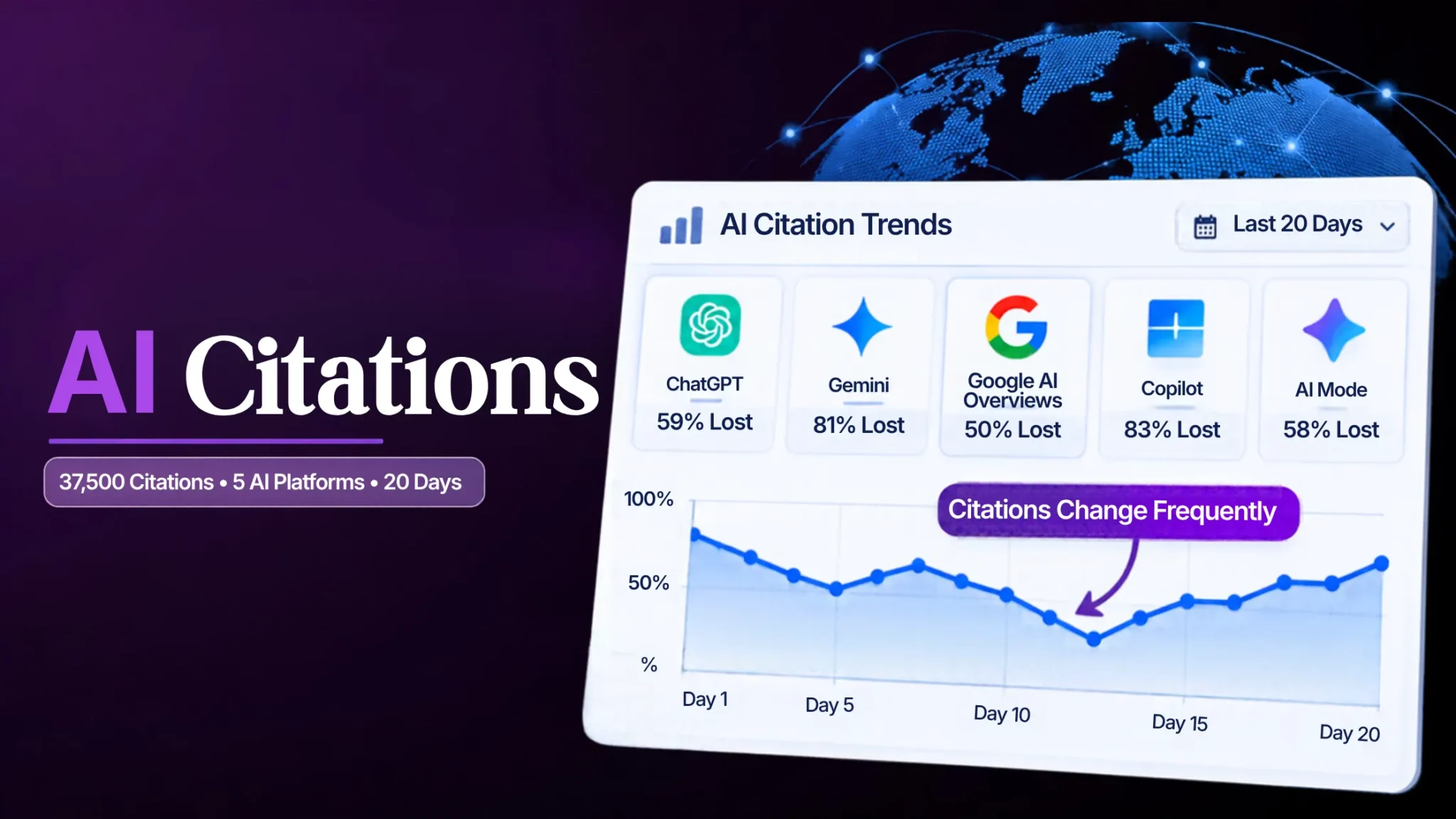
Your website gets cited by ChatGPT today. Tomorrow, another website takes its place. A few days later, your original citation returns. This isn’t necessarily a sign that your content has lost relevance. It’s how frequently AI-generated answers can change their sources.
For businesses investing in Generative Engine Optimization (GEO), this creates a measurement problem. A website appearing in one ChatGPT response or Google AI Overview doesn’t guarantee consistent visibility. Marketers need to understand how frequently these citations change, why they disappear, and what makes some sources more persistent than others.
A study published by Ahrefs on October 29, 2026, tracked approximately 37,500 citations across five AI platforms over 20 days. The findings reveal just how unpredictable AI citations can be and why businesses should rethink how they measure AI search performance.
Key Findings From the Study
- 50% to 83% of citations disappeared by the next day, depending on the AI platform.
- Approximately 75% of lost citations returned at some point during the 20-day tracking period.
- Google rankings were associated with longer-lasting citations, particularly in Google AI Overviews and AI Mode.
- Brand mentions lasted longer than website citations, showing that linked citations aren’t the only measure of AI visibility.
- Around 75% of cited pages for some recommendation queries changed daily, making competitive searches particularly unpredictable.
How Often Do AI Platforms Change Their Sources?
AI platforms don’t necessarily use the same websites every time they answer a question. Even when users submit identical prompts, the sources included in generated answers can change.
To measure this, Ahrefs researchers tracked five AI platforms by asking them the same questions daily for 20 days. They recorded the websites cited on the first day and monitored whether those sources remained, disappeared, or returned.
Here’s how the platforms performed:
| AI platform | Questions tracked | Citations lost by the next day |
| Google AI Overviews | 563 | 50% |
| Google AI Mode | 1,996 | 58% |
| ChatGPT | 3,173 | 59% |
| Gemini | 1,276 | 81% |
| Microsoft Copilot | 823 | 83% |
The differences between platforms are noticeable. Gemini and Copilot showed the highest citation turnover, while Google AI Overviews recorded the lowest.
However, there’s an important distinction. Gemini and Copilot frequently generated answers without citing any website. When researchers excluded these responses, citation disappearance rates across the five platforms became much closer, at approximately 50% to 60%.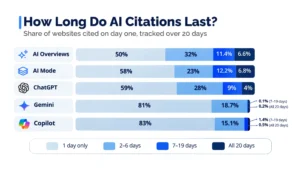 The research also found that only 4% to 7% of citations on Google AI Overviews, Google AI Mode, and ChatGPT remained throughout the entire 20-day period.
What this means: A single AI visibility check provides only a snapshot. Businesses need repeated observations to understand whether their websites maintain visibility across AI-generated answers.
Why Losing an AI Citation Doesn’t Always Mean Losing Visibility
A website disappearing from an AI response doesn’t necessarily mean another competitor has replaced it. The Ahrefs research identified two situations that make citation loss more complicated.
- AI platforms sometimes generate answers without citing websites.
This was particularly common with Gemini and Copilot. Approximately 64% of Gemini answers and 53% of Copilot answers in the study contained no citations.
Therefore, a missing citation could mean the AI selected another source, or it could simply mean the response didn’t include external references.
- AI platforms can mention brands without linking to their websites.
A response might mention a company by name without providing a clickable website citation. Conversely, an AI platform can cite a webpage without mentioning the brand in its written answer.
Ahrefs found that 50% to 70% of cited websites appeared on only one day during the study. For brand names, the figure was closer to one in five.
This suggests that brand visibility can be more persistent than individual website citations.
For marketers, the distinction matters. Tracking only website links can underestimate how frequently AI platforms recognize and mention a business.
What Makes Some AI Citations Last Longer?
If AI citations change so frequently, what separates sources that remain visible from those that disappear quickly?
Ahrefs compared cited pages using organic search performance, website authority, page relevance, and query characteristics. Three findings are particularly useful for SEO professionals.
1. Google rankings have a stronger relationship with citation stability than domAIn rating
Pages that ranked in Google for the same question were approximately seven times more likely to maintain citations for at least a week in Google AI Overviews and AI Mode.
Organic traffic showed a similar relationship. Pages cited in Google AI Overviews for 15 days or longer had median estimated monthly organic traffic of 88 visits, compared with eight visits for pages cited for just one day.
Domain Rating and backlinks showed a much weaker relationship with citation duration.
This doesn’t mean backlinks are irrelevant to AI search. They can help pages earn organic rankings, which were associated with longer-lasting citations.
However, strong Google rankings don’t automatically guarantee visibility across AI-generated answers. Understanding why websites rank on Google but don’t appear in AI search can help businesses identify the content, accessibility, and visibility gaps affecting their AI search presence.
2. Pages that match search questions more closely tend to retAIn citations
The study also examined how closely page titles and meta descriptions matched the questions that triggered AI citations.
For Google AI Overviews and AI Mode, the median query-match score increased from 0.54 for one-day citations to approximately 0.65 to 0.68 for citations lasting at least 15 days.
This suggests that pages clearly aligned with the questions users ask may have an advantage in maintaining AI visibility.
For content teams, this reinforces a few familiar SEO practices:
- Use descriptive page titles that reflect the target search query.
- Organize information with clear, relevant headings.
- Answer the primary question directly.
- Keep supporting information closely related to the page’s subject.
These practices improve content clarity without requiring artificial AI-specific writing techniques.
3. Content freshness can influence citation opportunities
Ahrefs also shared examples where updated pages gained AI citations.
In one case, a competitor’s regularly updated SEO pricing page overtook Ahrefs’ page in AI citations. In another, Ahrefs updated an article about trending products with additional categories and fresher data. The page subsequently appeared in 35 AI answers within a few days.
These examples are observations, not controlled proof that updating a page will automatically improve citation stability.
Still, they highlight why businesses should regularly review content containing pricing, product information, statistics, and other details that can become outdated.
Why Your Search Query Changes the Results
AI citation stability also depends on what users are asking.
A factual question about a specific company is different from a broad recommendation query such as “best project management software.”
Ahrefs found that brand-related questions generally produced more consistent citations. For factual questions about pricing and product features, a company’s own website was frequently cited.
However, third-party websites became more important for reviews and comparisons.
The study also found that approximately 64% to 76% of cited pages changed daily across different query types on ChatGPT and Google AI Mode. “Best X” questions were among the least stable.
This makes sense when considering the competition. Dozens of websites might offer useful recommendations for a broad product category, giving AI platforms more potential sources to choose from.
Businesses should therefore monitor different query categories separately:
| Search intent | Example prompt | What to monitor |
| Branded | What does [Brand] offer? | Official website citations and brand mentions |
| Informational | How does email marketing work? | Visibility across educational sources |
| Comparative | [Brand A] vs. [Brand B] | Third-party comparisons and competitor citations |
| Recommendation | Best email marketing tools | Inclusion in AI-generated recommendations |
A strong citation rate for branded searches doesn’t necessarily mean a business is visible when potential customers ask AI platforms for recommendations.
How Should Businesses Measure AI Search Visibility?
The research makes one thing clear: counting individual citations isn’t enough to evaluate GEO performance.
Businesses need a repeatable monitoring process that measures how consistently their content and brand appear across AI platforms.
Here are five practical steps:
- Create a fixed prompt list: Include branded, informational, comparative, and recommendation-based questions relevant to your business.
- Monitor multiple AI platforms: Track ChatGPT, Google AI Overviews, Google AI Mode, Gemini, and other relevant platforms separately.
- Measure citation frequency: Record how many days your website appears in responses over the previous seven days.
- Track brand mentions independently: Record when AI platforms mention your business without linking to your website.
- Investigate sustained drops: If citations remain missing for two to three weeks, review the page’s organic performance, content relevance, accuracy, and competing sources.
Tools such as Ahrefs Brand Radar can help track cited pages and historical citation patterns. A consistent prompt-tracking process also makes it easier to compare performance over time.
Tracking citations is only one part of the process. Businesses should also evaluate their technical accessibility, content structure, and brand signals using a practical AI search optimization checklist to identify gaps that could affect their visibility across AI platforms.
The objective is to identify sustained visibility changes rather than react to every temporary citation loss.
What Should Businesses Change About Their GEO Strategy?
The Ahrefs research doesn’t suggest that businesses should stop pursuing AI citations. Instead, it highlights why citation acquisition alone shouldn’t define GEO success.
A more sustainable approach involves three priorities:
- Build strong organic search foundations: Improve rankings, content relevance, and organic visibility for the questions your audience searches.
- Strengthen your presence beyond your website: Develop brand recognition through relevant industry publications, reviews, comparisons, and third-party discussions.
- Measure visibility across time and platforms: Evaluate citation frequency, brand mentions, and prompt-level performance instead of relying on isolated AI responses.
At Crawl Vision, we believe AI search optimization should extend beyond getting a website mentioned in a single AI-generated answer. Businesses need a consistent presence across the content sources, platforms, and discussions that influence how AI systems discover and represent brands.
Final Thoughts
AI search visibility isn’t permanent. A website can appear in an AI-generated answer today, disappear tomorrow, and return without any changes to its content.
The Ahrefs study shows why businesses should stop treating individual citations as definitive measures of GEO performance. Consistent visibility, brand recognition, and the ability to appear across relevant AI-generated answers provide a more meaningful picture.
The goal isn’t to keep every citation forever. It’s to make your brand a consistently relevant source when people turn to AI platforms for information, comparisons, and recommendations.