


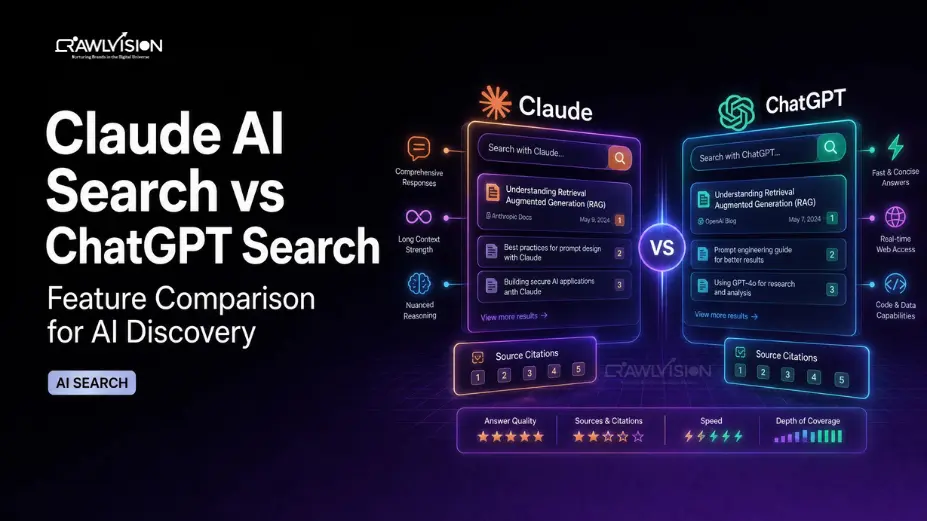
In 2026, optimizing your content for Claude AI Search is no longer optional; it’s a core pillar of any serious digital marketing strategy. But with multiple AI platforms now shaping how users discover brands, a crucial question has emerged for SEO and GEO professionals: Should you optimize for Claude AI search first, or should ChatGPT be your primary target? The answer matters more than you think, and the data might surprise you. This guide breaks down the key differences between Claude AI and ChatGPT search behaviour, which platform deserves your attention first based on your business type, and how to build a strategy that earns visibility across both.
The claude AI search landscape in 2026: why platform choice matters
The scale of Claude AI Search is now undeniable. ChatGPT reached approximately 190.6 million daily active users in 2025, handling between 2.5 and 3 billion prompts per day. Claude’s app recorded 3.9 million downloads and saw its monthly active users grow by 40% to approximately 30 million. Perplexity, Google AI Mode, and Gemini round out a landscape where AI-generated answers now influence a massive share of the research and discovery process.
For SEO and GEO professionals, these platforms are no longer side channels; they are primary discovery surfaces. The brands being cited in ChatGPT responses, Claude answers, and Perplexity results are receiving the kind of trusted, unsolicited endorsement that no amount of paid advertising can replicate. Getting your optimization priority wrong means leaving that visibility on the table.
Research from Triple Dart tracking multiple B2B brands across AI platforms reveals a striking insight: for most mid-market brands, ChatGPT visibility tends to follow as a trailing indicator of Claude optimization. Teams that chase ChatGPT volume at the expense of Claude depth end up with broad but shallow visibility that lacks the authoritative signals needed to sustain AI citation over time.
How claude and chatgpt approach search differently
Before deciding where to focus your efforts, it’s essential to understand how these two AI platforms fundamentally differ in how they retrieve, evaluate, and cite information.
How claude evaluates content
Claude is designed with a strong emphasis on accuracy, depth, and careful reasoning. It rewards content that demonstrates genuine expertise, nuanced analysis, and authoritative sourcing. Claude tends to cite sources that have comprehensive topical coverage, clear E-E-A-T signals, and content that thoroughly explores a subject rather than skimming it. It is more conservative and restrained in what it cites, meaning that when Claude does reference your content, it carries a higher signal of trustworthiness than a citation from a more permissive platform.
Claude also shows a strong preference for natural, human-sounding language over keyword-optimized copy. Content written purely to satisfy search algorithms tends to be deprioritized; content written to genuinely help a knowledgeable reader tends to be favored.
How chatgpt evaluates content
ChatGPT is tuned for action, completion, and scale. It has a broader, more permissive citation profile and rewards content with high volume, consistent publication frequency, and strong keyword signals. It tends to favor content from domains with high brand recognition, large content libraries, and significant social proof in the form of links and mentions. ChatGPT is also directly integrated with Bing’s search index, meaning traditional SEO signals, particularly those that perform well on Bing, carry direct weight.
ChatGPT is also the platform where paid brand promotion is beginning to emerge: as of February 2026, ChatGPT ads appear in nearly 20% of sampled US responses, according to data tracked by LLMrefs across 682,000 ChatGPT answers. This means the organic visibility playing field on ChatGPT is narrowing in some categories.
The core difference
In short: Claude rewards quality and depth. ChatGPT rewards scale and brand recognition. Perplexity rewards citation-worthy owned content with strong third-party corroboration. Google AI Mode rewards traditional SEO strength. Each platform has its own optimization logic, and treating them as interchangeable is a strategic mistake.
Which platform should you optimize for first?
The answer depends on your business size, audience type, and current SEO foundation. Here is a clear framework for making the decision:
Optimize for claude first if:
- You are a mid-market B2B brand or specialist service provider where depth and trust matter more than raw volume.
- Your audience values expertise and carefully evaluates sources before making a decision.
- You have a strong existing SEO foundation and high-quality content. Claude will reward this.
- Your goal is long-term brand authority rather than immediate traffic spikes.
- Research from Triple Dart consistently shows that B2B brands that optimize for Claude depth see ChatGPT visibility improve as a downstream result within two to three quarters.
Optimize for chatgpt first if:
- You are a large, consumer-facing brand with very high existing awareness.
- You operate in a high-volume, competitive category where quantity of mentions matters.
- Your content is already widely linked, broadly shared, and frequently cited by third-party sources.
- You sell products or services that consumers research quickly and decide on fast ChatGPT’s action-oriented outputs favour transactional, recommendation-style content.
Optimize for Google AI mode first if:
- You have years of established traditional SEO investment, domain authority, strong backlinks, and well-optimized content pages that translate directly into Google AI Mode visibility.
- Data from TripleDart shows B2B brands achieving 28% visibility on Google AI Mode vs. just 9% on ChatGPT, purely on the strength of traditional SEO foundations.
- You are in a local, regional, or service-area-based business where Google’s location intelligence gives AI Mode a meaningful advantage over other platforms.
The integrated strategy: how to optimize for both claude and chatgpt without duplicating effort
The good news is that roughly 60 to 70% of the optimization work required for Claude also benefits ChatGPT’s visibility. The overlapping signals include topical authority, strong E-E-A-T, clear content structure, off-site community mentions, and consistent content updates. The platform-specific layer is where you differentiate.
Shared optimization layer (applies to both platforms)
- Build deep, comprehensive content that fully covers your target topics not just one page, but a network of related, interlinked resources.
- Earn third-party mentions and citations in forums, communities, and authoritative publications that both Claude and ChatGPT use as training and retrieval signals.
- Structure your content with clear headings, short paragraphs, and direct answer formats that AI engines can extract and cite easily.
- Keep content fresh both platforms demonstrate strong recency bias, preferring content updated within the last three months for time-sensitive topics.
Claude-specific layer
- Prioritize writing depth and nuance over keyword density. Claude penalizes thin, formulaic content.
- Include original analysis, proprietary data, and expert perspectives that cannot be found elsewhere.
- Write in a natural, conversational but authoritative voice, not marketing copy, not AI-generated filler.
Chatgpt-specific layer
- Build volume alongside quality. A strong content library signals authority at scale.
- Strengthen your Bing SEO signals ChatGPT’s web retrieval draws heavily from Bing’s index.
- Pursue high-authority backlinks and brand mentions in major publications, as ChatGPT’s citation model leans heavily on brand recognition and link equity.