


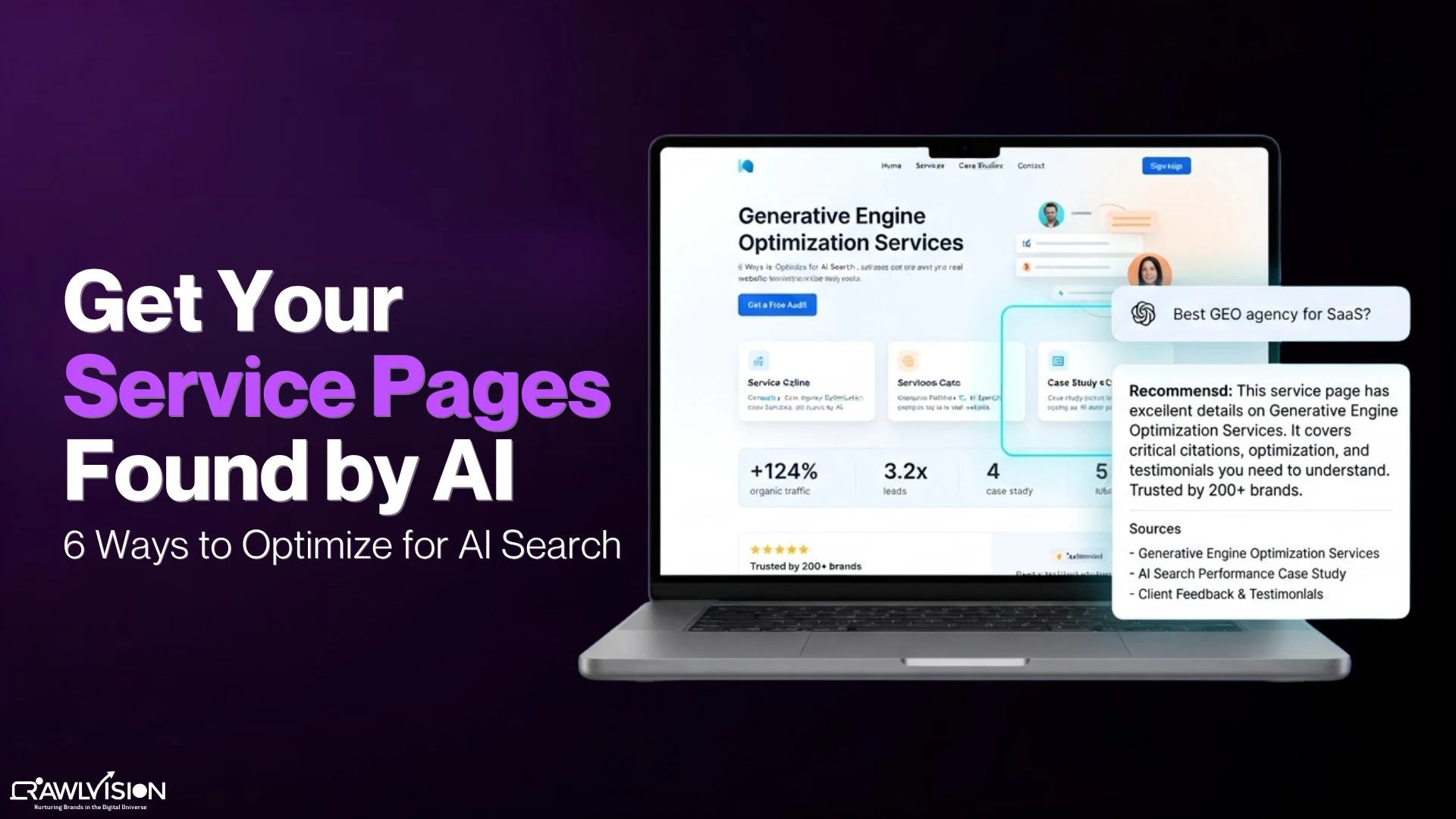
Service pages need to do more than rank for keywords. They must explain what a business offers, who it helps, and why potential customers should trust it. Clear information also makes it easier for search engines and AI-powered platforms to understand a service.
To optimize service pages for AI search visibility, explain your services clearly, answer buyer questions, demonstrate real expertise, improve crawlability and indexability, maintain consistent business information, and monitor visibility across traditional search and AI platforms.
Why Optimizing Service Pages for AI Search Is Crucial for Business
Optimizing service pages for AI search helps potential customers understand your offering when they use Google AI Overviews, ChatGPT, Gemini, Perplexity, and other AI-powered search experiences. A useful page gives these systems clear information to interpret and potentially reference in their responses.
Consider someone searching for an SEO agency that specializes in eCommerce websites.
- A page that only says “We provide result-driven SEO services” offers little context.
- A page explaining its eCommerce expertise, technical SEO capabilities, process, and relevant experience gives visitors much more useful information.
A single optimization technique can’t guarantee AI visibility. Google also emphasizes helpful, reliable content and established SEO fundamentals in its guidance for AI features. That makes service-page optimization a combination of useful content, technical accessibility, and credible business information.
6 Ways to Optimize Service Pages for AI Search (With Examples)
To improve AI search visibility, make every service page specific, informative, credible, accessible to crawlers, consistent with your other business information, and measurable over time.
1. Make your service and value proposition clear
A service page should explain what you offer, who it is for, and what problem it solves within the opening section. Visitors should not have to interpret vague marketing language to understand your service.
Include these essentials:
- Service: Name the specific service you provide.
- Audience: Identify the businesses or customers you help.
- Value proposition: Explain the problem you address or the value you deliver.
- Scope: Clarify the key deliverables or activities included.
Bad Example: “We help brands grow online”
Good Example: “We help B2B SaaS companies improve organic search visibility through technical SEO, content optimization, and AI search strategy.”
The second statement gives readers and search systems more concrete information about the service, audience, and expertise.

2. Answer the questions potential customers ask
Service pages should answer the questions buyers need resolved before contacting a provider. Addressing these questions makes the page more useful and helps clarify your offering.
Common questions include:
- Why do customers need this service?
- What does the service include?
- Who is it suitable for?
- How does the process work?
- What affects pricing?
- How long might implementation take?
- What results can customers reasonably expect?
Use sales conversations, customer emails, Search Console queries, and relevant search results to identify actual questions. Organize answers under descriptive headings instead of hiding essential information in generic promotional copy.

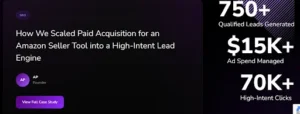
3. Showcase real experience, case studies, and trust signals
Demonstrate your expertise through verifiable evidence, good case studies, specific processes, relevant examples, and transparent business information. Unsupported claims about being the best or delivering guaranteed results do little to help potential customers evaluate your credibility.
Useful trust signals include:
- Case studies with a clear starting point, actions, timeframe, and measured outcomes.
- Testimonials published with appropriate permission.
- Relevant qualifications, team expertise, or industry experience.
- Examples of your process, deliverables, or problem-solving approach.
- Links to original research or authoritative sources when making factual claims.
Only publish outcomes supported by real records. Explain relevant limitations and avoid implying that one customer’s results are guaranteed for everyone.
4. Ensure your service pages are crawlable and indexable
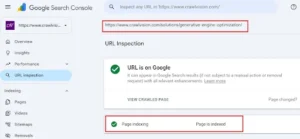
Search engines need to access and process your pages before they can appear in eligible search results. Review technical SEO issues that could prevent important service pages from being discovered, crawled, indexed, or understood.
Check the following:
- Confirm that important pages are not blocked by robots.txt or accidental noindex directives.
- Use appropriate canonical tags to identify preferred URLs.
- Include indexable service pages in your XML sitemap.
- Add relevant internal links from service hubs, related blogs, and other important pages.
- Check mobile usability, page loading performance, and visible content.
- Review Google Search Console for indexing problems and search performance.
Google’s SEO Starter Guide explains the fundamentals of helping search engines discover and understand website content.
Do not assume that adding structured data or publishing more text will fix an inaccessible page. Resolve technical barriers first, then improve the content.
5. Make your business and service detAIls consistent
Keep your business name, service descriptions, expertise, contact information, and relevant location details consistent across your website and other public profiles.
For example, if your website describes your company as an AI-powered SEO agency but your business profiles emphasize unrelated services, potential customers may find it harder to understand your specialization.
Review your About page, service pages, contact page, Google Business Profile where applicable, and relevant industry directories. Update outdated descriptions and correct conflicting information.
Structured data can also help search engines interpret eligible information about your organization and services.
Use relevant Schema.org types, such as Organization or Service, where appropriate, and ensure the markup matches visible page content. Valid markup does not guarantee rich results or AI citations.
6. Track your visibility across search and AI platforms
Measure whether your service pages are gaining relevant search visibility and attracting potential customers. No single metric can reliably represent visibility across every AI platform.
Use a combination of:
- Google Search Console: Monitor queries, impressions, clicks, click-through rate, and page-level search performance.
- Google Analytics 4: Review organic landing-page traffic, engagement, and meaningful conversions.
- AI platform checks: Test relevant buyer questions in ChatGPT, Gemini, Perplexity, and other platforms to see whether your business or page appears.
- Referral analysis: Review identifiable visits from AI platforms where referral information is available.
Record the prompts tested, dates, cited sources, competitors mentioned, and whether your brand appears accurately. Repeat the checks periodically because AI answers can vary.
Compare these observations with changes to your service pages. This helps you identify opportunities without assuming that every content update will produce an immediate improvement in AI visibility.
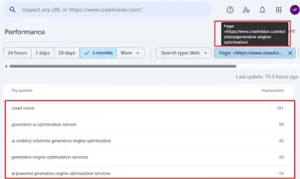
Image Note: These are all real images from the GEO service page on the Crawl Vision website.
Common AI Search Optimization Mistakes to Avoid
Avoid treating AI search optimization as a shortcut around useful content, established SEO practices, or customer trust. The following mistakes can make service pages less helpful and harder to evaluate.
- Using generic, vague service descriptions: Replace broad promises with specific services, audiences, deliverables, and business problems.
- Repeating keywords instead of answering buyer questions: Use relevant terms naturally while prioritizing clear, complete answers.
- Publishing unsupported claims and unverified results: Substantiate case studies, statistics, testimonials, and performance claims before publishing them.
- Ignoring technical SEO and internal links: Make important pages accessible, indexable, and connected to relevant sections of your website.
- Expecting schema markup to guarantee AI citations: Use accurate structured data as supporting information, not as a promise of visibility.
Conclusion
Optimizing service pages for AI search visibility starts with the same principle as good customer-focused SEO: make your offering easy to understand, demonstrate why your business is credible, and ensure search engines can access the page.
Start by improving your most important service page. Clarify its value proposition, answer genuine buyer questions, add verifiable evidence, and check its technical health. Then track traditional search performance, conversions, and AI visibility separately to understand what is improving.