


A local SEO audit evaluates how well a business can appear in location-based searches by checking its Google Business Profile, website, local keywords, citations, reviews, backlinks, technical SEO, competitors, and search performance.
A local SEO audit should not stop at checking whether a business has a Google Business Profile. The real goal is to find gaps that can affect local visibility, understand why those gaps exist, and prioritize the fixes that matter most.
What Is a Local SEO Audit?
A local SEO audit is a systematic review of the website, Google Business Profile, local search signals, and online presence that influence how a business appears in local search.
Google says local results are primarily based on relevance, distance, and prominence. Relevance reflects how closely a business matches the search, while distance considers the searcher’s location, and prominence relates to how well-known the business is.
That means an effective local SEO audit needs to examine more than keywords. It should connect the business’s profile, website, location information, reviews, citations, links, and actual search performance.
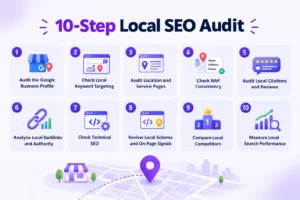
How to Perform a Local SEO Audit: 10 Step Process
A practical local SEO audit can be completed in 10 steps, starting with the business’s Google presence and moving through its website, authority, technical setup, competitors, and performance data.
Step 1: Audit the Google Business Profile
Start by checking whether the Google Business Profile contains complete and accurate information. Review the primary category, additional categories, business name, address or service area, phone number, website, hours, services, photos, and other available profile information.
Do not treat profile completeness as the final goal. Ask whether the profile accurately represents what the business offers and matches the information on its website.
Google’s Business Profile performance report can also show searches, views, calls, website clicks, directions, and other interactions for eligible verified profiles.
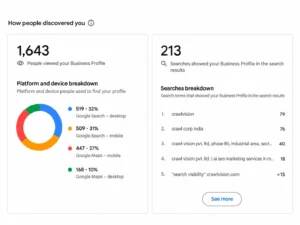 Note: The image shows the real performance overview of Crawl Vision’s GBP.
Step 2: Check Local Keyword Targeting
Review the searches the business wants to be visible for and map them to relevant pages. Look beyond broad service terms and identify searches combining services, products, locations, neighborhoods, and specific local intent.
For example, a page targeting “plumber” may be too broad for a local business. A relevant service page could target a specific service and location naturally, without repeating the city name unnaturally throughout the copy.
Step 3: Audit Location and Service Pages
Check whether important services and locations have useful, indexable pages that satisfy the searcher’s intent.
Review titles, H1s, content, contact details, internal links, location information, service descriptions, and conversion elements. Each location page should provide genuine value rather than changing a city name on an otherwise identical template.
Step 4: Check NAP Consistency
NAP stands for Name, Address, and Phone number. Compare NAP consistency across the website, Google Business Profile, directories, social profiles, and other important listings.
Look specifically for outdated addresses, incorrect phone numbers, duplicate listings, or conflicting business information. Google also gathers local listing information from websites, third parties, users, and other sources, so keeping important business details accurate matters.
Step 5: Audit Local Citations and Reviews
Review major directories, industry listings, local websites, and other citation sources for accuracy and completeness. Remove or correct obvious duplicates and outdated information where possible.
Then examine reviews for volume, recency, responses, and recurring customer feedback. Having more Google reviews can also contribute to a business’s prominence in local search, as Google considers review-related signals when determining local results.
Step 6: Analyze Local Backlinks and Authority
Review the site’s backlink profile and identify whether it has links from relevant local organizations, publications, associations, community websites, and industry sources.
The goal is not simply to collect more backlinks. A local SEO audit should identify authority gaps and determine whether the business has credible connections within its geographic and industry context.
Step 7: Check Technical SEO
Technical problems can undermine otherwise strong local optimization. Check technical SEO factors like indexability, robots.txt, XML sitemaps, canonicals, mobile usability, page speed, redirects, broken links, duplicate pages, and internal linking.
Pay particular attention to important location and service pages. If a page cannot be crawled or indexed properly, improving its keywords or content will not solve the underlying problem.
Step 8: Review Local Schema and On-Page Signals
Check whether relevant structured data is implemented correctly and whether important business details are clearly represented on the site.
Also review title tags, headings, location references, service information, contact details, internal links, and other on-page signals. Schema should support clearer understanding of the page, not be treated as a shortcut to higher rankings.
Step 9: Compare Local Competitors
Search the main local service queries and compare the business with the competitors appearing in relevant results.
Look for differences in Google Business Profile categories, reviews, services, location pages, content, backlinks, citations, and overall local relevance. The purpose is to identify gaps that your audit may otherwise miss.
Step 10: Measure Local Search Performance
Use Google Search Console, Google Business Profile performance data, analytics, and rank-tracking tools to establish a baseline.
Search Console can show clicks, impressions, CTR, average position, queries, and pages. Google recommends focusing on trends in clicks and impressions alongside position rather than treating average position as the complete picture.
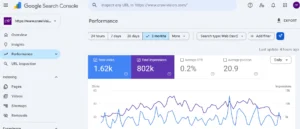 Note: Image shows 3-month real performance data of Crawl Vision.
For local SEO, also examine whether important service and location queries are generating impressions and clicks, and whether local visibility is translating into calls, website visits, directions, or leads.
We also compare these trends against the pages and queries generating local visibility, which helps separate traffic changes from deeper page-level or targeting issues.
How to Prioritize Issues Found in a Local SEO Audit
Prioritize audit findings according to their potential impact and how directly they affect visibility, relevance, authority, or conversion.
Priority 1: Visibility blockers
Fix issues that can prevent important assets from being discovered or used properly. Examples include indexing problems, incorrect business information, major technical errors, or serious Google Business Profile issues.
Priority 2: Relevance gaps
Address incorrect categories, weak service-location targeting, missing location pages, and content that does not clearly satisfy local search intent.
Priority 3: Authority gaps
Look at missing citations, weak local backlinks, limited local mentions, and areas where competing businesses have stronger signals.
Priority 4: Optimization opportunities
Once major issues are addressed, improve review management, internal linking, profile content, photos, service information, and conversion elements.
This order prevents an audit from becoming a long list of equally urgent tasks. It turns findings into an actionable local SEO roadmap.
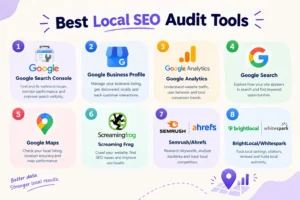
Tools You Can Use for a Local SEO Audit
Use different local SEO tools for different parts of the audit rather than relying on a single platform.
- Google Search Console: Analyze queries, pages, impressions, clicks, CTR, and average position.
- Google Business Profile: Review profile searches, views, calls, website clicks, directions, and other available interactions.
- Google Analytics: Analyze website traffic, acquisition, engagement, and conversions.
- Google Search: Manually review local SERPs, competitors, search intent, and result types.
- Google Maps: Check local visibility and compare Business Profiles.
- Screaming Frog: Crawl websites to identify technical and on-page issues.
- Semrush/Ahrefs: Research keywords, backlinks, competitors, and authority gaps.
- BrightLocal/Whitespark: Analyze local rankings and citation opportunities.
At Crawl Vision, we use a combination of these tools during our local SEO audits because each reveals a different part of the picture. Comparing their data helps us spot issues, validate findings, and prioritize the fixes with the clearest impact on local visibility.
Conclusion
A local SEO audit is useful when it goes beyond a checklist and explains what is affecting a business’s local visibility. Start with the Google Business Profile, then examine keywords, pages, citations, reviews, backlinks, technical SEO, competitors, and performance data.
The final output should not simply list problems. It should show which issues need attention first, why they matter, and what action should follow. That makes the audit useful for both ongoing local SEO work and measurable business growth.