

Table of Contents
ToggleWhat “AI choosing your content” actually means
When a brand appears in AI-generated answers, it usually happens because of one or more of the following reasons:
• The AI could retrieve the content easily
• The content aligned closely with the user’s prompt
• The information was simple to summarise
• The source demonstrated higher trust and authority
• The brand and topic entities were clearly defined
Most modern AI systems use a retrieve-then-generate approach, often referred to as Retrieval-Augmented Generation. In this process, relevant documents are retrieved first and then used to generate the final answer.
You can explore the technical foundation of this approach in this academic overview of retrieval-augmented generation models: Understanding Retrieval-Augmented Generation
If your content is not retrieved confidently, it will never be considered during answer generation.
Why prompts matter more than keywords
Traditional SEO focuses on keywords.
AI visibility focuses on prompts.
Prompts are how users naturally express intent. They are often full of questions or instructions, such as:
• How does AI decide which sources to cite
• Is schema still useful for AI search visibility
• How can brands appear in AI search answers
AI systems prioritise intent, clarity, and structure over exact-match keywords. This is where prompt engineering becomes critical. It allows you to design content that matches how AI systems interpret and respond to real user questions.
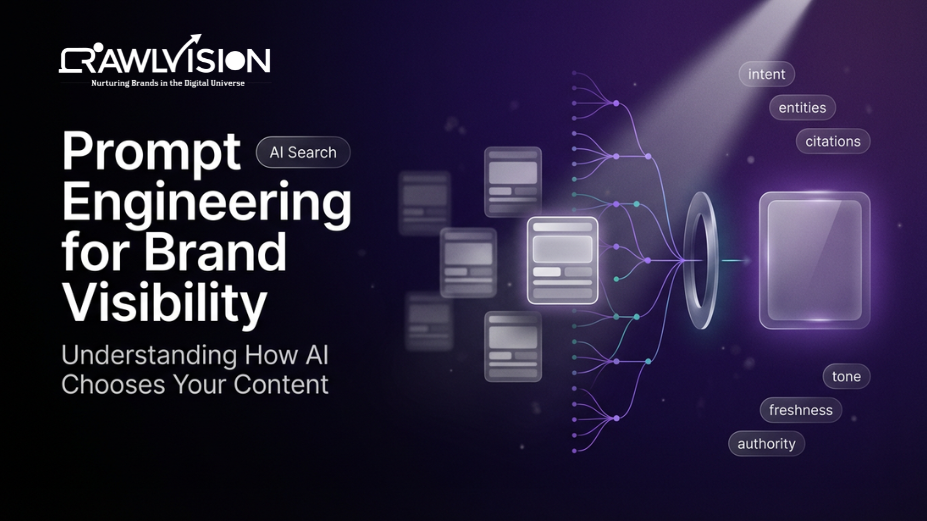
How AI systems decide which content to include
AI-driven search and answer engines apply multiple filters before selecting content. Understanding these filters helps you optimise with purpose rather than guesswork.
1. Prompt alignment
AI systems prefer content that matches the exact angle of a prompt.
They distinguish clearly between:
• Definitions and explanations
• Step-by-step guides
• Comparisons and evaluations
• Beginner-level and expert-level content
Pages that focus on one primary question perform better than pages that try to cover everything at once.
Action to take: Structure each page around one main prompt and support it with clearly labelled sections that answer related sub-questions.
2. Extractability and structure
Even accurate content can be ignored if it is difficult to extract. AI systems favour content that is easy to break into usable chunks, including:
• Short paragraphs
• Clear headings
• Bullet lists
• Tables and summaries
Long, dense paragraphs reduce the likelihood of selection.
Action to take: Design each section so it can stand alone and still communicate a complete idea.
3. Evidence and grounding
AI systems are more likely to reuse content that is supported by credible sources.
Google explicitly recommends creating helpful, original content and discourages scaled, low-value AI-generated pages. You can verify this guidance directly in Google’s documentation: Google’s guidance on using generative AI content
When claims are supported by trustworthy sources, AI systems have more confidence in grounding answers in that content.
Action to take: Whenever you state a fact, trend, or recommendation, support it with a reputable source.
4. Authority and trust signals
Authority in AI selection goes beyond backlinks.
AI systems also evaluate:
• Consistency of brand messaging
• Depth of topic coverage
• Clarity of expertise and positioning
• Logical internal linking across related topics
Brands that demonstrate topical depth are more likely to be trusted than those publishing isolated articles.
This is why long-term AI search visibility requires a structured content and authority strategy, not one-off posts.
5. Entity clarity
AI systems rely heavily on entities such as brands, services, concepts, and people. If your brand or offerings are unclear, the AI may struggle to categorise or trust your content.
Clear entity signals help AI systems understand:
• Who you are
• What you specialise in
• Which topics are you authoritative on
Action to take:
Use consistent terminology, clear service descriptions, and internal links that reinforce topical relationships across your site.
6. Freshness where it matters
In fast-moving areas such as AI search, freshness is a strong signal.
Google has been actively testing AI-first search experiences, highlighting how quickly this ecosystem is evolving. This has been reported by Reuters: Google tests AI-only search experiences
Outdated content is less likely to be selected, even if it still ranks.
Action to take:
Update important pages regularly and clearly indicate when content has been refreshed.
Prompt engineering for content visibility
Prompt engineering for brand visibility is not about writing better prompts in AI tools. It is about building content that aligns with the prompts your audience already uses.
Step 1: Collect real prompts
Instead of relying only on keyword tools, gather prompts from:
• People Also Ask results
• Sales and support conversations
• Customer emails and chat logs
• Community forums and discussions
These reflect how users actually think and search.
Step 2: Match the expected answer format
AI answers usually follow predictable formats:
• Definitions
• Checklists
• Comparisons
• Recommendations
• Explanations
• Templates
Content that matches the expected format of the prompt is easier to reuse.
Step 3: Write citation-ready sections
Citation-ready sections are designed to be quoted or summarised independently.
Each section should include:
• A clear heading
• A direct answer
• Supporting explanation
• Optional steps or examples
This significantly increases the likelihood of being referenced by AI systems.
Step 4: Use natural retrieval cues
Certain phrases help AI understand structure without sounding forced:
• Here is how it works
• The key difference is
• A simple example is
• Use this checklist if
These cues improve clarity and extractability.
On-page improvements that increase AI visibility
Small structural changes often have a large impact on AI selection.
• Add a short, direct answer near the top of the page
• Include at least one checklist or comparison
• Use real, prompt-based FAQ questions
• Strengthen internal linking between related topics
This approach aligns closely with modern AI search optimisation strategies focused on selection rather than rankings.
A practical AI visibility checklist
Use this checklist to audit your most important pages:
• Does the page clearly answer one main question
• Are headings written like real user questions
• Is the content easy to extract and summarise
• Are factual claims supported by sources
• Is brand expertise clearly visible
• Are entities clearly defined
• Is the content updated where required
Fixing even a few of these consistently can improve AI visibility significantly.
Final thoughts
AI visibility is not random. It is driven by clarity, structure, trust, and relevance.
Prompt engineering for brand visibility means understanding how people ask questions and how AI systems decide which sources to trust. When your content is easy to retrieve, easy to summarise, and clearly authoritative, AI systems are far more likely to choose it.
That is how brands move from ranking to being selected.