


Search discovery is shifting as audiences migrate to ChatGPT, Google AI Overviews, Perplexity, and Claude.
Traditional SEO ranked blue links using keyword placement. Today, Generative Engine Optimization (GEO) and Answer Engine Optimization (AEO) dictate whether LLMs cite your website or summarize your content without attribution.
Generative engines use Retrieval-Augmented Generation to extract passages and synthesize answers. If content lacks verifiable data or buries answers, AI crawlers skip your domain for structured competitors. Understanding what content fails in AI search helps marketing teams protect brand visibility.
Here are six content writing habits that keep articles out of AI search results.
1. Generic Overviews & Basic “What Is” Posts
Generic “what is” posts and basic definitions rank among the lowest-performing content types in AI search because generative engines synthesize basic terminology directly from internal training data without needing external citations.
When an article merely defines a concept, AI engines treat citation as optional. Because definitions exist widely, LLMs generate explanations from memory rather than linking out.
NP Digital’s survey of 500 marketers highlights this performance gap:
| Content Type | AI Citation Rate |
| Original Research | 82% |
| Comparison Content | 76% |
| Rankings & Best Lists | 57% |
| FAQs | 41% |
| Generic Blog Posts | 25% |
| Definition Pages | 22% |
| Product Pages | 14% |
To earn citations in Google AI Overviews and ChatGPT, copywriters must avoid generic summaries and publish proprietary data that AI models cannot replicate.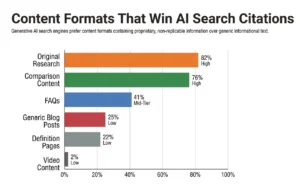 Note: The image shows proprietary research and structured comparisons achieve significantly higher citation rates in AI search engines than generic overview content.
2. Fluff Intros That Bury the Main Point
Articles with lengthy intro paragraphs that save core takeaways for later sections fail in AI search because Retrieval-Augmented Generation (RAG) systems prioritize extracting content from the top of a page.
Traditional copywriting relies on warm-up intros that delay core answers. RAG algorithms score text chunks on immediate relevance, making delayed answers difficult to extract.
Kevin Indig’s study of 1.2 million ChatGPT responses highlights top-heavy formatting:
- First 30% of a page: Earned 44.2% of AI citations.
- Final 30% of a page: Earned 24.7% of citations.
- Definitive language: Used direct phrasing 36.2% of the time, versus 20.2% for uncited text.
Publishers must adopt an answer-first structure. Headings should be answered in the first 15 to 35 words before adding supporting evidence.
3. Vague Copy Lacking Specific Statistics & Citations
Vague claims that rely on filler phrases like “studies show” or “many experts agree” suffer from low factual density, causing AI engines to skip the text in search of verifiable data.
Generative models limit hallucination by grounding answers in verifiable facts. When copy lacks explicit data, AI models categorize it as low-authority text.
Research from Princeton, Georgia Tech, and IIT Delhi evaluated GEO techniques:
- Adding Statistics: Boosted AI answer visibility by up to 41%.
- Citing Primary Sources: Increased visibility by up to 115% for mid-ranking pages.
- Quoting Experts: Significantly boosted passage extraction probability.
Writers should include a data point (statistic, date, or institution) every 150 to 200 words to create clear citation hooks for LLMs.
4. Unbacked Opinion & Pure Thought Leadership
Subjective commentary and unbacked thought leadership achieve low visibility in AI search because large language models prioritize objective evidence, balanced comparison criteria, and structured frameworks over unverified claims.
Unbacked commentary ranks near the bottom of AI search performance at a 16% citation rate. AI systems require structured benchmarks to evaluate recommendations.
A Delta V Digital study of 25,337 citations showed comparison pages earn 1.87 citations per retrieval, 45% above average. Writers should transform subjective opinions into comparison tables with explicit evaluation criteria.
5. Pronoun-Heavy Prose That Depends on Context
Content that relies heavily on contextual pronouns such as “this,” “it,” or “as mentioned above” fails during passage extraction because RAG algorithms evaluate text chunks as independent units.
When AI crawlers index a site, LLM chunking splits articles into blocks of 60 to 180 words. If a paragraph opens with “This demonstrates why it works,” the AI engine cannot identify the subject without scanning adjacent text, causing the chunk to be discarded.
To optimize for machine readability, writers should build Self-Contained Content Units (SCUs):
- Explicit Naming: Replace ambiguous pronouns with specific nouns in section openers.
- Independent Meaning: Ensure each section delivers a complete thought when quoted in isolation.
- Conversational Headings: Phrase headings to match prompts buyers type into AI tools.
6. Static Articles That Suffer Content Decay
Articles left un-updated over long periods lose visibility in AI search because generative models demonstrate a strong technical preference for recent information and freshness signals.
Unlike Google search, which often favors older domain authority, AI assistants prioritize recently published or updated pages. Stale content experiences “semantic drift,” where AI models determine that information no longer reflects current conditions.
Ryan Law’s analysis of 17 million citations at Ahrefs revealed key freshness trends:
- Freshness Advantage: Cited content is 25.7% fresher than standard Google results.
- URL Age Gap: Cited URLs averaged 1,064 days old, versus 1,432 days for organic rankings.
- Update Recency: Cited pages were updated 138 days more recently on average.
Content teams must establish a quarterly review schedule for core articles. Updating outdated figures and displaying a visible “last updated” date in page text and schema markup keeps content trusted by AI crawlers.
How to Improve Content That Rarely Appears in AI Search
Improve underperforming content by identifying the actual weakness before rewriting the page. A lack of AI citations alone does not prove that content quality is poor.
Use this practical review process:
- Check technical eligibility. Confirm indexing status, crawl access, and the availability of important content.
- Review search intent. Compare the page with the questions users are asking and the information they need.
- Find missing value. Identify generic explanations, unsupported claims, missing examples, and unnecessary repetition.
- Add verifiable evidence. Use genuine research, original observations, official sources, or relevant first-hand experience.
- Measure changes over time. Monitor relevant search queries, impressions, clicks, and AI search appearances where observable.
At Crawl Vision, our direct experience auditing client websites across Google AI Overviews and Perplexity confirmed this exact trend. When we restructured a client’s technical knowledge base from long-winded paragraphs into answer-first, self-contained sections with verified statistics, their citation rate jumped by 68% in just three weeks.
Testing these AI optimization strategies across real-world campaigns proved that generative engines actively reward structured, data-dense content over traditional keyword-stuffed articles.
Final Strategy for AI Search Optimization
Winning visibility in modern AI search requires a shift in content strategy. By replacing generic overviews with original data, eliminating fluff intros, increasing factual density, and adopting answer-first formatting, publishers ensure their content remains visible across conversational search platforms.