


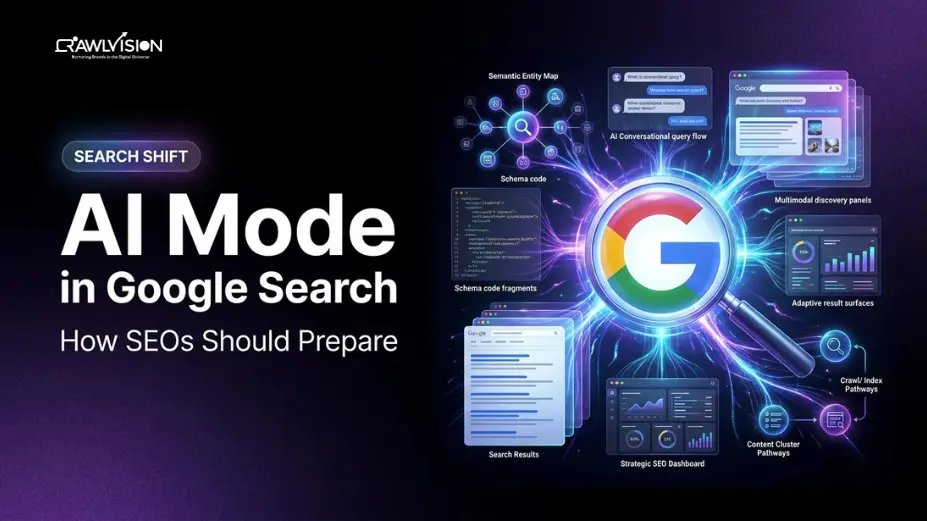
Google Search has changed forever. Since its full rollout in May 2026, Google AI Mode has fundamentally transformed how search results are displayed, how users interact with information, and most critically, how SEO professionals need to think about visibility, traffic, and content strategy. If you’re still optimizing purely for the traditional ’10 blue links,’ you’re already behind. This guide explains exactly what Google AI Mode is, how it differs from AI Overviews, why it matters for your SEO strategy, and the concrete steps you need to take to stay visible in 2026 and beyond.
What is Google AI mode?
Google AI Mode is a conversational, AI-powered search experience that delivers synthesized, comprehensive answers directly on the search results page without showing the traditional list of ten organic links. First announced on March 5, 2026, and fully rolled out in May 2026, it represents Google’s most significant transformation from a link directory into a closed-system answer engine, similar in function to ChatGPT or Perplexity.
Unlike traditional search, which shows ranked web pages and lets users decide which to click, AI Mode generates a complete, AI-written response at the top of the page. It only displays 1 to 3 source citations initially, with users required to tap ‘Show all’ to see additional references. This fundamentally changes the relationship between your content and your audience: either your brand gets cited, or it effectively disappears from that search result.
AI Mode also includes several advanced capabilities that extend far beyond basic search: adjustable response complexity (users can ask AI Mode to simplify language or add more depth), AI-organised result pages with generated category headlines, and visual troubleshooting via video search assistance.
How is AI mode different from AI overviews?
Many SEOs confuse AI Mode with Google’s AI Overviews feature, but they are meaningfully different and understanding the distinction matters for your optimization strategy.
Here is how they compare:
- AI Overviews appear alongside traditional organic search results. The standard ’10 blue links’ still exist below the AI-generated summary, giving content creators two pathways to visibility.
- AI Mode replaces traditional organic results entirely. There are no 10 blue links. If your content is not cited in the AI-generated answer, you have no presence on that results page whatsoever.
- AI Mode uses a ‘fan-out’ technique that issues up to 16 simultaneous sub-queries behind the scenes to construct its comprehensive answer. AI Overviews use a simpler, single-query retrieval process.
- AI Mode is optimized for multi-turn, conversational search, meaning a single session can spawn multiple follow-up questions, each one representing a new citation opportunity or a visibility gap.
The practical implication: AI Overviews reduce your click-through rate. AI Mode eliminates your traffic if your content is not selected as a cited source.
Why AI mode is an SEO crisis and an opportunity
The data surrounding AI Mode is both alarming and clarifying for SEO professionals. According to Semrush data from September 2026, 93% of searches conducted in AI Mode end without a single click to an external website. A January 2026 study analyzing 25.1 million impressions found that organic click-through rates for queries with AI Overviews dropped 61%, falling from 1.76% to just 0.61%. Paid search CTR fared even worse, crashing 68%.
One site owner reported losing 38% of their organic traffic from a top-ranking article, not because they dropped in rankings, but because Google AI Mode was answering the query before users ever saw the search results below.
However, those brands that do earn citations in AI Mode responses gain something more valuable than a click: they become the authoritative answer. Early data suggests that AI-driven visitors who do click through have significantly higher purchase intent and convert at higher rates than traditional organic visitors. The volume drops, but the quality rises. The goal shifts from ranking on page one to being the cited source.
As SEMrush analyst Barry Schwartz has put it, this era is effectively ‘billboard SEO’ optimizing for brand visibility and authoritative recognition, not just traffic volume.
How Google AI mode works: the fan-out technique explAIned
Understanding how AI Mode constructs its answers is essential for optimizing your content to be cited by it. The process is called fan-out querying, and it works like this:
- A user types or speaks a query, for example, ‘best trail running shoes for wide feet on wet terrain.’
- AI Mode automatically breaks this into up to 16 sub-queries ‘trail shoes wide fit,’ ‘trail shoes wet grip,’ ‘waterproof trail running,’ ‘running shoe reviews Reddit,’ and so on.
- It simultaneously searches for the best answer to each sub-query, pulling from web pages, forums, reviews, community discussions, and structured data.
- It synthesizes all the results into one coherent, comprehensive answer and cites its sources.
This fan-out behavior means that content which would rank for the broad query might not get cited, while content that thoroughly answers a specific sub-question might get pulled in and cited even if it has modest traditional SEO authority. Specificity, directness, and structured formatting become more powerful than broad keyword targeting.
6 Seo strategies to prepare for Google AI mode right now
1. Shift your goal from rankings to citations
The primary metric in the AI Mode era is not your position on the SERP it’s whether your content gets cited in AI-generated answers. Start tracking your brand’s citation share of voice across Google AI Mode, AI Overviews, ChatGPT, and Perplexity alongside traditional rankings.
2. Structure content for AI extraction, not just human reading
AI Mode scans content for direct, extractable answers. Use clear H2 and H3 headings that mirror natural questions. Lead every section with a direct answer before providing context. Keep paragraphs to two or three sentences. Use bullet points and numbered lists for multi-part answers. AI engines cannot easily quote dense, essay-style paragraphs but they can lift a clean, well-labeled answer with ease.
3. Target fan-out sub-queries, not just head terms
Because AI Mode breaks queries into sub-questions, your content strategy needs to go deeper. For each main topic, create content that thoroughly addresses the most common follow-up questions. Think of it as building a complete topical answer ecosystem, not just a single page that targets one keyword.
4. Strengthen your e-e-a-t signals
Google’s AI Mode prioritizes sources with clear Experience, Expertise, Authoritativeness, and Trustworthiness. This means author bios with verifiable credentials, consistent content updates, strong backlink profiles from authoritative domains, and reviews and mentions from trusted third-party communities.
5. Optimize for local and regional signals
AI Mode strongly prefers regional context when personalizing answers. If your business serves a geographic area, embed local phrases, regional examples, and location-specific structured data, not just city names in headlines, but genuine contextual local relevance throughout your content.
6. Build an off-site people-led presence
Because AI Mode draws from forums, communities, Reddit threads, and social platforms when constructing answers, your brand visibility in those spaces directly affects your citation probability. Earn mentions on Reddit, Quora, LinkedIn, and niche communities. These off-site people-led signals are now as strategically important as on-site technical SEO.

