

Google has published new technical guidelines explaining how website owners can allow Google-Agent traffic through their security systems.
The new documentation explains how publishers can identify Google-Agent requests and prevent content delivery networks (CDNs), web application firewalls (WAFs), and bot-detection services from blocking legitimate traffic.
Google added the new guidance on November 17, 2026, through its Google Crawling Infrastructure documentation.
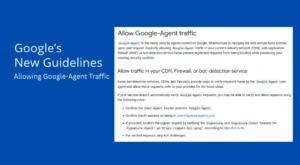
What Are Google’s New Google-Agent Guidelines?
Google’s new guidelines explain how website owners can identify and allow traffic from Google’s user-triggered AI agents.
The documentation covers how to configure CDNs, firewalls, and bot-detection systems to prevent blocking legitimate Google-Agent requests.
Google defines Google-Agent as:
“Google-Agent is the name used by agents hosted on Google infrastructure to navigate the web and perform actions upon user request.”
To verify these requests, Google recommends checking the User-Agent header and matching the IP address against its official user-triggered-agents.json file.
The goal is to let Google’s agents access websites while keeping existing security protections in place.
How Can Websites Identify Google-Agent Traffic?
Google explains that Google-Agent requests can be identified through two main signals.
Each request includes a User-Agent HTTP header containing “Google-Agent” and originates from an IP address listed in Google’s official user-triggered-agents.json file.
Google also recommends checking signed requests when Web Bot Auth information is available.
Website owners can use the following signals:
- User-Agent header: Check whether the request contains Google-Agent.
- IP addresses: Verify that the requesting IP appears in Google’s published user-triggered agents list.
- Web Bot Auth: Verify signed requests using the Signature and Signature-Input headers when provided.
Google recommends skipping bot challenges for verified Google-Agent requests.
Google Provides CDN and Firewall Configuration Guidance
The new documentation specifically addresses website security systems that may block automated traffic.
Google says some CDNs, firewalls, and bot-detection services already provide ways to verify and allow Google-Agent requests.
If a security service does not automatically recognize the agent, website owners may need to configure their own verification and allow rules.
Google also provides troubleshooting guidance for websites where legitimate requests keep getting blocked.
This includes checking firewall rule priority, CAPTCHA challenges, JavaScript challenges, shared-IP rate limits, and outdated IP ranges.
Google also highlights that access should cover more than homepage visits. Its examples include on-site search, filtering, product detail pages, add-to-cart actions, and booking processes.
Google Is Experimenting With Web Bot Auth
Another important detail is Google’s ongoing experiment with the Web Bot Auth protocol.
Google says it is experimenting with Web Bot Auth using the https://agent.bot.goog identity.
The system uses the HTTP Message Signatures standard (RFC 9421) to sign participating Google-Agent requests.
These signatures provide another way for websites to verify that requests are associated with Google’s agent infrastructure.
However, Google describes this as an experiment, not a requirement for every Google-Agent request.
What Does This Mean for SEO and Website Owners?
The new Google-Agent guidelines do not announce a Google Search ranking update.
Instead, they provide technical instructions for website owners who want to ensure Google’s user-triggered agents can access their websites.
This could be particularly relevant for:
- Websites using strict bot-protection systems.
- E-commerce websites supporting automated shopping actions.
- Travel and booking platforms.
- Publishers using CDN or firewall protection.
- Businesses managing AI-agent access through security services.
For most website owners, the immediate step is to review their existing CDN, WAF, and bot-detection configurations.
The bigger takeaway is that Google is providing clearer guidance for websites that want to support user-triggered AI agents without weakening their overall security protections.