


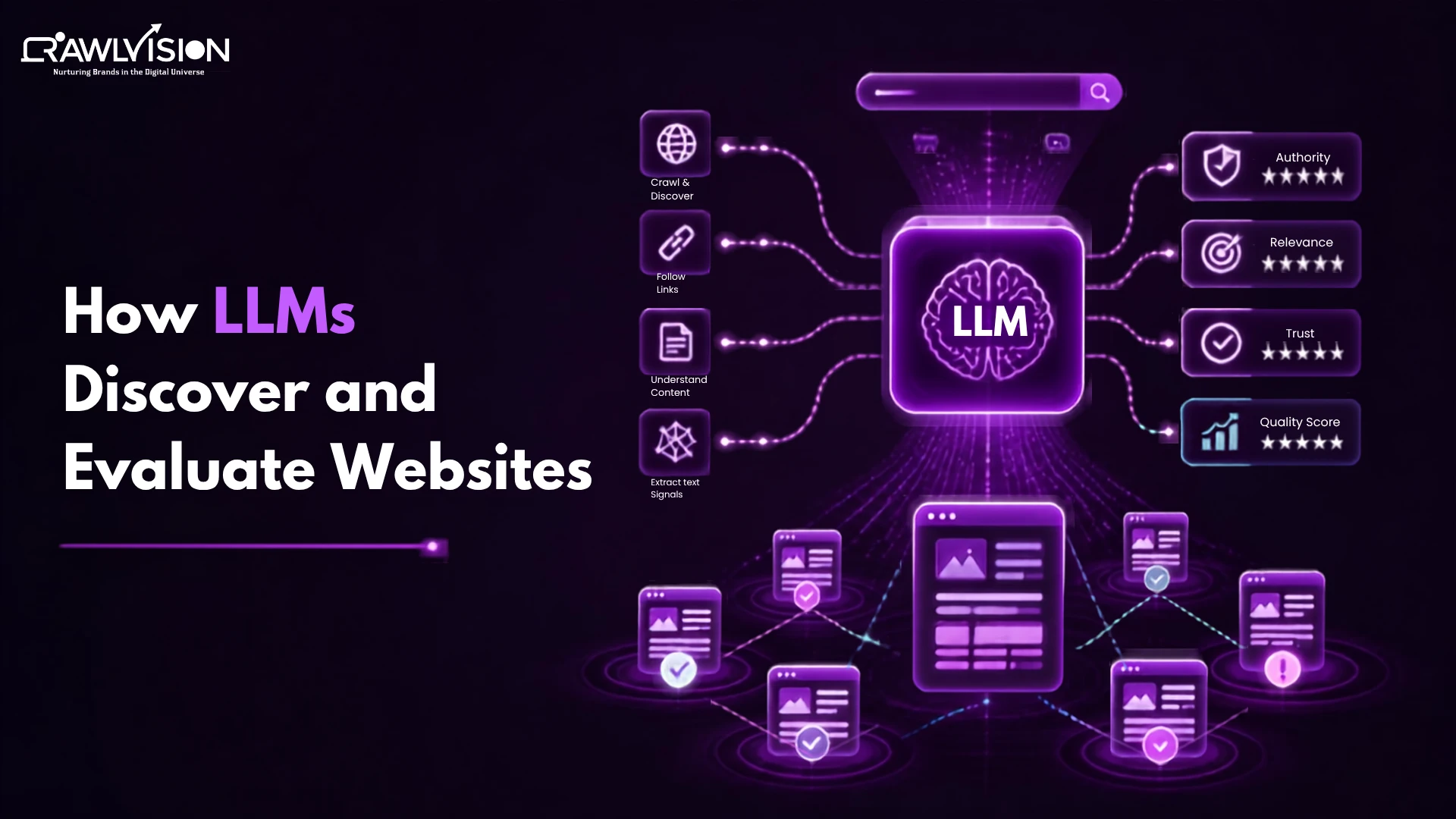
Quick answer: LLMs don’t evaluate every website directly. AI search systems can discover and retrieve web content, interpret it in the context of a user’s query, evaluate its relevance and credibility, and select useful information to include or cite in an answer.
When someone asks an AI search engine a question, it does not simply scan the entire internet and choose the most popular website. Depending on the platform, it may use crawlers, search indexes, retrieval systems, and multiple searches to find useful information.
For website owners, this means visibility in AI search starts with the same fundamentals as SEO: your content needs to be accessible, discoverable, understandable, relevant, and trustworthy.
How Do LLMs Discover Websites?
Before an AI system can use information from a webpage, it needs a way to find and access that content. The exact process varies between platforms, but several discovery mechanisms matter.
1. Crawlers and Bots
Search engines and AI companies use automated crawlers to access publicly available web content.
For example, OpenAI operates OAI-SearchBot for discovering content that can appear in ChatGPT Search. Publishers can use robots.txt to control crawler access.
This makes technical accessibility important for AI visibility. A page can contain excellent information, but if important content is blocked or inaccessible, it becomes harder for systems to discover and use.
2. Search Indexes
AI search systems do not necessarily crawl the entire web whenever a user asks a question. They can retrieve information through search systems and indexes that already contain information about webpages.
Google says its AI search features continue to rely on foundational Search practices and can use relevant web pages to generate responses.
In simple terms, crawling helps discover content, while indexing makes content available for retrieval.
3. Links and Website Structure
Internal and external links help systems discover pages and understand relationships between them.
For example, an SEO website might connect:
Technical SEO → Crawling → Indexing → Orphan Pages → Internal Linking
This structure helps users and search systems understand how the site’s content fits together.
4. Search Queries Trigger Retrieval
A user’s question starts the next stage.
AI search systems can expand or rewrite queries to find information from different angles. Google calls this query fan-out, where related searches can be generated across subtopics and data sources.
This means a page may be retrieved for a related search even when it does not contain the user’s exact wording.
How AI Search Retrieves Information From the Web
Discovery is only the beginning. Once a system has access to a large collection of webpages, it needs to find information relevant to the user’s question.
Consider a query: “How do I find orphan pages on my website?”
A useful answer may require information about orphan pages, internal links, XML sitemaps, crawling, and website audits.
The system therefore needs more than an exact keyword match. It needs information that addresses the intent behind the query.
This creates an important distinction: A page can be crawlable without being relevant enough to retrieve for a particular question.
Relevance, context, query expansion, and passage-level information can all influence what gets surfaced.
How AI Systems Understand Website Content
After content is retrieved, AI systems need to interpret what it says.
From an SEO perspective, this means making your content clear enough that its topic, claims, context, and relationships are easy to understand.
Compare two statements:
- SEO is important for businesses.
- Orphan pages are URLs that have no internal links pointing to them from other crawlable pages.
The second statement gives a much clearer definition and stronger topical context.
Make important information easier to understand with:
- Descriptive titles and headings
- Direct answers to questions
- Clear definitions
- Relevant examples
- Logical content structure
- Context around important claims
- Consistent terminology
The goal is not to write content for machines. It is to make useful information clear for both people and search systems.
How Do LLMs Evaluate Websites?
There is no universal public AI score that every LLM assigns to websites. Different systems use different retrieval and ranking processes.
However, several qualities can make content more useful and credible.
1. Relevance
Does the page actually answer the user’s question?
A detailed article about technical SEO may not be the best source for a query specifically asking about a recent Google update.
2. Content Quality
Useful content should provide substance instead of repeating generic statements.
Strong pages explain concepts clearly, answer real questions, provide examples, and support important claims.
3. Authority and Trust
Reliable sources matter, particularly for topics where inaccurate information can mislead users.
Helpful trust signals include:
- Clear authorship
- Demonstrated expertise
- Reputable references
- Accurate claims
- Transparent sourcing
4. Originality and First-Hand Experience
Content that simply repeats information found across dozens of websites gives readers and AI systems little new value.
Original research, first-hand observations, case studies, experiments, and unique data can make content more useful.
Google’s guidance emphasizes creating unique and valuable LLM-friendly content rather than producing large amounts of commodity content.
5. Freshness
Some information changes quickly, including SEO guidance, software features, statistics, and technology.
Keeping important facts and examples updated helps ensure that your content remains useful.
6. Accessibility and Crawlability
A page cannot be retrieved if the systems that need to access it cannot reach its important content. Identifying and fixing technical SEO issues therefore remain part of the AI visibility equation.
How Can You Make Your Website Easier for AI Systems to Discover?
Start with fundamentals rather than trying to optimize for a hypothetical AI ranking formula.
Make pages discoverable
- Maintain a useful XML sitemap
- Build strong internal links
- Avoid unnecessary crawl blocks
- Fix broken links and server errors
- Keep important pages accessible
Make content understandable
- Use descriptive titles and headings
- Answer important questions directly
- Define technical terms clearly
- Organize related information logically
- Avoid vague or unsupported claims
Make information useful
- Answer specific user questions clearly.
- Cover related subtopics where useful.
- Avoid repetitive or thin content.
- Focus on value, not volume.
Make claims trustworthy
- Cite reliable sources for key claims.
- Support claims with data or evidence.
- Add expert insights where relevant.
- Show experience through real examples.
SEO vs. GEO: What Website Owners Need to Know
SEO and GEO should not be treated as competing strategies.
SEO (Search Engine Optimization) helps search systems discover, crawl, understand, and rank your website.
GEO (Generative Engine Optimization) focuses more specifically on improving visibility in generative AI experiences, including the likelihood of content being surfaced or cited.
There is significant overlap between them.
| SEO | GEO |
| Crawlability | AI accessibility |
| Search intent | Conversational intent |
| Internal linking | Context and relationships |
| Content quality | Useful, quotable information |
| Authority | Source credibility |
| Rankings | AI visibility and citations |
The key point is simple: GEO does not replace SEO. Strong technical SEO and useful content provide the foundation for AI search visibility.
Google also states that its generative AI features are rooted in core Search ranking and quality systems, reinforcing the continued importance of SEO fundamentals.
5 Common Myths About LLMs and Website Discovery
Myth 1: LLMs read every website.
Reality: No. AI systems use different combinations of crawlers, indexes, retrieval systems, and other sources. You should not assume an LLM has read every webpage.
Myth 2: You need special AI schema to appear in AI search.
Reality: There is no universal AI schema that guarantees visibility. Google says there are no additional technical requirements or special markup required for its AI features beyond Search eligibility.
Myth 3: Ranking #1 guarantees an AI citation.
Reality: A traditional ranking does not guarantee a citation. AI search systems can retrieve information from multiple sources depending on the query and platform.
Myth 4: More content means more AI visibility.
Reality: Publishing more pages does not automatically improve visibility. Original, useful, relevant content is more valuable than repetitive content created at scale.
Myth 5: Robots.txt only matters for traditional SEO.
Reality: Robots.txt can also affect AI crawler access. OpenAI, for example, documents how publishers can control OAI-SearchBot through robots.txt.
The Bottom Line
AI visibility starts before an AI-generated answer appears.
Your website needs to be discoverable, accessible, retrievable, understandable, relevant, and trustworthy before its information can become useful for an AI-generated response.
That is why SEO and GEO both matter. The technical and content foundations that help search engines understand your website also help AI search systems find and use your information.
Regular SEO audits can help identify barriers across technical accessibility, internal linking, content structure, and content quality. At Crawl Vision, these areas are part of understanding how websites perform in search.
You do not need to hack LLMs. Build a website search systems can access, create content users can understand, and provide original, well-supported information worth referencing.