


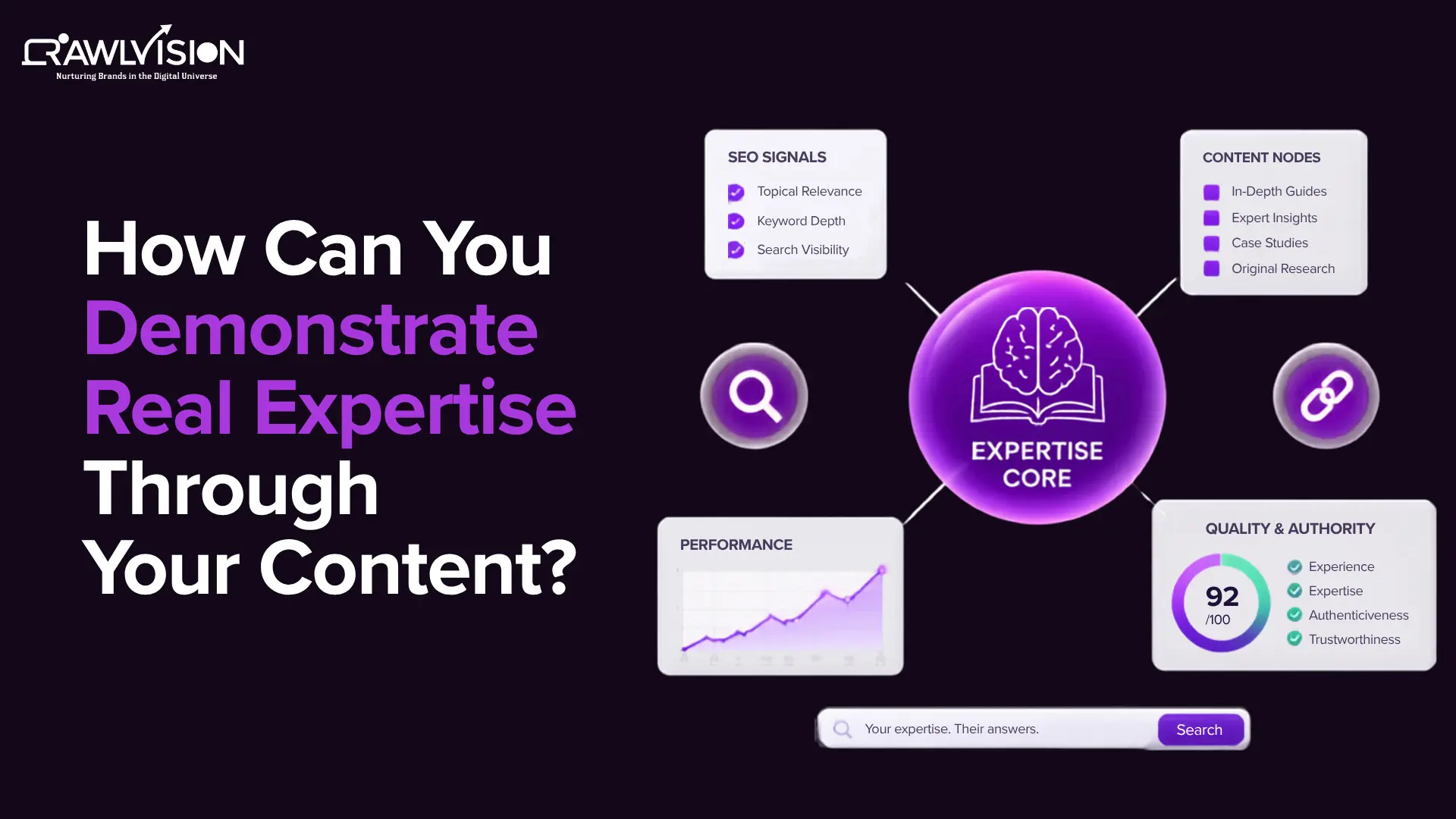
Quick Answer: You demonstrate real expertise by sharing first-hand experience, adding original insights, explaining your reasoning, using reliable evidence, acknowledging limitations, and making the author’s relevant experience clear. Expert content should give readers something more useful than a basic summary of information already available online
What Does Real Expertise Look Like in Content?
Real expertise is not about complicated language or calling yourself an expert. It is about explaining a subject accurately, applying it to real situations, and recognizing where common advice falls short.
For example, saying “Internal linking is important for SEO” demonstrates basic knowledge.
Explaining how you prioritize internal links on a large website, which pages you connect first, what problems you have encountered, and what changed after implementation demonstrates much stronger expertise.
As mentioned in Google’s guidance, creating helpful content encourages publishers to add unique value from their own experience rather than simply reworking information already available online.
7 Ways to Demonstrate Real Expertise Through Your Content
1. Share First-Hand Experience
Sharing first-hand experience is one of the clearest ways to make expertise visible.
Instead of only explaining what readers should do, share what you or your team have actually done. This could include:
- Projects you have worked on
- Experiments you have conducted
- Problems you encountered
- Strategies you tested
- Lessons learned from failures
- Results observed after implementation
For example, an SEO agency can explain how it approached a technical SEO problem across a large website instead of simply listing the standard recommendations.
The experience makes the advice more specific, useful, and difficult to replicate through a basic content summary.
2. Add Original Insights, Not Just Basic Information
If your article says exactly what the first five search results say, it gives readers little reason to choose your version.
Look for opportunities to write thoughtful leadership content and provide something new. You could:
- Share an observation from your own work
- Identify a common misconception
- Explain a pattern you repeatedly see
- Compare different approaches
- Provide a practical framework
- Explain when a commonly recommended tactic may not work
Google’s current guidance for AI features also emphasizes creating unique, useful content that provides value beyond information that can easily be generated or repeated.
3. Use Real Examples and Case Studies
Examples turn abstract advice into something readers can understand and evaluate.
Instead of saying: “Improve your website’s internal linking.” Show what that means in practice.
For example, explain how you identified poorly connected pages, decided which pages deserved more internal links, changed the structure, and evaluated the outcome.
Case studies can include:
- The original problem
- Your approach
- Why you chose that approach
- What happened
- What you learned
You do not need to reveal confidential client information. Even anonymized examples can demonstrate how you think and work.
4. Explain the Reasoning Behind Your Recommendations
Expert content does not simply give instructions. It explains the thinking behind them.
Consider the difference:
Basic: “Update old content regularly.”
More useful: “Do not update an article simply because it is old. First check whether the information is outdated, search intent has changed, important competitors have improved their coverage, or the page has lost relevance.”
The second recommendation demonstrates judgment.
That is important because expertise is often visible in the decisions you make, not just the information you know.
5. Support Claims With Reliable Evidence
Expertise should not mean asking readers to trust every statement simply because an author sounds confident.
Support important claims with appropriate evidence, such as:
- Official documentation
- Original research
- First-party data
- Reputable studies
- Industry research
- Relevant expert sources
However, citations alone do not make content expert-level.
Add your interpretation, explain what the evidence means, where it applies, and what readers should take away from it. This helps both readers and AI search engines understand your content and evaluate your claims
That combination of evidence + interpretation is much stronger than filling an article with statistics.
6. Acknowledge Limitations, Exceptions, and Trade-Offs
One of the clearest signs of genuine expertise is knowing when advice does not apply. Avoid presenting every strategy as universally effective.
Instead, explain:
- When the recommendation works best
- When another approach may be better
- What risks exist
- What assumptions you are making
- What results readers should realistically expect
For example, increasing content length does not automatically make a page better. A short page that directly satisfies the searcher’s intent can be more useful than a much longer article filled with repetition.
Showing these nuances makes your content more credible because it demonstrates judgment rather than certainty for its own sake.
7. Make the Author’s Expertise Clear
Readers should be able to understand why the person creating the content is qualified to discuss the subject.
An author page or bio can highlight:
- Relevant professional experience
- Industry specialization
- Qualifications or certifications
- Published work
- Practical experience
- Areas of subject-matter expertise
But an optimised author bio should support the content, not compensate for it.
If an article claims that its author is an SEO expert but contains only generic information, the credential does little to strengthen the actual content.
What Is the Difference Between Expert Content and Generic Content?
Both types of content can provide accurate information, but expert content goes further. It adds context, reasoning, experience, and insights that make the information more useful.
Here’s a simple comparison table:
| Generic Content | Expert Content |
| Repeats common advice | Adds original observations |
| Makes broad claims | Explains context and exceptions |
| Gives instructions | Explains the reasoning |
| Uses generic examples | Uses relevant real-world examples |
| Relies heavily on summaries | Adds interpretation and experience |
| Claims authority | Demonstrates knowledge through the content |
The goal is not to make every sentence sound sophisticated. Expert content should make the reader think, “This person understands how this works in the real world.”
How Does Expertise Contribute to E-E-A-T?
Expertise is one part of Google’s E-E-A-T framework: Experience, Expertise, Authoritativeness, and Trustworthiness.
The concepts overlap, but they are not identical.
- Experience: Shows what someone has actually done or encountered. For example, dated project notes, specific outcomes, tools used, failures, and fixes reflect experience.
- Expertise: Shows their knowledge and ability to explain the subject. For example, accurate terminology, correct explanations, and depth appropriate to the audience reflect expertise.
- Authoritativeness: Reflects recognition and credibility within a topic. For example, a named expert author, a bio with credentials, and links to other expert work reflect authoritativeness.
- Trustworthiness: Covers accuracy, transparency, and reliability. For example, transparent sourcing, limitations, clear ownership, and contact info reflect trustworthiness.
Strong content can demonstrate several of these qualities at once. First-hand examples can show experience, accurate explanations can demonstrate expertise, and transparent sourcing can support trust.
How to Show Expertise in Different Types of Content
The best way to demonstrate expertise depends on what you are publishing. A blog post, product review, how-to guide, and news article each provide different opportunities to show knowledge and experience.
Blog Posts
Use original observations, practical examples, first-hand lessons, and evidence instead of simply summarizing existing articles.
Product Reviews
Explain how the product was tested, what was evaluated, and which situations it performs well or poorly in. Original testing adds meaningful value.
How-to Guides
Include actual implementation steps, common mistakes, troubleshooting advice, and details that someone gains from doing the task themselves.
Industry/News Content
Do more than report what happened. Explain why the development matters, who it affects, what may change, and what readers should watch next.
Expert Content Checklist
Before publishing, use this checklist to make sure your content reflects true expertise.
- Have I included first-hand experience where relevant?
- Does the article provide something beyond existing search results?
- Have I added original observations or insights?
- Have I explained why my recommendations make sense?
- Are important claims supported by reliable sources?
- Have I acknowledged limitations or exceptions?
- Have I included at least one specific example with outcomes where relevant?
- Are my examples specific and useful?
- Is the author’s relevant expertise clear?
- Would an experienced practitioner find this genuinely useful?
If most answers are yes, your content is doing more than claiming expertise. It is demonstrating it.
Conclusion
Real expertise is not something you establish by adding “expert” to an author bio or filling an article with technical terminology.
It becomes visible when your content shows what you know, what you have experienced, how you reached your conclusions, and where your recommendations may or may not apply. That is the approach the Crawl Vision team follows when auditing websites.
The strongest approach is simple: share what you have learned, support important claims, explain your reasoning, and give readers something they cannot get from a generic summary.
That is what turns content from information into genuine expertise.