



ChatGPT can speed up SEO by helping with keyword clustering, content optimization, on-page recommendations, technical SEO analysis, and repetitive research tasks. It works best as an SEO assistant that processes information and accelerates workflows, while SEO professionals validate data and make strategic decisions.
What SEO Tasks Can ChatGPT Speed Up?
ChatGPT is most useful for SEO tasks that involve organizing information, spotting patterns, creating drafts, and turning research into actionable work. Four areas where it can save time are:
1. Keyword Research
ChatGPT can turn a large keyword list into useful groups based on topic and search intent. It can also identify closely related terms and suggest potential topic clusters.
2. Content Optimization
It can review existing content for missing subtopics, unclear sections, repetitive writing, weak answers, and opportunities to improve topical coverage.
3. On-Page SEO
ChatGPT can help review page titles, meta descriptions, headings, keyword placement, alt text, content structure, and contextual internal-link opportunities.
4. Technical SEO Analysis
When you provide crawl data or technical SEO findings, ChatGPT can explain issues, categorize them, and help turn a long audit into a prioritized action list.
| SEO task | How ChatGPT can help |
| Keyword research | Cluster keywords, classify intent, and build topic groups |
| Content optimization | Find gaps, improve structure, and suggest updates |
| On-page SEO | Review titles, headings, metadata, and internal links |
| Technical SEO analysis | Explain crawl findings and organize technical issues |
The goal is to reduce repetitive work and focus on decisions requiring context.
How to Use ChatGPT for Keyword Research
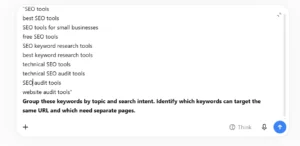
Start with real keyword data from your SEO tools, such as Google Search Console, rather than asking ChatGPT to invent search volumes. Paste a relevant keyword list and ask it to group terms by search intent, topic, and likely landing page.
For example, ask:
“Group these keywords by search intent. Identify keywords that can target the same page and explain your grouping.”
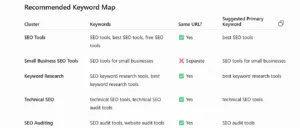
Use the clusters to build content plans and keyword maps, then verify them against actual search results because similar phrases don’t always have the same intent.
Prompt given to ChatGPT:
ChatGPT Output:
How to Use ChatGPT for Content Optimization
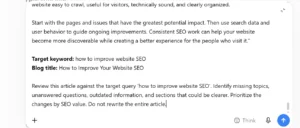
Give ChatGPT the existing article, target query, and relevant SEO information. Ask it to identify missing information, sections that need clarification, and questions the page should answer.
A useful workflow is:
- Review the page and target query.
- Compare the content with the actual SERP.
- Give ChatGPT the page and your research.
- Ask it to identify and prioritize gaps.
- Edit and fact-check before publishing.
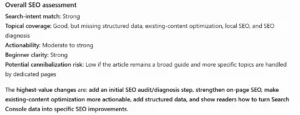
This approach is more useful than asking ChatGPT to rewrite an entire article from scratch because it preserves first-hand expertise and keeps the optimization tied to search intent.
Prompt given to ChatGPT:
ChatGPT Output:
How to Use ChatGPT for On-Page SEO
ChatGPT can speed up smaller on-page tasks that often take time when handled one page at a time. Give it the page content, target keyword, and context, then ask for specific recommendations.
You can use it to review:
- Title tag and meta description variations
- Heading structure
- Keyword placement
- Image alt text
- Internal-link opportunities
- Content clarity and structure
- FAQ opportunities
For internal links, provide your URL list. ChatGPT can suggest contextual matches, but you should confirm that each recommended page is relevant, live, indexable, and worth linking to.
How to Use ChatGPT for Technical SEO Analysis
ChatGPT should not replace a technical SEO crawler. Instead, use it after collecting data from your crawl and analytics tools.
Export status codes, redirect chains, canonical issues, or indexation findings. Ask ChatGPT to group them, explain the likely impact, and organize the findings into an action list.
You can also use it to understand technical concepts or create formulas, regex patterns, or scripts. Test the output before applying changes to a live website.
What Can New GPT-6 Astra Do for SEO?
Recently launched GPT-6 Astra makes AI-assisted SEO workflows more interesting because OpenAI says the model is designed for complex, multi-step work, browsing, computer use, research, and professional tasks. It can also work across websites and desktop applications in supported environments.
For SEO teams, this could make research, file analysis, browser-based tasks, and reporting more efficient. OpenAI says Astra can create documents, spreadsheets, and presentations and adapt when requirements change.
However, SEO judgment is still necessary. Search intent, business priorities, technical risk, content accuracy, and recommendations need human review. Astra’s output depends on the data and instructions it receives.
ChatGPT SEO Prompts (2026)
ChatGPT Prompt for Keyword Research
“Cluster this keyword list by search intent and topic. Identify which terms can target the same URL, explain why, and flag keywords that need separate pages.”
ChatGPT Prompt for Content Optimization
“Review this article against its target query and identify missing topics, unanswered questions, outdated information, and sections that could be clearer. Prioritize the changes by SEO value.”
ChatGPT Prompt for On-Page SEO
“Review this page for on-page SEO. Suggest improvements to the title, meta description, headings, keyword usage, internal links, and content structure. Avoid unnecessary keyword repetition.”
ChatGPT Prompt for Technical SEO Analysis
“Analyze this technical SEO issue list. Group related problems, explain what each issue means, identify potential impact, and create a prioritized action list. Do not assume an issue exists beyond the data provided.”
What SEO Tasks ChatGPT Can Not Do
ChatGPT is not a replacement for specialized SEO tools and should not be treated as the authoritative source for live SEO data. Depending on the setup and information provided, it may not know your current rankings, search volume, crawl state, backlink profile, or conversion performance.
It also cannot make reliable SEO decisions without business and website context. Before publishing or changing a site, verify:
- Search volume, rankings, and keyword difficulty
- Current search results and search intent
- Crawl and indexation status
- Backlinks and referring domains
- Traffic and conversion data
- Technical changes on the live site
AI can accelerate analysis, but verification protects your site from decisions based on incomplete or incorrect information.
Conclusion
ChatGPT can make SEO work faster when you use it for the parts of the process that are repetitive, data-heavy, or language-focused. Keyword clustering, content optimization, on-page reviews, technical analysis, and reporting can all become more efficient with the right workflow.
At Crawl Vision, the practical value of AI is not about removing SEO expertise. It is about reducing manual effort so more time can go into research, validation, strategy, and improving real search performance.