


Ahrefs and Semrush are both powerful SEO tools, but they suit different workflows. Ahrefs is particularly strong for backlink and organic search research. Semrush offers a broader SEO and marketing toolkit with strong keyword research, rank tracking, competitor analysis, and AI search visibility features. The better choice depends on your SEO priorities, team needs, and budget.
Ahrefs vs Semrush: What Is the Difference?
Ahrefs and Semrush are comprehensive SEO tools, but they are built around somewhat different workflows. Both provide data for keyword research, competitor analysis, website audits, rank monitoring, and understanding backlinks.
Ahrefs has historically been closely associated with backlink and organic search research, although its current platform also includes content research, site auditing, rank tracking, and AI visibility tools.
Semrush has a broader marketing ecosystem that extends into PPC, social media, local search, content, and AI visibility.
For an SEO team, the question is not simply which SEO tool has more features. It is which platform gives you the data and workflow you need for the decisions you make regularly.
Which Is Better for SEO Tasks: Ahrefs or Semrush?
Both Ahrefs and Semrush cover major SEO tasks, but their strengths differ across keyword research, backlink analysis, competitor research, technical SEO, rank tracking, and AI search visibility.
1. Keyword Research
Ahrefs
Ahrefs’ Keywords Explorer provides keyword ideas, search volume, keyword difficulty, traffic potential, SERP analysis, parent topics, and related terms. Its interface is particularly useful when building an SEO-focused content strategy around search demand and ranking opportunities.
Semrush
Semrush’s Keyword Magic Tool provides a large range of keyword ideas with search volume, keyword difficulty, search intent, SERP features, trends, and competitive insights. It also supports keyword grouping and filtering for large-scale research.
Winner: Semrush
Semrush has an edge for teams that want keyword research connected with search intent, competitive insights, PPC data, and broader search marketing workflows.
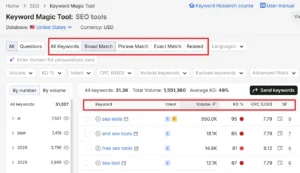
Image: Semrush Keyword Magic Tool showing keyword metrics and search data.
2. Backlink Analysis
Ahrefs
Ahrefs has a strong focus on backlink analysis, with tools for examining referring domains, backlinks, anchor text, broken backlinks, new and lost links, and competitors’ link profiles. Its backlink data is one of the platform’s core strengths.
Semrush
Semrush’s Backlink Analytics provides backlink and referring-domain data, authority metrics, anchor text analysis, new and lost backlinks, and competitor backlink comparisons. Its Backlink Gap tool can also identify referring domains linking to competitors but not to your site.
Winner: Ahrefs
Ahrefs has a particularly strong backlink research workflow for analyzing referring domains, link profiles, new and lost backlinks, competitor links, and potential link opportunities.
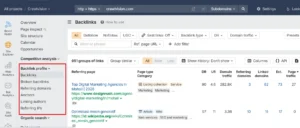 Image: Ahrefs Site Explorer showing multiple backlink analysis options.
3. Competitor Research
Ahrefs
Ahrefs allows you to analyze competitors’ organic keywords, top pages, backlinks, traffic potential, content gaps, and ranking performance. Its competing domains and content research features can help identify areas where competitors are gaining organic visibility.
Semrush
Semrush offers a broader competitor research workflow covering organic search, paid search, keyword gaps, backlinks, advertising research, traffic trends, and market-level insights. This makes it useful when competitor research extends beyond SEO.
Winner: Tie
Both tools provide comprehensive competitor research. Ahrefs is strong for organic search, content, and backlink analysis, while Semrush extends competitor research into paid search and broader marketing data.
4. Site Audits and Technical SEO
Ahrefs
Ahrefs Site Audit crawls websites and identifies technical and on-page SEO issues, including broken links, redirects, crawlability problems, duplicate content, metadata issues, and other site-health concerns.
Semrush
Semrush Site Audit analyzes technical SEO issues across a website and provides reports covering crawlability, HTTPS, internal linking, structured data, Core Web Vitals, duplicate content, redirects, and other technical factors.
Winner: Tie
Both provide comprehensive technical SEO auditing, including crawlability, broken links, redirects, duplicate content, metadata, internal linking, and other site-health issues.
5. Rank Tracking
Ahrefs
Ahrefs Rank Tracker monitors keyword positions across search engines and locations while providing visibility into ranking changes, competitors, SERP features, and historical performance.
Semrush
Semrush Position Tracking provides daily ranking data, competitor comparisons, visibility trends, SERP features, local and mobile tracking, and reporting options.
Winner: Semrush
Semrush is particularly strong for detailed rank tracking across locations, devices, competitors, SERP features, and reporting requirements.
6. AI Search Visibility
Ahrefs
Ahrefs has expanded into AI search measurement through Brand Radar, which helps track brand visibility and mentions across AI search experiences. This extends Ahrefs beyond traditional rankings into monitoring how brands appear in AI-generated answers.
Semrush
Semrush’s AI Visibility Toolkit tracks brand visibility across AI platforms and provides insights into mentions, citations, prompts, competitors, and AI search performance. Its broader marketing ecosystem also connects AI visibility with traditional SEO data.
Winner: Tie
Both platforms offer dedicated AI search visibility features. Ahrefs Brand Radar focuses on AI visibility, citations, share of voice, and sources appearing in AI answers, while Semrush combines AI visibility tracking with prompt research, competitor analysis, and AI search monitoring.
Pricing: Ahrefs vs Semrush
Ahrefs has a significantly lower entry price, while Semrush’s paid plans bundle a broader range of SEO and AI search capabilities. The better value depends on the features, usage limits, and workflows you need.
| Pricing | Ahrefs | Semrush |
| Starting Price | $29/month | $139/month |
| Main Paid Plans | Starter, Lite, Standard, Advanced | Pro, Guru, Business |
| Free Access | Limited free tools | Limited free access |
| Annual Billing | Available | Available |
| Key Focus | SEO and backlink research | SEO, competitive research, and AI search |
| Best For | Users looking for a lower-cost entry point | Teams needing a broader SEO and marketing toolkit |
Note: Prices last checked in September 2026 and subject to change.
Which SEO Tool Should You Use?
Choosing the best SEO tools in the age of AI is extremely important. The right choice depends on your SEO workflow, team size, and the types of data you use most often.
Choose Ahrefs when your workflow emphasizes:
- Backlink and organic search research
- Competitor content and link analysis
- SEO-focused research workflows
- Content opportunities and SERP analysis
Choose Semrush when your workflow emphasizes:
- SEO combined with PPC and broader marketing research
- Content, local, social, or advertising workflows
- Cross-channel competitor analysis
- Broader reporting and marketing tool integration
Consider Using Both When:
- Your team needs different datasets for different workflows
- You regularly cross-check keyword or backlink research
- Multiple specialists use different parts of the SEO stack
- The cost is justified by the additional data and workflows
At Crawl Vision, we’ve found that the right SEO tool depends more on the workflow than the feature count. We use both Ahrefs and Semrush based on the campaign’s research, tracking, and reporting needs.
Conslusion
Ahrefs and Semrush can both support serious SEO work, so there is no universal answer to which tool is better. The practical choice comes down to your priorities, the data you need, and how your team works.
Instead of choosing based only on feature counts, test the workflows you use most often: keyword research, competitor analysis, technical audits, backlink research, rank tracking, and AI visibility. The platform that fits those workflows and provides useful data at a sustainable cost is the more appropriate choice for your team.