


A new website should prepare for AI search by building a strong SEO foundation, clearly answering important user questions with AEO, establishing credible brand and expertise signals, and monitoring how AI systems represent the site through GEO.
What Is AI Search Optimization?
AI search optimization is the process of making a website easier for search and AI systems to discover, understand, interpret, and use when answering user queries. It includes traditional SEO, answer-focused content practices, and broader signals that help AI systems understand a business or website.
Google’s current guidance makes an important point: SEO best practices remain relevant for generative AI features in Search. AI Overviews and AI Mode use Google’s existing Search systems, so a new website should not treat AI optimization as a replacement for SEO.
AI Search Optimization Checklist for a New Website
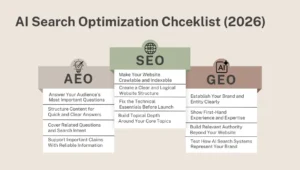
A practical AI search optimization checklist should cover three connected layers: SEO for accessibility and discoverability, AEO for clear answers, and GEO for brand context, experience, authority, and AI visibility.
Build a strong search foundation (SEO)
A new website needs a strong technical foundation so search engines can easily crawl, index, and understand its content.
-
Make your website crawlable and indexable
Make sure Googlebot and other relevant crawlers can access the pages you want discovered. Review robots.txt, noindex directives, XML sitemaps, status codes, canonical URLs, and important page accessibility before launch.
Tip: Review your robots.txt file to ensure you are not unintentionally blocking relevant search or AI crawlers from accessing the content.
-
Create a clear and logical website structure
Organize the site around clear relationships between pages. Your navigation should make it obvious how the homepage connects to services, products, categories, and supporting content.
Tip: Use descriptive URLs and meaningful internal links. A clear hierarchy helps search systems understand how individual pages relate to the broader website subject.
-
Fix the technical essentials before launch
Check HTTPS, mobile usability, Core Web Vitals, redirects, canonicalization, broken links, and Search Console setup before sending the site live.
Tip: Google includes secure pages, mobile usability, and Core Web Vitals among its main page experience considerations.
-
Build topical depth around your core topics
A new website should not publish a collection of thin pages targeting isolated keywords. Build the important pages around the topics your business genuinely serves.
Start with core service, product, or category pages, then add supporting content that answers related questions and explains important subtopics.
Tip: This creates clearer topical relationships and gives search engines and AI systems more context about what the website actually covers.
Make your content easier to understand and answer (aeo)
AEO turns useful information into clear, extractable, structured answers by matching content structure with the questions people actually ask.
-
Answer your audience’s most important questions
Identify the questions customers ask before, during, and after choosing your product or service. Answer those questions directly rather than making readers search through several paragraphs for basic information.
For example, a technical SEO service page might clearly answer what a technical SEO audit includes, which problems it identifies, and when a business should consider one.
-
Structure content for quick and clear answers
Use descriptive headings, short explanatory paragraphs, lists, tables, definitions, and examples where they genuinely help. Put the main answer close to the question instead of burying it beneath a long introduction.
This structure helps people scan the page and makes individual passages easier for search systems to interpret.
-
Cover related questions and search intent
Look beyond the primary keyword. A person searching for a service may also want to know about pricing factors, process, timelines, alternatives, requirements, limitations, and expected outcomes.
Covering relevant follow-up questions makes the page more complete without turning it into a keyword list. The goal is to satisfy the underlying information need.
For example, a page about a technical SEO audit could cover questions such as:
“What does a technical SEO audit check?”
“How long does an SEO audit take?”
“What happens after an SEO audit?”
“Which issues should be fixed first?”
-
Support important clAIms with reliable information
Use credible sources when discussing statistics, regulations, technical standards, platform features, or other facts that can change. Where possible, add original examples, documentation, research, or clearly attributed evidence.
Bad Example: “Core Web Vitals are important for SEO and can significantly improve your rankings.”
Good Example: “Core Web Vitals are part of Google’s page experience considerations. Monitor metrics such as LCP, INP, and CLS in Google Search Console and PageSpeed Insights, then address issues that affect real user experience.”
The second example makes a more specific claim and points readers toward reliable sources and measurable information instead of making a broad unsupported statement.
Strengthen your website’s AI search visibility (geo)
In 2026, Generative Engine Optimization can complement traditional SEO by helping strengthen the signals that make a brand, its expertise, and its content easier for AI systems to understand and represent.
-
Establish your brand and entity clearly
Make it easy to understand who the organization is, what it offers, where it operates, and who it serves. Maintain consistent business details across the website and relevant external profiles.
Include useful About, Contact, and organization information. Use appropriate structured data when it accurately describes the page. Google says structured data can help it understand page content, although it does not guarantee a particular search appearance.
-
Show first-hand experience and expertise
Generic explanations are easy to reproduce. Useful first-hand experience content is harder to replace. Add original processes, examples, observations, screenshots, expert commentary, case evidence, or lessons learned when you genuinely have them.
For a new website, this can mean explaining how a service is delivered, showing what a real audit includes, or answering practical questions that come from working with customers.
Bad Example: “A technical SEO audit identifies website problems.”
Good Example: “We review indexability, crawlability, redirects, canonical tags, internal links, page speed, and structured data to identify technical issues that may affect search visibility.”
-
Build relevant authority beyond your website
AI search visibility is not only about what you publish on your own domain. Relevant third-party mentions, links, reviews, industry references, and other credible sources can reflect brand authority and provide additional context.
Tip: Focus on earning relevant recognition rather than pursuing large volumes of low-quality links.
-
Test how AI search systems represent your brand
Do not assume that publishing a website means AI systems understand it correctly. Test important customer queries across Google AI Overview, AI Mode, ChatGPT, and other AI-powered experiences and record whether your brand appears, which pages are cited, and whether the information is accurate.
You can search questions customers might actually ask, like:
- Who provides [service] in [location]?
- What should I know before choosing [product]?
Repeat the checks over time because AI search results can change.
AI Search Optimization Mistakes to Avoid in 2026
The biggest AI search optimization mistakes usually come from treating AI visibility as a separate shortcut instead of building on solid SEO, useful content, and credible brand signals.
- Treating GEO as a replacement for SEO: AI search optimization still depends on a website being accessible, crawlable, technically sound, and useful.
- Publishing generic AI-generated content at scale: Content that adds little original information, experience, or value can make the website less useful rather than improving its visibility.
- Unintentionally blocking search or AI crawlers: Incorrect robots.txt rules or other access restrictions can prevent important pages from being discovered by search or AI systems.
- Writing only for keywords instead of questions: New websites should address the real questions and information needs behind searches instead of creating separate pages for every keyword variation.
- Ignoring brand and entity information: If your website does not clearly explain who you are, what you offer, and what you specialize in, AI systems have less context about the organization.
- Assuming AI visibility without testing it: Publishing content is not proof that AI search systems will mention your brand or cite your pages. Test important queries and monitor what appears over time.
It is better to prioritize crawlability, useful content, site structure, and established SEO practices than chase every new AI optimization trend.
Conclusion
AI search optimization for a new website is best treated as an ongoing process rather than a final launch task. Start with crawlability and technical SEO, make important information easy to understand and answer, then build the brand, expertise, and authority signals that support AI search visibility.
At Crawl Vision, we use the same principles when working with new websites: establish a strong technical foundation first, make content genuinely useful, and then build the signals that support broader search visibility.
Remember, the most useful checklist is not the one with the most AI-specific tricks. It is the one that makes the website genuinely accessible, understandable, useful, and trustworthy from the beginning.

