



Your blog posts may rank on Google but still fail to appear in ChatGPT, Google AI Overviews, or other AI-generated answers. Improving AI search visibility starts with finding out why your content is being overlooked, whether the problem is technical access, relevance, originality, or topic coverage.
Why AI Search Ignores Your Blog Posts (and How to Fix Each Issue)
AI search systems select sources based on relevance, available information, and the systems each platform uses. A blog being published or indexed does not guarantee it will be cited. These eight issues are practical starting points for diagnosing missing visibility.
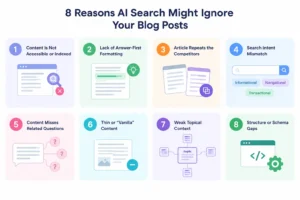
1. Your content is not accessible or indexed
If search systems cannot access your page, they may be unable to retrieve its content for an answer. Google requires pages to be indexed and eligible for search snippets to appear as supporting links in AI Overviews and AI Mode.
How to fix it:
- Check the page’s index status in Google Search Console using URL Inspection. Review crawl and indexing issues.
- Inspect your robots.txt, canonical tags, noindex directives, and server responses. For ChatGPT Search, check whether OAI-SearchBot can access relevant pages.
- Ensure important blog posts are linked from relevant, crawlable pages on your website.
Helpful tools: Google Search Console, URL Inspection, and your website’s robots.txt file.
2. Your content does not answer questions clearly
AI-friendly content makes the answer easy to find and understand. If readers must work through several paragraphs before reaching the main point, the page may be less useful for a specific question.
How to fix it:
- Answer the main question directly near the beginning of the relevant section.
- Use descriptive headings that tell readers what each section explains.
- Follow the direct answer with evidence, examples, qualifications, or steps that explain how the solution works.
Helpful tools: Hemingway Editor for readability checks and Google Docs for reviewing structure. These tools help improve clarity, but they cannot guarantee AI citations.
3. Your article offers nothing distinctive from competitors
If your article repeats the same advice as competing pages without adding useful evidence or perspective, it gives readers little reason to choose it. Google recommends creating valuable, unique content rather than commodity information.
How to fix it:
- Compare competing pages to identify missing explanations, examples, and unanswered questions.
- Add genuine first-hand observations, original analysis, expert commentary, or verified data where available.
- Replace generic claims with specific explanations that demonstrate how a recommendation works in practice.
Helpful tools: Ahrefs or Semrush for competitor research, alongside your own published content and verified business data. Use the findings to identify content gaps, not to copy competitors.
4. Your content does not match search intent
A blog post can cover the right keyword yet answer the wrong question. Someone searching for a practical solution expects actionable steps, while someone comparing options needs clear differences and trade-offs.
How to fix it:
- Review the search results and the questions people ask around your target query.
- Identify whether the reader wants an explanation, a tutorial, a comparison, or a solution to a specific problem.
- Restructure the article around that need, removing sections that distract from the main purpose.
Helpful tools: Google Search, Google Search Console, and keyword research tools such as Ahrefs or Semrush.
5. Your article misses important related questions
AI-generated answers can address several connected aspects of a topic. A blog post that answers only the headline question may not provide enough context for related queries.
How to fix it:
- Identify follow-up questions readers are likely to ask after the main question.
- Add relevant explanations where they naturally support the article’s purpose.
- Link to separate, detailed articles when a related topic deserves its own treatment.
Helpful tools: Google’s People Also Ask results, autocomplete suggestions, and AlsoAsked. Use these to discover relevant questions, not as a checklist for adding every possible subsection.
6. Your content is too thin or generic
Thin content provides little explanation beyond familiar advice. A useful article goes further by explaining why a recommendation matters, when to apply it, and what limitations readers should understand.
How to fix it:
- Replace vague advice with concrete steps and realistic examples.
- Support factual claims with credible sources and explain the context behind important statistics.
- Remove repetitive paragraphs and expand areas where readers genuinely need more detail.
Helpful tools: Google Search Central’s guidance on helpful content and generative AI and a manual editorial review.
7. Your website lacks strong topical context
A useful article can become harder to discover when the rest of the website provides little context about the subject. Related content and descriptive internal links help readers and search engines understand how pages connect.
How to fix it:
- Publish genuinely useful supporting articles around the broader topic.
- Add contextual internal links using descriptive anchor text.
- Keep important pages accessible through logical navigation and a clear site structure.
Helpful tools: Screaming Frog SEO Spider, Google Search Console, and an internal linking audit. A good internal linking strategy provides additional help to connect related pages.
8. Your technical SEO or structured data needs attention
Technical issues can prevent search systems from accessing or interpreting content properly. Structured data can clarify page information, but it is not a shortcut to AI visibility.
How to fix it:
- Check for broken pages, rendering problems, blocked resources, and incorrect canonical or indexing directives.
- Validate relevant structured data and ensure it accurately reflects the visible page content.
- Make important information available in readable text rather than relying entirely on images or interactive elements.
Helpful tools: Google Search Console, PageSpeed Insights, and Google’s Rich Results Test. Google confirms that no special schema markup is required for inclusion in AI Overviews or AI Mode.
How to Check Whether AI Search Is Citing Your Blog Posts
You can assess AI search visibility by testing relevant questions, recording which sources appear, and monitoring available search performance data. No single test proves that a page is consistently visible across AI platforms.
- Choose target questions. Select five to ten queries that your blog post should answer, including specific questions and relevant follow-ups.
- Test AI platforms. Search those queries in relevant experiences, such as ChatGPT Search, Google AI Mode, and Perplexity.
- Record the results. Track brand mentions, linked citations, cited URLs, and competing sources in a spreadsheet.
- Review performance data. Check Google Search Console’s available generative AI performance reporting and use analytics to examine relevant referral traffic.
- Repeat and compare. Retest periodically and look for patterns before deciding which pages need improvement.
Common AI Search Optimization Mistakes to Avoid
Avoid changes based on assumptions rather than evidence. The most useful improvements address a specific technical, relevance, or content-quality problem.
- Assuming Google rankings guarantee AI citations. Traditional rankings do not guarantee selection as a source in generated answers.
- Adding schema to every page. Use relevant structured data correctly, but do not expect it to guarantee AI visibility.
- Rewriting every blog post. Diagnose indexing, relevance, and content gaps before making major changes.
- Publishing more content without improving existing pages. Prioritize useful updates over unnecessary content volume.
- Trusting a single AI response. Responses and cited sources can change between queries and over time.
Focus on measurable improvements instead of chasing a formula that promises guaranteed citations.
Conclusion
AI search may overlook your blog posts because of technical barriers, unclear answers, weak differentiation, or incomplete topic coverage. Diagnose the underlying issue, make targeted improvements, and measure the results over time.
At Crawl Vision, we help businesses identify SEO issues, improve content quality, and strengthen their visibility across traditional search engines and AI-powered search platforms. Our approach focuses on finding what holds a website back and making practical, data-driven improvements that support long-term search visibility.