


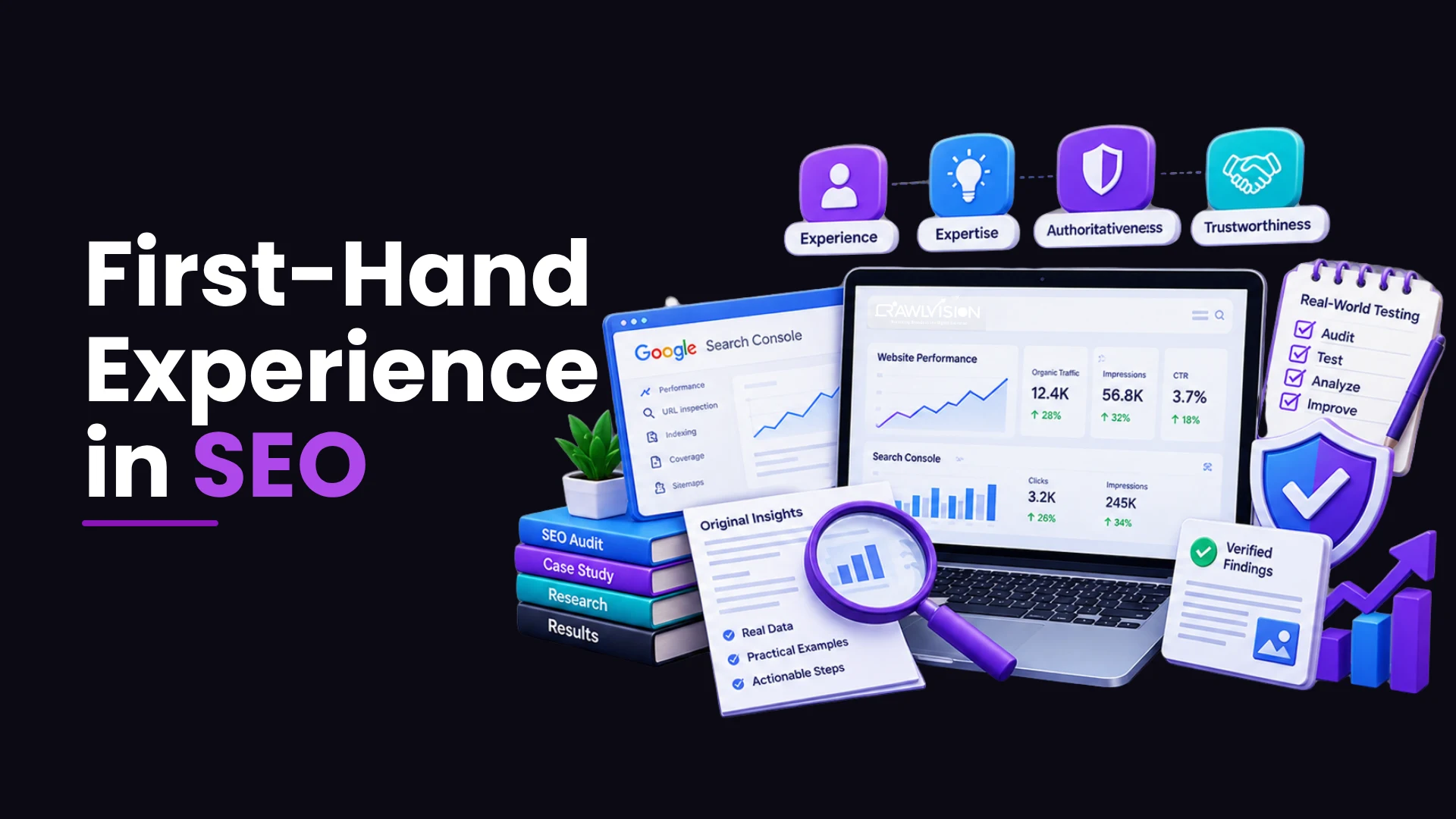
First-hand experience matters for SEO because it adds original insights, practical examples, and evidence that make content more useful and credible. It supports Google’s people-first content principles and helps differentiate pages from generic information available elsewhere.
Search engines can find thousands of pages explaining the same SEO concept. However, not every page offers something new. Many articles repeat familiar advice without showing how a strategy works in practice or what happens when someone implements it.
First-hand experience helps bridge that gap. Instead of simply explaining a process, content can demonstrate what someone learned by applying it, testing a tool, or solving a real problem.
As AI tools make generic explanations easier to produce, original observations and practical evidence can give content a clearer purpose.
What Does First-Hand Experience Mean in SEO?
First-hand experience in SEO means sharing knowledge gained through direct involvement with a subject, such as conducting a website audit, implementing a strategy, testing a tool, or analyzing campaign results.
For example, an article about technical SEO might list common indexing problems and explain their solutions. An experience-based article could also show how an indexing issue was discovered, which checks helped identify its cause, and what happened after the fix.
The difference is the depth of practical insight.
First-hand experience does not mean every article needs a personal story. It means that when practical experience is relevant, the content should reflect genuine involvement rather than relying entirely on information collected from other sources.
Why Does First-Hand Experience Matter for SEO?
First-hand experience helps make content more original, credible, and useful to readers. It also aligns with Google’s emphasis on helpful, reliable, people-first content. However, experience alone does not guarantee higher rankings.
1. Adds original insights beyond basic information
Readers can find basic definitions and standard recommendations across many websites. First-hand experience adds value by explaining details that generic explanations often miss.
Consider a guide about keyword research.
- A basic article might recommend choosing relevant keywords with reasonable search volume and manageable competition.
- An experience-based explanation could show how examining search intent changed the keyword priorities for a particular project.
These practical observations help readers understand not just what to do, but why a decision makes sense in a particular situation.
Original insight content do not always require large research projects. They can come from documented observations, real testing, comparisons, and lessons learned while completing everyday work.
2. Demonstrates Google’s e-e-a-t principles
Google uses the E-E-A-T framework to describe Experience, Expertise, Authoritativeness, and Trustworthiness. First-hand experience relates directly to the Experience component because it can demonstrate practical knowledge of a subject.
For example, a product review becomes more useful when the writer explains how the product was tested, what the testing revealed, and which limitations appeared during use.
Google’s explanation of E-E-A-T makes an important distinction: E-E-A-T is not a specific ranking factor. Instead, Google’s systems use various signals to identify helpful, reliable content. Demonstrating experience can contribute to content quality, but it does not automatically improve rankings.
3. Builds credibility through authentic evidence
Specific evidence helps readers assess whether an explanation is grounded in actual work. Depending on the topic, that evidence might include screenshots, original data, testing methods, documented observations, or relevant project examples.
For instance, an article discussing organic search performance can explain how Google Search Console was used to identify pages receiving impressions but relatively few clicks. A genuine screenshot, with sensitive information removed, can support the explanation.
Evidence should support the claim being made. A screenshot without context or a statistic without a reliable source does little to establish credibility.
4. Helps content stand out in the age of AI
AI tools can produce explanations, summaries, and outlines quickly. As a result, publishing another general explanation of an established topic may offer limited additional value.
Google’s guidance on generative AI content specifically encourages publishers to create unique, valuable content. It identifies first-hand reviews as an example of content that can provide a distinct perspective compared with summaries of existing information.
For SEO content, this could mean sharing the findings of an actual audit, explaining a testing method, or documenting how a recommendation performed under specific conditions.
The goal is not to compete with AI by avoiding it altogether. It is to ensure that the finished content contributes something useful that is grounded in genuine knowledge or evidence.
5. Makes content more useful and actionable
Experience helps readers understand how to apply advice in real situations. It can reveal the order in which tasks should be completed, common obstacles, and circumstances that might change the recommended approach.
For example, an article about improving website indexing becomes more actionable when it explains how to inspect indexing reports, investigate affected URLs, and verify whether the underlying issue has been resolved.
This practical detail helps readers move from understanding a concept to making an informed decision.
How to Demonstrate First-Hand Experience in Your Content
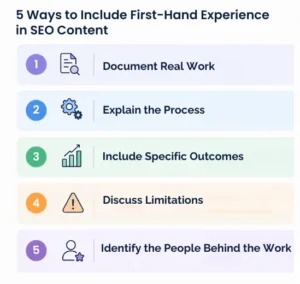
You can demonstrate first-hand experience by documenting real work, explaining your methods, supporting claims with evidence, acknowledging limitations, and identifying the people responsible for the content. Apply the following five practices when creating or updating articles.
-
Document real work
Use relevant findings from actual projects, research, experiments, or implementations. These details help distinguish your content from articles that only summarize common recommendations.
Example: “During a technical SEO audit, we found that several important pages were not indexed because incorrect robots.txt rules blocked crawling.”
-
ExplAIn the process
Describe how you reached a conclusion, not just the final recommendation. Explain the tools, checks, or methods involved so readers can understand how the finding was reached.
Example: “We checked Google Search Console’s indexing report, inspected the affected URLs, and reviewed robots.txt to identify why Google could not crawl those pages.”
-
Include specific outcomes
Use reliable measurements when they help readers understand the impact of a change. Explain the timeframe, starting conditions, and relevant limitations so the results are not presented without context.
Example: “After correcting the indexing issues, we monitored the affected URLs in Google Search Console to track changes in indexing status. ”
-
Discuss limitations
Explain what did not work, what remains uncertain, and when a recommendation might not apply. Honest limitations help readers understand the conditions behind your advice.
Example: “Fixing indexing issues can help search engines access pages, but it does not guarantee higher rankings or increased organic traffic.”
-
Identify the people behind the work
Provide accurate author information and relevant professional experience. When a page includes research or testing, explain who conducted the work and how the findings were obtained.
Example: “Article is written by Sagar Rauthan, Founder & CEO of Crawl Vision, with expertise in SEO, AI search visibility, and organic growth strategies.”
How to Audit Your Content for First-Hand Experience
Audit existing content to identify where genuine experience, supporting evidence, or practical details could make them more useful. Review each page against the following questions before deciding what needs improvement.
| Audit question | What to check |
| Does the content offer original insights? | Look for observations or analysis beyond commonly available advice. |
| Are practical examples included? | Check for genuine projects, testing, or documented scenarios. |
| Are important claims supported? | Look for reliable sources, evidence, and clear methodology. |
| Is relevant experience demonstrated? | Review accurate author information and evidence of practical involvement. |
| Are limitations acknowledged? | Check whether the content explains exceptions and relevant constraints. |
| Does the page offer distinctive value? | Assess whether it adds something useful beyond competing content. |
Prioritize pages where additional experience would meaningfully improve the answer. You do not need to add screenshots or personal anecdotes to every article. Focus on making the content more accurate, useful, and relevant to its purpose.
Conclusion
First-hand experience can strengthen SEO content by adding original insights, credible evidence, and practical guidance. It also supports Google’s emphasis on helpful, reliable, people-first content, although it does not guarantee higher rankings.
Start by reviewing your existing articles. Identify generic explanations that could benefit from genuine examples, documented findings, or clearer explanations of how a recommendation works. Then update those sections with evidence you can verify.
At Crawl Vision, an experience-led approach to SEO content means going beyond standard recommendations and focusing on useful analysis, practical findings, and evidence-backed explanations. The objective is to give readers a clear reason to trust the information and apply it.