


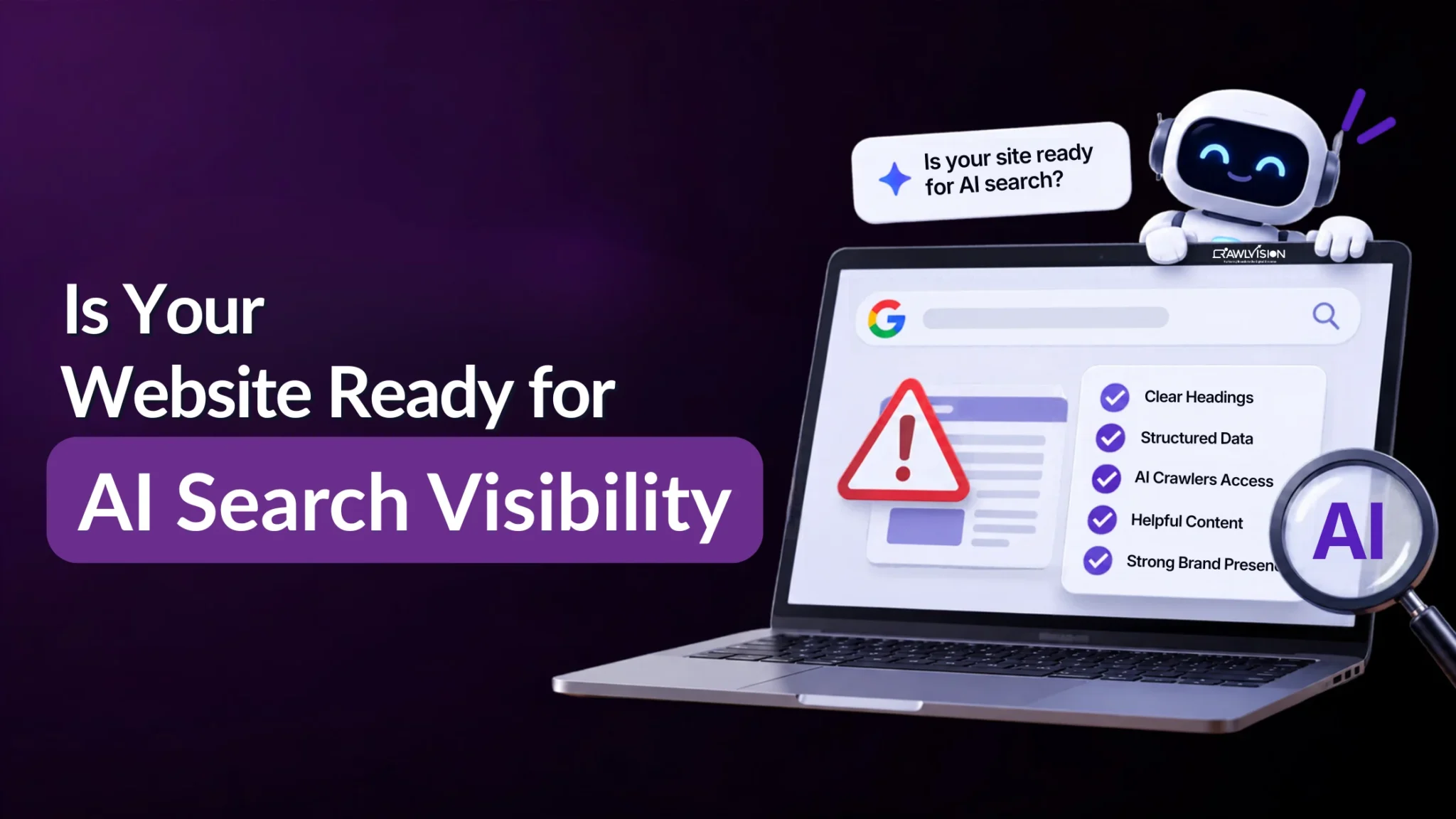
Your website may not be ready for AI search if AI crawlers cannot access its pages, content lacks clear answers, structured data is inaccurate, or your brand has weak authority and inconsistent information.
AI search optimization goes beyond traditional Google rankings. Your website needs to be technically accessible, provide useful & well-structured content, and establish a consistent brand presence.
Addressing these gaps can help AI-powered search platforms understand your business and improve its chances of appearing in relevant AI-generated answers.
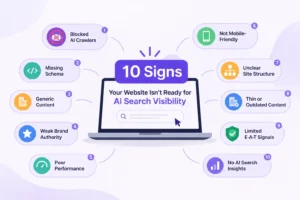
10 Signs Your Website Isn’t Ready for AI Search
A website can have good rankings and still struggle to appear in AI-generated answers. The following signs can help you identify whether technical, content, or brand-related issues are limiting your AI search visibility.
1. Headings are vague and don’t match search intent
Sign: Your page headings sound creative but don’t clearly explain what the section covers. For example, headings such as “Our Approach to Growth” or “The Bigger Picture” provide little context about the information underneath them.
AI search optimization starts with making information easy to understand. Descriptive headings help readers navigate a page and give search systems clearer context about its content.
How to fix this:
- Use headings that describe the actual subject of each section.
- Match headings to the questions and problems your target audience searches for.
- Keep each section focused on one main idea instead of combining unrelated topics.
Bad Heading: “A Better Way Forward”
Good Heading: “How Does Technical SEO Improve Website Crawlability?”
The second heading immediately communicates what the reader will learn.
2. Structured data (schema markup) is missing or incorrect
Sign: Your website contains incomplete, outdated, or incorrect structured data, or its schema describes information that visitors cannot actually see on the page.
The schema markup uses standardized vocabulary to describe page elements, such as articles, products, organizations, and local businesses. It can help search engines interpret your content, but it does not guarantee AI citations or better rankings.
How to fix this:
- Identify relevant schema types for your website, such as Organization, Article, Product, or LocalBusiness.
- Make sure structured data accurately reflects the visible information on each page.
- Validate your implementation using Google’s Rich Results Test or Schema Markup Validator.
Expert Tip: Don’t add schema just to make your website appear more AI-friendly. Accurate markup that describes real page content is more useful than unnecessary structured data.
3. Ai search crawlers are blocked in your robots.txt
Sign: Your robots.txt file or website security settings prevent relevant AI search crawlers from accessing important pages.
For example, OpenAI uses OAI-SearchBot to discover websites for ChatGPT search. Blocking it can prevent your pages from appearing in ChatGPT search answers. However, OAI-SearchBot and GPTBot serve different purposes, so blocking one does not automatically mean blocking the other.
How to check:
- Visit “yourdomain.com/robots.txt” and review its crawling rules.
- Look for restrictions affecting AI crawlers, including OAI-SearchBot.
- Review CDN, firewall, and hosting security settings for blocked crawler requests.
How to fix this:
- Allow the relevant search crawlers if you want your content to be discoverable through those platforms.
- Review firewall and bot protection rules that might block legitimate crawler requests.
- Test important pages and monitor server logs for access errors.
4. Content ignores the obvious follow-up questions
Sign: Your page answers the main question but leaves readers without the additional information they need to understand or act on the answer.
For example, an article explaining technical SEO might define crawlability without explaining how to check blocked pages or fix crawling problems.
AI search experiences often address related questions within a single response. Content that provides useful context, explanations, and practical details can serve these information needs more effectively.
How to fix this:
- Identify related questions using customer conversations, search suggestions, and keyword research.
- Cover relevant follow-up questions within the appropriate sections.
- Include practical examples, limitations, and next steps instead of adding unnecessary paragraphs.
Bad Example: “Keyword research helps websites find relevant keywords.”
Good Example: “Keyword research identifies the terms your audience uses, helping you choose relevant topics, understand search intent, and create content that addresses their needs.”
5. Brand cannot be explAIned in one sentence
Sign: Your homepage, About page, and service pages describe your business differently, making it difficult to understand what you actually offer.
A brand needs a clear identity. If visitors cannot quickly understand what your company does, who it serves, and what makes its offering relevant, your website is missing important context.
How to fix this:
- Write a clear one-sentence description explaining what your business offers and whom it serves.
- Use consistent business descriptions across your homepage, About page, and important service pages.
- Clearly explain your products, services, industry, and areas of specialization.
Bad Example: “We deliver innovative solutions that transform business growth.”
Good Example: “We help SaaS and eCommerce businesses improve organic visibility through technical SEO, content marketing, and AI search optimization.”
6. Website content sounds too generic
Sign: Your articles repeat commonly available information without providing original examples, research, practical observations, or meaningful insights.
AI tools can generate basic explanations of almost any topic. Publishing another article that says the same thing as dozens of competing pages gives readers little reason to choose your content.
How to fix this:
- Include original research, real examples, and observations from relevant projects.
- Explain why a recommendation works and where it might not apply.
- Replace generic explanations with practical advice that reflects genuine industry knowledge.
Expert Tip: Review your existing content and ask: Could a competitor publish this exact article without changing anything? If the answer is yes, look for opportunities to add something distinctive.
7. Missing authoritative third-party mentions
Sign: Your brand has very little recognition outside its own website. There are few relevant industry mentions, editorial references, expert contributions, or credible reviews that help establish its reputation.
Your website is only one source of information about your business. Relevant external references can provide additional context about your brand and its expertise.
How to fix this:
- Contribute useful insights to respected industry publications and relevant websites.
- Participate in industry discussions, interviews, podcasts, and expert roundups.
- Build relationships that lead to genuine editorial mentions and relevant backlinks.
Where to Get Third-Party Mentions: Look for industry publications, professional associations, relevant podcasts, trusted review platforms, and websites that your target audience already follows. Prioritize relevance and credibility over the number of mentions.
8. Brand information is inconsistent across the web
Sign: Your website, social profiles, business listings, and third-party directories contain conflicting descriptions, outdated services, or different business details.
For example, your website might describe your company as an AI marketing agency, while older profiles still present it as a general digital marketing company. Such inconsistencies can make it harder for people and search systems to establish a clear picture of your brand.
How to fix this:
- Audit your website, social media profiles, business listings, and important directory entries.
- Update outdated descriptions, service information, contact details, and business names.
- Maintain consistent messaging whenever your company changes its positioning or offerings.
Bad Example: Your website describes you as a SaaS SEO agency, but LinkedIn calls it a general web development company.
Good Example: Your website, LinkedIn profile, and relevant business listings provide consistent and accurate information about your brand.
9. Website pages lack conversational structure
Sign: Your content uses long, complicated sentences, unexplained terminology, and poorly connected sections. Readers have to work harder to understand the main point.
AI-friendly content doesn’t mean turning every heading into a question or writing every paragraph in a conversational tone. It means presenting information clearly, logically, and in a format that readers can follow.
How to fix this:
- Use descriptive headings and organize related information into logical sections.
- Explain technical terms before using them extensively.
- Use concise paragraphs, meaningful lists, and examples wherever they improve understanding.
For example, instead of hiding all your service details in one lengthy paragraph, explain each service under a separate heading with its purpose and practical benefits.
10. Brand is missing from relevant AI answers
Sign: Your website contains relevant information, but your brand rarely appears when potential customers ask AI platforms questions related to your products, services, or industry.
For example, if someone asks ChatGPT to recommend SEO agencies, your competitors appear while your brand is missing.
This doesn’t automatically mean your website has a technical problem. Your competitors may have stronger topical relevance, more useful content, or greater recognition across external sources.
How to check:
- Identify 10-15 questions your potential customers might ask AI platforms.
- Test those questions across ChatGPT, Google AI Mode, and Perplexity.
- Record whether your brand appears, which competitors are mentioned, and which websites are cited.
How to fix this:
- Create useful content addressing the questions and problems your audience actually searches for.
- Strengthen your website’s expertise and build relevant recognition beyond your domain.
- Review missing topics and competitor citations to identify opportunities for improvement.
Repeat these checks periodically. AI-generated answers can change depending on the query, platform, and available information.
How to Check If Your Website Is Ready for AI Search
You can evaluate your website’s AI search readiness through a simple audit covering technical accessibility, content quality, brand clarity, and visibility. Use this checklist to identify the areas that need attention.
| Area | What to Check |
| Headings | Do headings clearly describe each section? |
| Structured data | Is schema accurate and relevant to visible content? |
| Crawler access | Can relevant AI search crawlers access important pages? |
| Content coverage | Does content answer related questions? |
| Brand identity | Can visitors understand what your business offers? |
| Content quality | Does your website provide original information? |
| External authority | Does your brand receive relevant third-party mentions? |
| Brand consistency | Are business descriptions and details consistent? |
| Content structure | Is information organized and easy to understand? |
| AI visibility | Does your brand appear in relevant AI-generated answers? |
Start with issues that prevent access to important information. Then prioritize content and brand improvements based on their potential impact.
How to Make Your Website AI Search Ready
Improving AI search readiness requires more than adding schema or changing your headings. Focus on five practical areas to make your website easier to discover, understand, and trust.
- Fix technical accessibility: Review robots.txt, server responses, firewall rules, and page rendering. Make sure relevant search crawlers can access the information you want to make discoverable.
- Improve content quality and structure: Use descriptive headings, answer relevant questions, organize information logically, and add original insights that make your content more useful than generic alternatives.
- Strengthen brand identity: Clearly explain your business, services, audience, and expertise. Keep important brand information consistent across your website and external profiles.
- Build relevant brand authority: Earn credible brand mentions, publish expert contributions, and develop useful relationships with websites and publications in your industry.
- Monitor AI search visibility: Regularly test customer queries across AI platforms, review brand mentions and citations, and use the findings to identify content and visibility gaps.
Google’s official guidance on generative AI features reinforces the importance of technical SEO fundamentals and unique, helpful content rather than relying on special GEO tricks.
Conclusion
AI search readiness is not about adding a few technical elements or rewriting every page to sound conversational. It is about making your website accessible, your content useful, and your brand easy to understand and recognize.
Start by identifying the biggest gaps in your website. Fix technical accessibility issues first, improve content that lacks original value, and build a consistent brand presence across relevant platforms. Regularly reviewing these areas can help your business strengthen its visibility as search experiences continue to evolve.
At Crawl Vision, we approach AI search optimization by bringing together technical SEO, useful content, and brand authority to help businesses build a stronger presence across traditional and AI-powered search.