


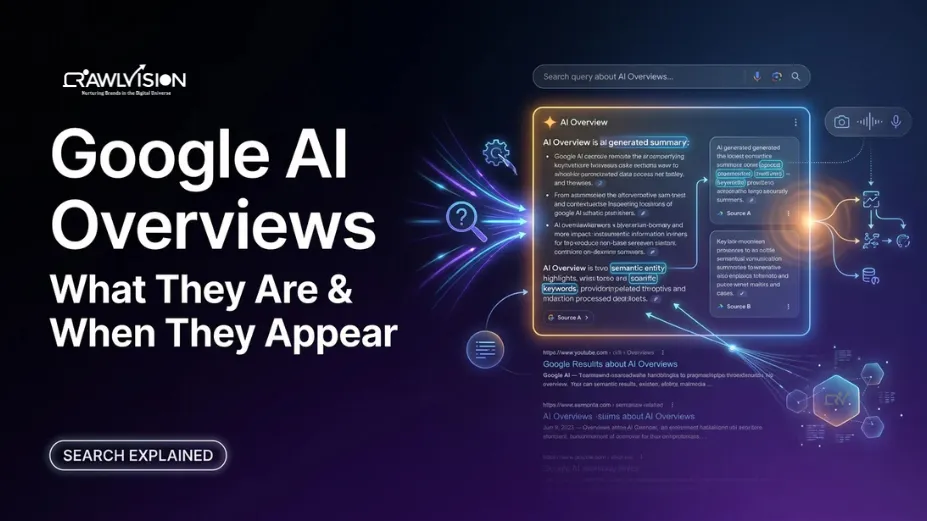
If you’ve searched for anything on Google recently, chances are you’ve already seen those AI-generated summaries that appear right at the top of search results, above all the blue links you’ve spent years trying to rank for. These are called Google AI Overviews, and they’re reshaping how people discover information online. Whether you’re a casual searcher, a business owner, or a digital marketer, understanding what Google AI Overviews are and when they appear is no longer optional; it’s essential.
In this blog, we’re going to break down everything you need to know about Google AI Overviews in plain English. We’ll explore how they work, why Google introduced them, what triggers them, and most importantly, how they affect your website’s organic visibility and what you can do about it.
What are Google AI overviews?
Google AI Overviews (formerly known as Search Generative Experience or SGE during its testing phase) are AI-generated summaries that Google displays at the very top of its search engine results pages (SERPs). These overviews use Google’s large language model powered by Gemini AI to synthesise information from multiple sources across the web and deliver a direct, concise answer to the user’s query.
Instead of simply listing ten blue links and leaving users to click through and find answers themselves, Google AI Overviews attempt to answer the question right there on the SERP. The goal, according to Google, is to make search faster, more helpful, and more conversational.
Think of it this way: if you ask Google “how do I treat a sunburn at home,” an AI Overview might instantly list the top steps, cool water, aloe vera, and hydration without you needing to click a single link. That’s convenient for the user, but it introduces new challenges for websites and SEO professionals who rely on organic traffic.
A brief history: from sge to AI overviews
Google’s journey into AI-powered search isn’t new. The company first introduced the Search Generative Experience (SGE) at Google I/O in May 2023, initially as an experimental feature within Google Search Labs. Users had to opt in to see it. The feedback was mixed; some loved the instant answers, while SEO professionals worried about the impact on organic click-through rates.
By May 2024, Google made a major move: it rebranded SGE to Google AI Overviews and began rolling it out to all U.S. users without requiring opt-in. The feature has since expanded globally, including in India, the UK, Japan, and other markets. If you’re reading this in 2025, AI Overviews are now a permanent, default feature of the Google Search experience.
How do Google AI overviews work?
Understanding the mechanics behind Google AI Overviews helps demystify why they appear for some queries and not others. At their core, AI Overviews are powered by Google’s Gemini AI model, deeply integrated into Google’s search system.
When you type a query, Google’s system doesn’t just match your words to web pages anymore. It also evaluates whether the query is complex, conversational, or multi-step enough to benefit from an AI-generated summary. If it qualifies, the system:
- Understands the intent behind your query using natural language processing (NLP)
- Retrieves relevant web content from multiple authoritative sources
- Synthesizes this information into a concise, structured answer
- Cites sources by showing links to the pages it pulled information from
- Displays the result at the top of the SERP, above paid ads and organic results
The AI does not simply copy and paste text. It paraphrases, reorganises, and contextualises the information to match the user’s specific question. The cited sources shown alongside the AI Overview are the websites Google deemed most helpful and authoritative for that query, and this is where a new SEO opportunity lies, which we’ll discuss later.
The role of e-e-a-t in AI overviews
Google’s content quality framework, E-E-A-T (Experience, Expertise, Authoritativeness, and Trustworthiness), plays a significant role in determining which sources are featured in AI Overviews. Content that clearly demonstrates first-hand experience, expert knowledge, and high credibility is more likely to be cited.
This means that AI Overviews are not entirely random; they tend to favour well-structured, factually accurate, and authoritative content. Sites with strong domain authority, clear authorship, and proper structured data markup tend to appear more frequently as cited sources within Google AI Overviews.
When do Google AI overviews appear?
This is arguably the most practical question for anyone managing a website or running an SEO strategy: when exactly do Google AI Overviews appear? The truth is, Google hasn’t published a definitive rulebook, but patterns have emerged from extensive observation.
1. Informational and educational queries
AI Overviews appear most frequently for informational search queries questions where the user is looking to learn or understand something. These are queries that typically begin with words like “how,” “what,” “why,” “when,” or “which.”
Examples of queries likely to trigger an AI Overview:
- “How does photosynthesis work?”
- “What is a 401 (k) retirement plan?”
- “Why is the sky blue?”
- “When should I plant tomatoes?”
These queries have clear, factual answers that the AI can compile from multiple sources. They don’t require opinion, personal advice, or real-time data, which is why they’re perfect candidates for an AI-generated summary.
2. Complex, multi-step questions
Google’s AI Overview also tends to show up for queries that are multi-dimensional questions that would typically require reading through multiple articles to get a complete picture. For example:
- “How to start a small business in India step by step”
- “What are the pros and cons of solar energy?”
- “How to prepare for a job interview as a fresher?”
In these cases, the AI Overview synthesizes a structured, multi-point answer so the user doesn’t need to piece it together from five different blog posts.
3. Definition and comparison queries
Queries asking for definitions (“What is machine learning?”) or comparisons (“SEO vs SEM: what’s the difference?“) are common triggers for Google AI Overviews. These are queries where the AI can clearly delineate and explain concepts in a structured format.
4. Health, nutrition, and wellness questions
Medical and health-related informational queries are heavily represented in AI Overview results, thinking “symptoms of vitamin D deficiency” or “what to eat for better gut health.” However, Google is cautious here due to the YMYL (Your Money or Your Life) guidelines, so medical AI Overviews tend to include disclaimers and cite established medical sources.
When Google AI overviews do not appear
It’s equally important to understand when Google AI Overviews are typically absent. Based on observed patterns:
- Navigational queries: When a user is searching for a specific website (e.g., “Facebook login” or “Amazon India”), Google understands the intent is to go somewhere, not learn something.
- Breaking news and real-time events: AI Overviews generally avoid live or rapidly changing situations where accuracy cannot be guaranteed.
- Highly controversial topics: Politically sensitive, opinion-heavy, or deeply contested topics are often excluded.
- Transactional queries: Searches like “buy Nike shoes online” or “book a flight to Delhi” are commercial in nature; Google displays Shopping ads and organic results instead.
- Adult content: Restricted or sensitive queries do not trigger AI Overviews.
How Google AI overviews are changing SEO
The rise of Google AI Overviews has sent ripples across the SEO industry. Early data and case studies suggest that for informational queries where AI Overviews appear, organic click-through rates (CTR) can drop, sometimes significantly. But the picture is more nuanced than just “AI Overviews are bad for SEO.”
Impact on organic click-through rates
Several SEO studies have noted that AI Overviews can reduce clicks to websites for informational queries because users get their answer directly on the SERP. However, the effect varies by query type, industry, and how well the overview actually answers the question.
Interestingly, when a user finds an AI Overview inadequate or wants to explore further, they may click on the cited sources, which means being featured as a cited source within an AI Overview can actually drive qualified, high-intent traffic. It’s a new form of visibility that SEO professionals are learning to optimize for.
The concept of aeo: answer engine optimization
A new discipline has emerged alongside AI Overviews: AEO, or Answer Engine Optimization. While traditional SEO focuses on ranking in the ten blue links, AEO focuses on structuring your content in a way that positions it as a credible, citable answer source for AI-driven systems like Google AI Overviews, ChatGPT, Perplexity, and Bing Copilot.
AEO strategies include writing in clear question-and-answer formats, using structured data markup (schema), building topical authority through content clusters, and ensuring your website demonstrates E-E-A-T signals at every level.
Similarly, GEO Generative Engine Optimization refers to the broader practice of optimizing content to be cited and featured by generative AI search engines. As AI-powered search becomes the norm, GEO is rapidly becoming as important as traditional SEO.
How to optimize your content for Google AI overviews
Now that you understand what Google AI Overviews are and when they appear, the logical next question is: how do you get your content featured in them? Here are the proven strategies that are making a difference:
1. Write content that directly answers questions
The most fundamental optimization for Google AI Overviews is writing content that clearly, concisely, and directly answers the questions your audience is asking. Use the “inverted pyramid” approach: lead with the most important answer, then provide supporting detail. Don’t bury your answer in the fifth paragraph.
Use actual question-based subheadings within your content (H2S and H3S phrased as questions). Google’s AI is very good at identifying content that follows a Q&A structure, and it tends to pull from these sections.
2. Use structured data and schema markup
Implementing schema markup, particularly FAQ Schema, How To Schema, and Article Schema, signals to Google exactly what type of content you have and how it should be interpreted. While schema alone doesn’t guarantee an AI Overview citation, it significantly improves your content’s machine-readability, which is exactly what AI systems need.
For a detailed guide on implementing structured data, you can refer to Google’s official Structured Data documentation.
3. Build topical authority
Google’s AI doesn’t cherry-pick individual articles in isolation. It looks at websites that demonstrate topical authority, meaning websites that have extensively covered a subject from multiple angles. If your website has 50 high-quality articles about digital marketing, Google is more likely to trust your content on that topic than a website with one.
Build content clusters: a comprehensive pillar page on a broad topic supported by detailed sub-topic pages. This structure signals depth and authority to both traditional SEO algorithms and AI-based systems.
4. Strengthen e-e-a-t signals
To get cited by Google AI Overviews, your website must be seen as trustworthy and authoritative. Practical steps to improve E-E-A-T include:
- Author bios with credentials and professional background
- Citing reputable external sources within your content
- Regular content updates to ensure accuracy
- Building high-quality backlinks from authoritative domains
- Displaying clear website policies (About, Privacy, Contact pages)
5. Optimize for featured snippets first
There’s a strong correlation between content that earns featured snippets and content that gets cited in Google AI Overviews. Both reward content that is well-structured, concise, and directly answers a query. If you’ve been optimizing for featured snippets, you’re already on the right track for AI Overviews.
You can learn more about Google Search features and how content is selected on the Google Search Central Blog.
6. Focus on technical SEO fundamentals
None of the above strategies will matter if your website has serious technical SEO issues. Ensure your site loads fast, is mobile-responsive, uses HTTPS, has a clean crawlable architecture, and has properly submitted XML sitemaps. Core Web Vitals continue to be a ranking signal that indirectly affects how Google perceives your site’s quality.
Use the Google Search Console to monitor your website’s technical health and identify issues that might prevent Google from properly indexing and understanding your content.
Common misconceptions about Google AI overviews
“Ai overviews will kill SEO”
This is an overreaction. SEO is evolving, not dying. Yes, traffic patterns are shifting, and informational queries are becoming harder to capture through traditional organic rankings alone. But transactional and navigational queries, which represent enormous commercial value, are largely unaffected. The focus of SEO is expanding, not disappearing.
“Only big brands get featured”
While domain authority plays a role, Google’s AI Overviews have been observed citing niche blogs, independent experts, and smaller websites as long as their content is highly relevant, well-structured, and authoritative on the specific topic. Quality content from credible, smaller sites absolutely gets featured.
“Ai overviews are always accurate”
Not always. Google AI Overviews have faced criticism and even public embarrassment for producing factually incorrect or misleading answers (sometimes humorously so). Google has been working to improve accuracy, but AI hallucination is still a known limitation. This is precisely why Google cites sources: to let users verify the information independently.
The future of Google AI overviews
Google’s investment in AI-powered search is not slowing down. With competitors like Perplexity AI, Bing Copilot, and ChatGPT search putting pressure on Google’s dominance, expect Google AI Overviews to become more sophisticated, more personalised, and more deeply integrated into the search experience.
We’re also likely to see AI Overviews expand into more query types over time, including some commercial and local queries where they currently don’t appear. Businesses with strong local SEO and well-optimized Google Business Profiles may find new opportunities to surface within AI-generated local content summaries.
Multimodal AI, which understands and generates text, images, and video, will also expand what AI Overviews look like. We may soon see AI summaries that include embedded images, comparison tables, or even short video clips pulled from relevant sources.
For businesses and marketers, the message is clear: adapt your content strategy now. Waiting until Google AI Overviews have fully matured before adjusting your SEO approach will leave you playing catch-up in a rapidly shifting landscape.

