


To find search intent for any keyword, study the query, analyse the current Google SERP, review top-ranking pages, identify the dominant intent, and check SERP features. The goal is to understand what users expect and create a page that matches that expectation.
What Is Search Intent in SEO?
Search intent is the reason behind a search query and the result a user expects to find. Understanding intent helps you choose the right page type, format, and information.
The 4 main categories:
- Informational: The user wants to learn, understand a topic, or find an answer.
- Navigational: The user wants to reach a particular website, brand, or page.
- Commercial: The user is researching options, comparing products or services, or moving toward a purchase decision.
- Transactional: The user is ready to take an action, such as buying, signing up, or booking.
| Intent | What the user wants | Example |
| Informational | Learn or solve a problem | How to find search intent |
| Navigational | Find a specific site or page | Crawl Vision |
| Commercial | Compare options | Best SEO tools |
| Transactional | Take an action | SEO audit service |
These categories are useful starting points, but they are not rigid labels. A keyword can have mixed search intent, so the live SERP is often the clearest evidence.
How to Find Search Intent for Any Keyword: Step-by-Step
Find search intent by combining keyword clues with SERP analysis, then validate your assumptions against current results.
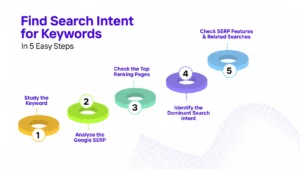
1. Study the keyword first
Before creating content, look closely at the keyword wording. Modifiers can provide an initial clue about search intent.
Words such as:
- “what,” “why,” “how,” and “guide” often indicate informational searches.
- “best,” “vs,” “review,” and “alternatives” often suggest commercial research.
- “buy,” “pricing,” “discount,” or “book” can indicate transactional intent.
Modifiers are clues, not proof. A keyword containing “best” might produce product pages, comparison guides, or mixed results, so validate the classification against the SERP.
2. Analyse the Google serp
Search the exact keyword on Google and study the current results to understand what type of content Google is prioritizing for that query.
Look at page types, titles, formats, and recurring topics. Ask whether results are mostly guides, comparisons, product pages, category pages, services, or videos.
Search intent is not determined by the keyword alone. It is reflected in what users are shown.
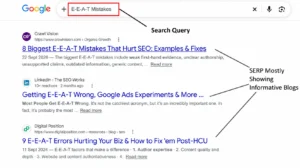 Image: Google SERP showing the results for the “E-E-A-T mistakes” query.
3. Check the top ranking pages
Open several top-ranking pages and compare them instead of relying only on the first result.
Check:
- Content type, such as blog, landing page, product page, or category page
- Content format, such as how-to guide, list, comparison, or review
- Main angle and questions answered
- Topics and subtopics covered
- Calls to action and conversion elements
If most pages solve the same problem in a similar format, that pattern is a strong intent signal.
4. Identify the dominant search intent
Decide which intent dominates. If most results are educational guides, the keyword is primarily informational.
Do not force a keyword into one category when the results show overlap. A query such as “best SEO tools” can have informational and commercial elements because users want to learn about available tools while comparing options.
The practical question is: what does a useful result need to help the searcher accomplish?
5. Check serp features and related searches
SERP features can reveal needs that the keyword itself does not make obvious.
Look for:
- People Also Ask
- Featured snippets
- Image or video results
- Local results
- Shopping features
- Related searches
These features can show whether users want quick answers, visual explanations, local options, product information, or follow-up answers.
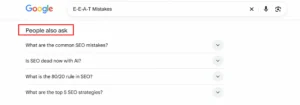 Image: Google SERP showing the People Also Ask section for the “E-E-A-T mistakes” query.
At Crawl Vision, we use this process to determine a keyword’s search intent. After working across 500+ client projects, we’ve found that combining keyword signals with live SERP analysis provides a reliable basis for deciding what type of content a query actually requires.
How to Find Search Intent Using SEO Tools
SEO tools can speed up intent analysis, but they should support, not replace, manual SERP review.
Ahrefs
Ahrefs Keywords Explorer lets you filter keywords by common intent categories, including informational, navigational, commercial, and transactional. Ahrefs also notes that intent is based on SERP data and that some keywords can carry multiple intents.
Use Ahrefs to narrow a keyword list, then inspect the SERP before deciding what page to create.
 Image: Ahrefs showing search intent for the keyword “airbnb”.
Semrush
Semrush assigns keyword intent using signals such as SERP features, words within the query, and whether the keyword is branded. Its Keyword Overview and Keyword Magic Tool can help identify intent during keyword research.
Use the tool to identify likely intent, then use Google to validate it.
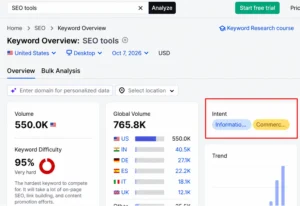 Image: Semrush showing search intent for the keyword “SEO tools”
Note: A keyword can also have more than one search intent. For example, people searching for SEO tools may want to learn about their options while also comparing tools.
Search Intent Examples
The difference becomes clearer when you connect each keyword to the page a searcher expects.
| Keyword | Intent | How to Target |
| what is search intent | Informational | Educational guide |
| best SEO tools | Commercial | Comparison/list |
| Crawl Vision | Navigational | Brand page |
| SEO audit service | Transactional | Service page |
Note: Search intent can be mixed. Treat the dominant SERP pattern as your main signal, but account for secondary intent when it clearly appears across ranking results.
Common Search Intent Mistakes to Avoid
Most search intent mistakes come from assumptions rather than SERP evidence:
- Assuming intent from the keyword modifier alone: Modifiers provide clues, but Google’s results provide stronger evidence.
- Looking only at the #1 result: One page may be an outlier. Compare several top-ranking results to identify the broader pattern.
- Ignoring SERP features: Features can reveal questions, formats, and needs that organic listings may not show.
- Confusing commercial and informational intent: A user can research options without being ready to buy.
- Creating a blog post when Google prefers a landing page: If service or product pages dominate the SERP, a generic article may not match the expected format.
- Ignoring mixed intent: Some keywords serve more than one need, so address the primary intent while supporting the secondary one.
- Not reassessing intent when the SERP changes: Search results evolve. Recheck intent when rankings shift significantly or when you update an important page.
Google recommends people-first content that helps visitors accomplish their goals rather than content created primarily to attract search traffic.
Conclusion
Finding search intent is less about guessing and more about observing what searchers are being served. Study the SERP, compare ranking pages, identify dominant intent, and use SERP features to refine it.
Intent should influence your page type, format, angle, and information. When content matches the underlying need, it becomes more useful to people and easier for search systems to understand.