


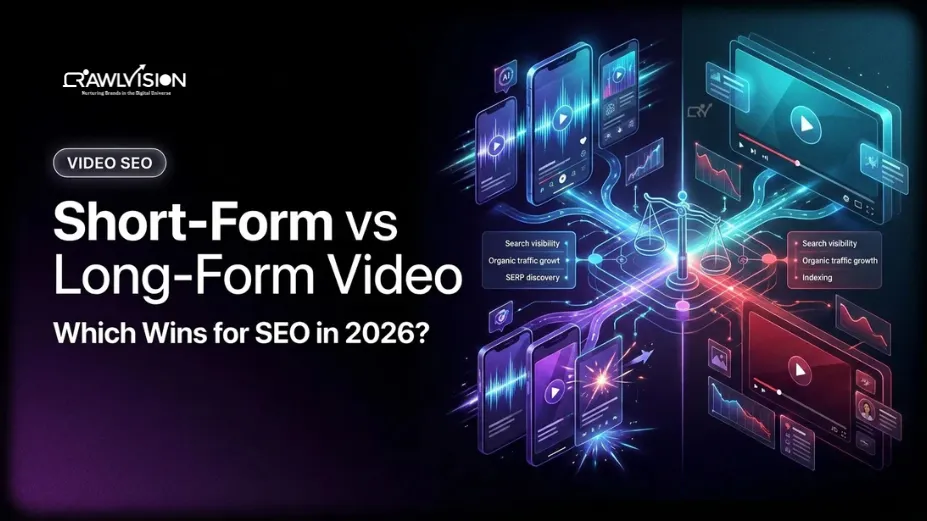
The format war that defines video SEO in 2026
Every video marketer in 2026 faces the same question: Should I invest in short-form video or long-form video for maximum SEO impact? The answer is not as simple as it was in 2022. The YouTube algorithm, Google Search integration, and AI-powered discovery engines have fundamentally changed how each format performs.
This guide gives you a definitive, data-backed comparison of short-form vs long-form video SEO in 2026, covering ranking signals, audience behaviour, AEO, GEO, production ROI, and which format wins for specific use cases.
1. Defining the formats
Short-form video
- Duration: Under 3 minutes (YouTube Shorts: under 60 sec; optimal: 30-59 sec)
- Aspect ratio: 9:16 vertical (Shorts), 1:1 square (Instagram)
- Platform: YouTube Shorts, TikTok, Instagram Reels
- Primary SEO signal: Watch-through rate and engagement velocity
Long-form video
- Duration: 7 minutes and above (sweet spot: 10-20 minutes)
- Aspect ratio: 16:9 horizontal
- Platform: YouTube, embedded video on websites, Vimeo
- Primary SEO signal: Total watch time, session duration, and keyword depth
2. How youtube’s algorithm treats each format
2.1 Youtube shorts algorithm
YouTube’s Shorts algorithm in 2026 is an interest graph engine that distributes content based on viewer behaviour patterns rather than subscriber count. Shorts with a watch-through rate above 75% receive exponential amplification. They also now appear in Google Search results as standalone short video carousels, making every Short a dual-platform SEO asset.
2.2 Long-form video algorithm
Long-form video ranking is driven by total watch time, click-through rate, comments, and shares. Google Search surfaces long-form videos for informational queries (how-to, tutorials, in-depth reviews) and gives them stronger topical authority signals because they cover subjects in greater depth.
3. Seo comparison: short-form vs long-form
|
SEO Factor |
Short-Form Video | Long-Form Video |
| Google SERP Visibility | High (Shorts carousel) |
High (Video results) |
|
Ranking Speed |
24-72 hours | 2-8 weeks |
| Keyword Depth | 1-3 keywords |
5-20+ keywords |
|
AEO Suitability |
Very High (direct answers) | Medium (chapter-based) |
| GEO Citation Rate | High (front-loaded answers) |
Medium (specific clips) |
|
Watch Signal |
Watch-through rate | Total watch time (minutes) |
| Backlink Potential | Low |
High |
|
Production Cost |
Low | High |
| Topical Authority Signal | Low |
Very High |
|
Audience Retention |
75-100% target | 40-60% target |
| Compounding Traffic | Moderate |
High (evergreen) |
|
Competition Level |
Low-Medium |
High |
4. Aeo performance: short-form wins
Answer Engine Optimization (AEO) strongly favours short-form video in 2026. AI answer engines, Google AI Overviews, Perplexity, and ChatGPT prefer concise, front-loaded answers. A 45-second Short that opens with ‘The answer is X, here’s why’ is dramatically more likely to be cited than a 15-minute video where the answer appears at the 8-minute mark.
- Short-form AEO advantage: Answer is immediate, machine-parseable, and fits within AI summary length constraints
- Long-form AEO advantage: Chapter markers and timestamps allow AI to cite specific clip segments
- Hybrid strategy: Create a Short that directly answers, then link to the long-form for depth
5. Geo performance: long-form has an edge for authority
Generative Engine Optimization (GEO) benefits both formats but in different ways. Long-form videos build topical authority. AI engines recognise channels with deep content libraries as credible sources and cite them more consistently. Short-form videos win on recency and specificity.
- Long-form GEO advantage: Comprehensive coverage builds entity authority that AI systems reference repeatedly
- Short-form GEO advantage: Trending Shorts on current topics get cited by AI engines quickly due to recency signals
6. Use case guide: which format to choose
|
Goal / Use Case |
Recommended Format | Why |
| Brand awareness, new audience | Short-Form |
Lower barrier, high discovery |
|
Tutorial / How-to content |
Long-Form | Depth satisfies search intent |
|
Product launch announcement |
Short-Form |
Fast reach, viral potential |
| In-depth product review | Long-Form |
Builds trust, higher buy intent |
|
AEO / Voice search targeting |
Short-Form | Direct answers, citeable |
| Topical authority building | Long-Form |
GEO signals, keyword depth |
|
Local business promotion |
Short-Form | Mobile-first, location signals |
| SEO for competitive keywords | Long-Form |
Watch time and backlink advantage |
|
Repurposing existing content |
Short-Form | Extract key moments cheaply |
| Educational series / courses | Long-Form |
Session depth, subscriber growth |
7. The winning strategy: hybrid video SEO
The creators and brands dominating video SEO in 2026 are not choosing one format; they are using a hybrid video content strategy:
- Publish a Long-Form video (10-20 min) targeting a high-value SEO keyword
- Create 3-5 Shorts from the best moments of the long-form video
- Each Short drives viewers to the full video via description links
- Shorts generate rapid engagement signals that boost the long-form video’s ranking
- Long-form builds topical authority that boosts the channel’s Shorts distribution
This content flywheel maximizes both short-form video SEO and long-form SEO simultaneously and it is the dominant strategy among top YouTube channels in 2026.