


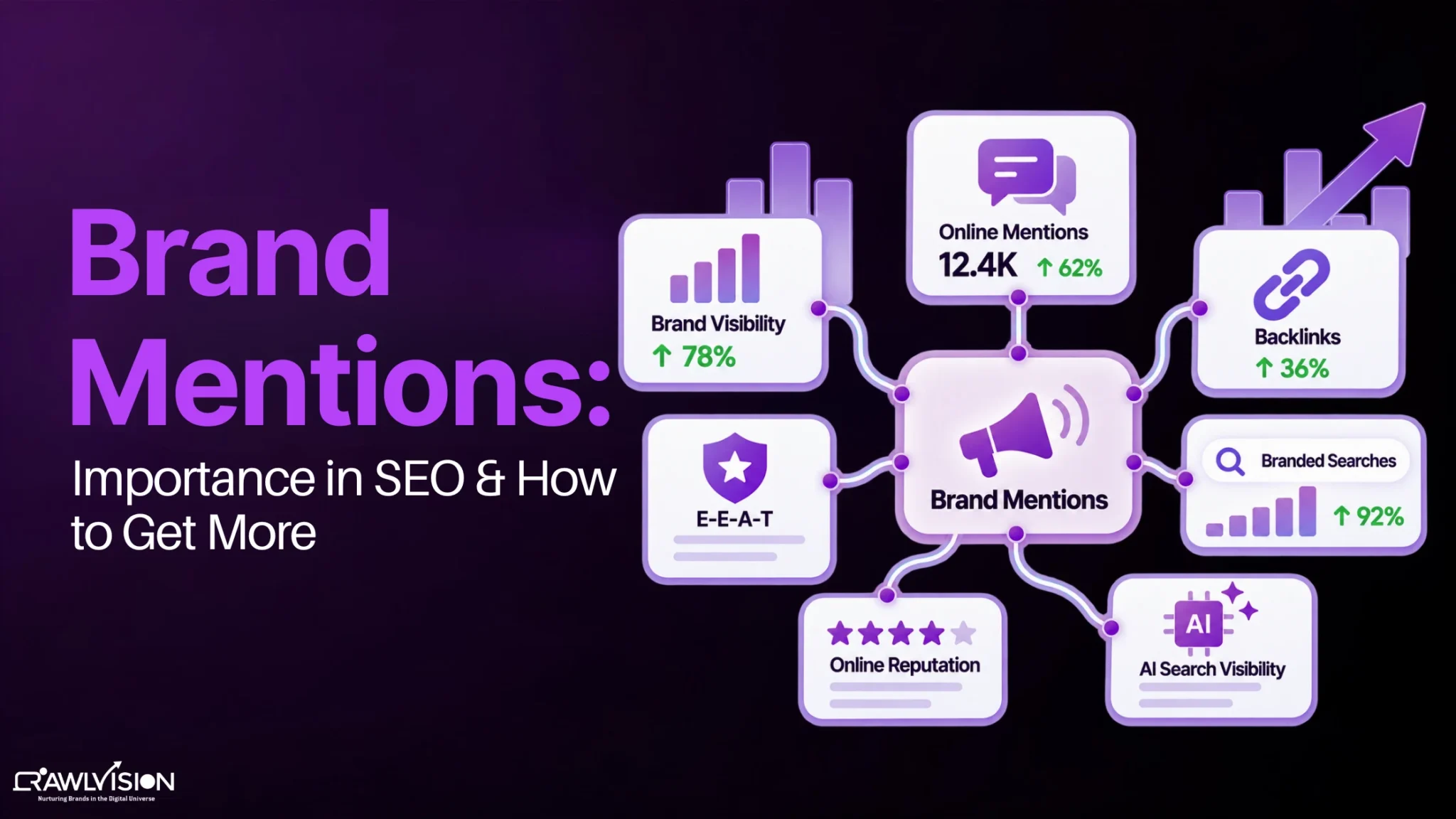
Online brand mentions are important for SEO because they expand where and how often your brand appears across the web. They can improve discovery, create backlink opportunities, reinforce brand associations, support credibility, increase branded searches, and strengthen broader search visibility.
What Is a Brand Mention?
A brand mention is any online reference to your business, product, service, founder, or brand name, whether or not it includes a link to your website.
For example, an industry article that says “Crawl Vision helped businesses improve their SEO” is a brand mention. If those words link to Crawl Vision’s website, it is also a backlink. If there is no link, it is an unlinked brand mention.
Mentions can appear in news articles, blogs, reviews, forums, social platforms, podcasts, directories, interviews, and industry discussions.
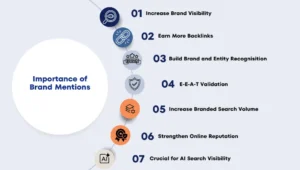
Why Are Brand Mentions Important for SEO?
Brand mentions matter because they build the broader online presence around your business. They can increase discovery, create link opportunities, reinforce brand associations, support credibility, increase branded searches, and contribute to visibility beyond traditional search results.
1. Increase Brand Visibility
Brand mentions put your business in front of people who may not find it through your own website. A relevant mention in an industry publication can introduce your brand to a new audience and create another path to your website.
The quality of the source matters. A few genuine references from relevant publications, communities, or websites can be more useful than numerous mentions on unrelated or low-quality sites.
2. Earn More Backlinks
A mention can eventually become a backlink when someone who discovers your brand decides to reference your website.
For example, a company might be mentioned in an expert roundup without a link. A reader visits the company, finds a useful resource, and later links to that resource from another article. The original mention did not provide a backlink, but it created a discovery opportunity.
This is why brand mentions and link building should not be treated as completely separate activities.
3. Build Brand and Entity Recognition
Consistent mentions can help establish relationships between your brand and the topics, products, services, or people associated with it.
If credible sources repeatedly discuss a company alongside terms such as “technical SEO,” “SEO audits,” and “AI search,” those references create a clearer picture of what the company does.
This does not mean Google simply counts mentions as ranking points. A consistent presence across relevant sources can instead make a brand easier for people and search systems to understand and discover.
4. E-E-A-T Validation
Third-party references can provide useful context around a brand’s expertise and reputation. Google says its systems use multiple signals to identify content demonstrating experience, expertise, authoritativeness, and trustworthiness, while E-E-A-T itself is not a specific ranking factor.
For example, an expert being quoted by an industry publication does not automatically improve rankings. However, it can strengthen the public evidence that the person or company is active and knowledgeable in its field.
5. Increase Branded Search Volume
People often search for a company after encountering its name elsewhere. They may search the brand directly, combine the brand name with a service, or look for reviews before visiting the website.
The path is simple:
brand mention → awareness → branded search → website discovery
Branded searches should not be manufactured through spam. They are more valuable when they happen naturally because people recognize your brand and want to learn more.
At Crawl Vision, we also monitor branded search performance in Google Search Console to understand how people discover and search for the brand. You can check clicks, impressions, average position, and CTR for branded queries in GSC.
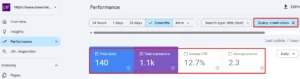
Note: Google Search Console showing Crawl Vision’s branded search performance over the last three months.
6. Strengthen Online Reputation
Brand mentions show how your business is being discussed outside your own website. Positive reviews, expert references, customer experiences, news coverage, and community discussions can all contribute to your broader online reputation.
Monitoring mentions can also reveal inaccurate information, recurring customer concerns, or opportunities to participate in relevant conversations. Reputation monitoring is therefore useful for SEO as well as wider digital marketing.
7. Crucial for AI Search Visibility
Brand mentions are increasingly relevant to AI search visibility because AI-powered search experiences use information from the wider web to understand topics and sources.
Google’s current guidance says its generative AI search features are built on its existing Search quality and ranking systems.
Relevant third-party references can provide external context about what a company does, which topics it is associated with, and how other sources describe it.
They are not a guaranteed way to appear in AI search engines, Google AI Overviews, or AI Mode, but they can contribute to a stronger and more consistent online presence.
Brand Mentions vs. Backlinks: What’s the Difference?
Brand mentions and backlinks are related, but they are not interchangeable. A brand mention refers to the brand, while a backlink specifically links from another website to your website.
| Brand Mentions | Backlinks |
| May be linked or unlinked | Include a link to your website |
| Increase brand exposure | Create a direct connection between sites |
| Can support discovery and reputation | Can support link-based brand authority and discovery |
| May lead to future backlinks | Already provide a linking opportunity |
| Can appear in reviews, forums, news, and articles | Commonly appear in editorial content, resources, directories, and partner pages |
The goal is not to choose between the two. Relevant brand mentions and genuine backlinks can work together as part of a broader off-page SEO strategy.
How to Find Unlinked Brand Mentions
You can find unlinked brand mentions by searching your brand name, product names, founder names, and common brand variations across Google and relevant industry platforms.
SEO tools such as Ahrefs or Semrush can also help identify mentions and referring domains. When reviewing results, prioritize relevant and credible sources rather than trying to collect every mention.
Look for situations where adding a link would genuinely help readers. A polite outreach request makes sense when the existing mention is relevant, and a link would provide useful context.
How to Get More Brand Mentions Online
Getting more brand mentions starts with giving people a genuine reason to talk about your business. Focus on useful, original contributions rather than manufacturing mentions.
- Publish original research: Share surveys, industry data, or original findings that others can reference.
- Create useful resources: Develop guides, templates, tools, or resources that solve real problems.
- Share expert commentary: Offer informed opinions on relevant industry developments.
- Contribute to publications: Provide useful insights to reputable websites in your industry.
- Build industry relationships: Connect with journalists, editors, creators, and other relevant professionals.
- Participate in communities: Contribute thoughtful answers to discussions where your expertise is relevant.
- Encourage genuine reviews: Make it easy for real customers to share honest experiences.
- Use digital PR: Pitch stories when you have something genuinely useful or newsworthy to share.
- Join expert opportunities: Contribute to interviews, podcasts, webinars, and expert roundups.
- Turn mentions into links: Where appropriate, contact publishers about relevant unlinked mentions and suggest a useful page to reference.
The strongest mentions usually happen because a brand has something useful, interesting, or credible to contribute. Artificially generating mentions at scale can create low-quality signals and damage reputation.
Conclusion
Online brand mentions are valuable because they extend your brand presence beyond your own website. They can support discovery, backlink opportunities, brand recognition, E-E-A-T context, branded searches, reputation, and AI search visibility.
They should not be treated as a replacement for backlinks or as a guaranteed ranking factor. A stronger approach is to build a credible online presence where relevant websites, customers, experts, and communities have genuine reasons to mention your brand.