

Google has updated its guidance on using generative AI content, with a stronger emphasis on reviewing AI-generated material before publishing it.
The updated guidance says it is critical to manually fact-check and review AI-generated content for accuracy and trustworthiness before publishing it.
Google made the documentation update on October 1, 2026. The company said the changes bring its documentation in line with presentations used at its developer events.
Google Strengthens Its AI Content Guidance
Google explains that generative AI models predict likely sequences of words based on their training data. They do not necessarily retrieve and verify facts before generating an answer.
As a result, AI-generated content can contain incorrect information or hallucinations.
Google now specifically emphasizes the need for manual fact-checking and review before publishing AI-generated content.
This matters for websites using AI to produce content at scale.
A page can sound polished and authoritative while still containing outdated information, incorrect claims, or details that were never properly verified.
Google Is Not Banning AI-Generated Content
The update does not mean Google has banned AI-generated content from Search.
Google’s guidance continues to focus on content quality and purpose rather than simply whether AI was involved in creating it.
Google warns against using automation, including generative AI, primarily to manipulate search rankings.
This means AI can still be part of a content workflow. The problem starts when websites publish large amounts of AI-generated content without adding useful information, originality, expertise, or proper quality control.
What This Means for SEO Teams
For SEO teams, Google’s guidance on generative AI content reinforces the importance of human oversight in AI-assisted content.
AI can help with research, outlines, content analysis, and repetitive tasks. But human reviewers still need to check the final content.
That review should include verifying facts, removing unsupported claims, checking sources, and adding relevant expertise or first-hand insights.
With Google’s focus on content quality continuing through September 2026 Spam Update, relying on AI output without proper review can create unnecessary quality risks.
This is especially important for topics where inaccurate information can affect important decisions.
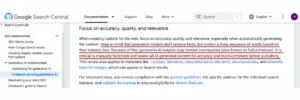
Image: Google’s updated guidance says AI-generated content should be manually fact-checked and reviewed before publishing.
AI Content Still Needs Human Review
Google’s latest guidance does not tell publishers to stop using AI.
Instead, it reinforces a simple principle: AI-generated content should not move directly from generation to publication without human review.
For businesses using AI in their SEO workflows, manual fact-checking should be treated as a core quality-control step.
Google’s updated guidance makes one thing clear: using AI can speed up content production, but it does not remove the need for accuracy, review, and human judgment.