


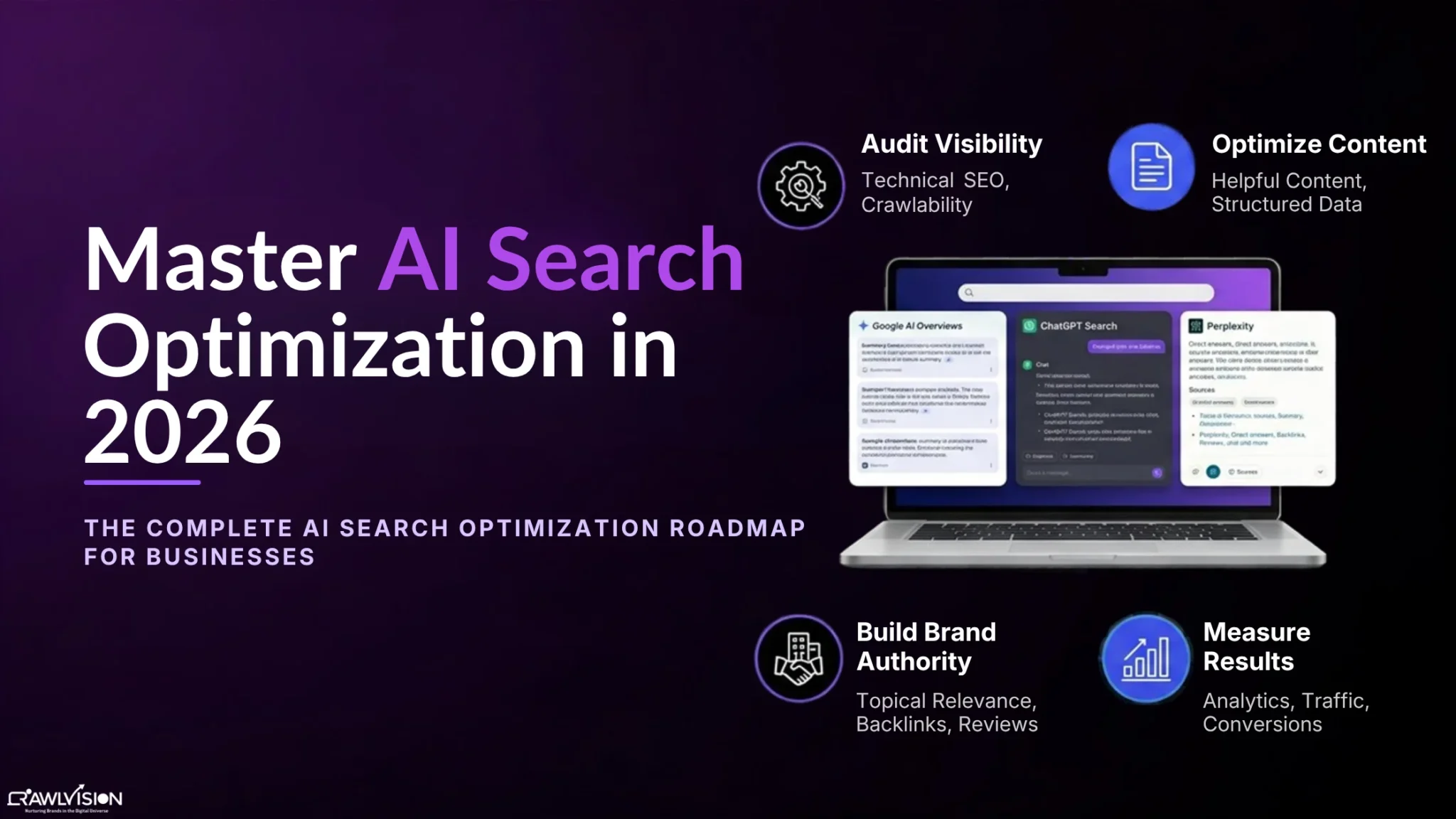
AI search optimization helps businesses improve their chances of being discovered, mentioned, and cited across AI-powered search experiences.
A practical roadmap has four phases: audit current visibility, optimize the website and content, build brand authority, and measure performance.
The goal is to make your business easier to discover, understand, and trust, while connecting visibility improvements to meaningful business outcomes.
What Is AI Search Optimization?
AI search optimization is the process of improving a website’s content, accessibility, and brand signals so that AI-powered search experiences can discover and use its information in relevant answers.
It builds on traditional SEO while addressing how people find information through Google AI Overviews, Google AI Mode, ChatGPT Search, and other AI platforms.
Why AI search optimization matters for businesses
- Customers are discovering brands through AI search
People can ask detailed questions, compare providers, and explore recommendations without visiting several websites individually. Businesses need useful information available wherever their potential customers search. - Traditional rankings do not guarantee AI visibility
A website can rank well in conventional search results without being cited in an AI-generated response. Strong SEO remains important, but businesses should also evaluate their visibility in relevant AI experiences. - Brand authority supports discoverability
Clear company information, credible expertise, useful content, and relevant third-party mentions help establish a consistent picture of what a business offers. - Visibility needs to connect to business results
Brand mentions are useful indicators, but they are not the final objective. Businesses should also examine referral traffic, enquiries, conversions, and whether AI search contributes to qualified leads.
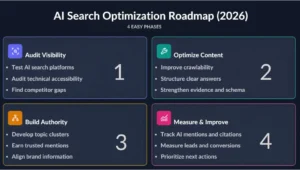
AI Search Optimization Roadmap in 4 Easy Phases
The most practical AI search optimization strategy follows four connected phases: audit, optimize, build authority, and measure. This sequence helps businesses address existing problems before investing heavily in new content or promotional activities.
Phase 1: Audit Your Current AI Search Visibility
Start by identifying where your business appears in AI search, which pages are accessible, and where competitors have an advantage. An initial audit gives you a baseline for deciding what deserves attention first.
1. Test your brand across AI search platforms
Search for your business using questions real customers might ask. Test relevant queries across Google AI Overviews, AI Mode, ChatGPT Search, and Perplexity, where available.
Include different types of searches:
- Informational questions about your industry.
- Comparisons between products, services, or providers.
- Queries asking for recommendations in your category.
- Questions about your brand, expertise, and specific services.
Record whether your brand appears, which sources are cited, and whether the information is accurate. Repeat the same queries periodically because AI answers can change depending on the query, context, and platform.
2. Audit technical SEO and content accessibility
Check whether important pages can be crawled, indexed, rendered, and accessed without unnecessary barriers. Review robots.txt rules, noindex directives, canonical tags, internal links, XML sitemaps, and server or CDN restrictions.
For ChatGPT Search, verify that OAI-SearchBot is not unintentionally blocked. Google also recommends maintaining the established technical and content fundamentals used for its AI search features. These checks improve accessibility, but they do not guarantee inclusion in AI answers.
3. Identify competitor gaps and opportunities
Compare your visibility with competitors for the same customer questions. Look for topics where competing brands are cited but your business is absent, as well as questions that your existing pages answer incompletely.
Prioritize gaps that connect to your core services and customer needs. A missing answer on a high-intent service page may deserve attention before creating another broad informational blog post.
At Crawl Vision, we believe the first step is to identify whether visibility gaps stem from technical barriers, content quality, or limited brand authority. Understanding the cause helps businesses prioritize the right fixes instead of simply publishing more content.
Phase 2: Optimize Your Website and Content for AI Search
Once the audit identifies weaknesses, improve the pages that matter most. Focus on making important information accessible, clearly structured, accurate, and genuinely useful rather than rewriting every page simply to target AI search.
1. Improve crawlability, indexability, and internal linking
Fix technical issues that prevent search engines from discovering or processing valuable pages. Connect related articles to relevant service pages using descriptive internal links, and ensure important pages are not isolated from the rest of the website.
For example, a digital marketing agency could connect its technical SEO, content strategy, and AI search articles to a central AI search optimization service page. This helps users navigate the site and clarifies the relationship between related topics.
2. Restructure content around clear answers and customer questions
Put the main answer near the beginning of a relevant section, then provide the explanation, evidence, and practical details readers need. Use descriptive headings, meaningful lists, and comparison tables when they improve understanding.
Consider a company selling inventory software. Instead of describing features without context, its page could directly answer how the software helps teams track stock, prevent shortages, and manage replenishment. Specific explanations are more useful than vague marketing language.
3. Strengthen content quality, evidence, and structured data
Improve content with original insights, verified claims, current examples, expert input, and clear explanations of how a product or service works. Remove outdated statements and avoid publishing multiple pages that repeat the same information without adding value.
Use appropriate structured data, such as Organization, Article, Product, or LocalBusiness schema, when it accurately describes the page. Validate the markup and ensure it matches visible content. Schema can clarify information for supported systems, but it is not a shortcut to AI citations.
Phase 3: Build Brand Authority and Topical Relevance
AI search optimization is not only about individual pages. Businesses should also build a clear, consistent body of information about their expertise, services, and reputation. This gives potential customers more ways to understand what the brand offers.
1. Build topic clusters around your core services
Organize content around the services and questions most relevant to your business. Create a central page for each important service, supported by articles that address customer problems, comparisons, implementation questions, and buying decisions.
For example, an agency offering AI search optimization could connect its main service page with content about AI search optimization checklist, SEO audits, content optimization, brand mentions, and visibility tracking. Each page should provide distinct value rather than repeating the same advice with slightly different keywords.
2. Strengthen brand trust and third-party mentions
Publish evidence that supports your expertise, including genuine case studies, author credentials, original research, and detailed examples. Seek relevant mentions from reputable industry publications, partners, and organizations where your business has a legitimate connection.
Avoid buying low-quality links or manufacturing brand mentions just to influence AI responses. Focus on building a reputation that customers can verify. No particular backlink count or number of brand mentions guarantees AI search visibility.
3. Improve brand consistency across relevant platforms
Keep your business name, services, contact details, and company description consistent across your website and important business profiles. Update outdated content and ensure that public profiles accurately represent what you do.
For local businesses, maintain an accurate Google Business Profile and relevant directory listings. For B2B brands, prioritize company profiles, professional biographies, and industry-specific publications. Choose platforms based on customer relevance rather than trying to maintain a presence everywhere.
Phase 4: Measure AI Search Performance and Improve Continuously
Measure AI search optimization using a combination of visibility indicators and business outcomes. Tracking the same queries and website metrics over time helps you distinguish meaningful progress from occasional changes in AI-generated answers.
1. Track AI mentions, citations, and share of visibility
Maintain a consistent set of customer queries and record how often your brand appears, which pages are cited, and which competitors are mentioned. If you calculate share of visibility, define the formula and keep the query set consistent so comparisons remain meaningful.
Google’s official guidance on AI features explains how traffic from AI Overviews and AI Mode is handled in Search Console. Use the available reporting to monitor search performance rather than assuming every AI mention generates a website visit.
2. Measure referral traffic, conversions, and qualified leads
Use Google Analytics 4 (GA4) to examine identifiable referral traffic from AI platforms, engagement, and conversions. ChatGPT Search referral URLs can include the utm_source=chatgpt.com parameter, which can help with attribution.
Compare these visits with enquiries, sign-ups, purchases, or other meaningful outcomes. Not every AI-assisted customer journey will be visible in referral reports, so treat attribution as an imperfect measure rather than a complete account of AI’s influence.
3. Review results and prioritize the next round of improvements
Review your findings monthly or at another interval suited to your traffic and campaign activity. Identify which pages need better evidence, which technical issues remain unresolved, and which customer questions still produce weak visibility.
Change one priority at a time where practical, then monitor the results. This makes it easier to learn what helps your particular website instead of relying on universal claims about ranking factors that have not been established.
How to Prioritize AI Search Optimization Based on Your Business Goals
The right starting point depends on your website’s condition, existing visibility, and commercial goals. Fix accessibility problems first, then prioritize the content and authority gaps most closely connected to customers and revenue.
| Business situation | First priority |
| New website with little visibility | Technical accessibility, core service pages, and useful foundational content |
| Established site absent from AI answers | Query-level visibility audit and competitor gap analysis |
| Strong traffic but few qualified leads | Clearer service information, relevant evidence, and conversion paths |
| Local service business | Accurate business profiles, local pages, reviews, and consistent contact details |
| Ecommerce or B2B brand | Detailed product or service pages, comparison content, and measurable conversion tracking |
You do not need to implement every recommendation at once. Start with the highest-impact problems, assign responsibility for each task, and review progress against a defined baseline.
Conclusion
AI search optimization works best as an ongoing business strategy, not a one-time content exercise. Audit your visibility, improve your website and content, strengthen brand authority, and measure what changes.
By connecting these four phases to customer needs and business outcomes, you can make more informed decisions about where to invest your SEO and AI search efforts.