


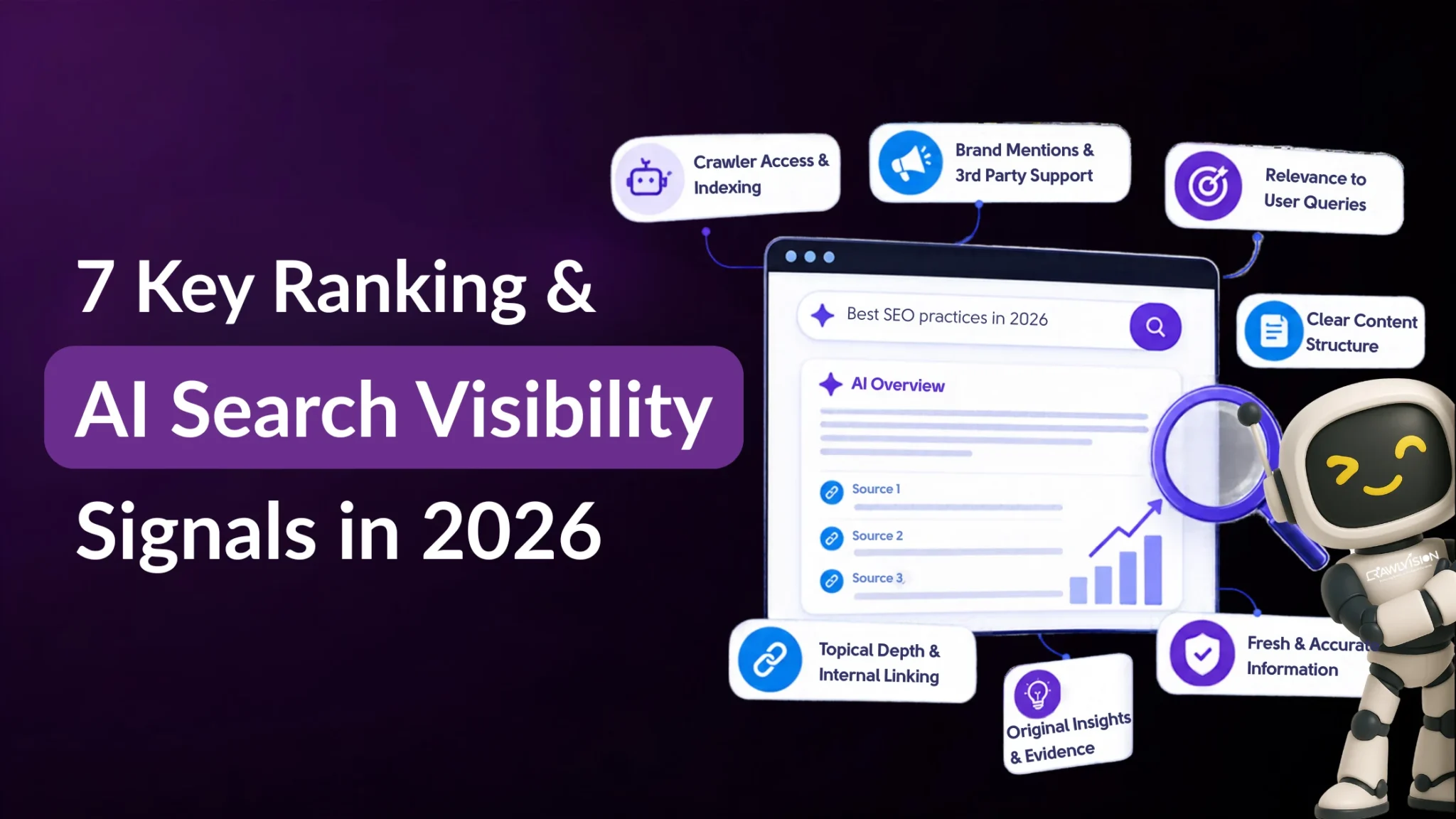
Websites can improve their chances of appearing in AI search by ensuring relevant pages are accessible, answering user queries accurately, providing original information, and establishing credible brand references. However, AI platforms use different systems, and no universal set of ranking signals guarantees citations.
How Do AI Search Engines Decide Which Websites to Cite?
AI search engines retrieve and evaluate information from sources that help answer a user’s question, then generate responses that may include links to supporting pages. The exact process varies by platform.
Google’s AI Overviews and AI Mode can use query fan-out, which means exploring related searches across multiple subtopics. ChatGPT Search can retrieve web results, while Perplexity provides answers supported by linked sources. These systems do not necessarily select the same pages for the same question.
This distinction matters because ranking in conventional search results and being cited in an AI-generated answer are related but different outcomes. Strong SEO foundations help make content discoverable, but relevance to the particular question and the information retrieved also matter.
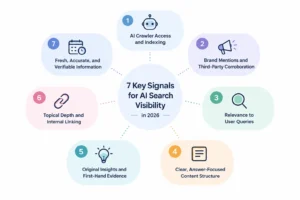
7 Key Signals for AI Search Visibility in 2026
AI search visibility depends on several connected factors, from whether a page can be discovered to whether its information helps answer a specific query. These seven signals are practical optimization priorities, not a confirmed universal ranking formula.
1. AI Crawler Access and Indexing
AI search systems need access to eligible web content to retrieve it. A page that blocks the relevant crawler may lose an opportunity to appear as a source.
Check robots.txt rules, noindex directives, HTTP status codes, canonical tags, and internal links. Also, distinguish between crawlers used for search and those used for model training.
For example, OpenAI identifies OAI-SearchBot as its search crawler and GPTBot as a crawler associated with model training. Their controls are independent.
2. Brand mentions and third-party corroboration
Credible information about your brand outside your own website can help AI systems establish context around your business, products, and expertise. Independent references are relevant when users ask for recommendations or comparisons.
Prioritize relevant industry publications, genuine customer reviews, expert contributions, and reputable websites that accurately describe your business. Ensure your company name, services, and important claims are consistent.
3. Relevance to user queries
Content has a better opportunity to be retrieved when it addresses the meaning and intent of a user’s question, rather than merely repeating the same keywords.
Google’s query fan-out approach illustrates why related subtopics matter. Build content around the main question and its relevant follow-ups, but avoid adding unrelated sections simply to cover more keywords.
4. Clear, answer-focused content structure
Clearly organized content makes information easier for readers to find and helps search systems interpret individual sections. Descriptive headings, focused paragraphs, meaningful lists, and relevant tables can improve clarity.
Imagine two sections:
- “How to Check Whether Google Can Index a Page”
2. “Technical Considerations”
First title communicates its purpose more clearly than the second one. Place the direct answer near the beginning, then explain the process and exceptions.
Do not assume that short paragraphs or FAQ sections automatically earn AI citations. Structure should make the information genuinely easier to understand, not serve as a shortcut to visibility.
5. Original insights and first-hand evidence
Content that contributes useful information beyond common explanations gives readers a reason to consult the source. Original research, documented processes, real examples, and expert observations can make a page more distinctive.
Instead of saying that technical errors affect visibility, show an anonymized audit example if reliable evidence is available. Explain the issue, how it was identified, and what the findings demonstrate.
Never manufacture case studies or present general knowledge as personal experience. When original evidence is unavailable, use credible sources and explain the limits of what they establish.
6. Topical depth and internal linking
A connected set of relevant pages helps users and search systems discover how different parts of a subject relate to one another. Internal links also provide pathways to important pages.
For example, an AI search visibility article can link to supporting content about AI search optimization checklist. It strengthens the topical depth of the website.
Build supporting pages around meaningful subtopics, link them where useful, and remove gaps or unnecessary duplication. More pages alone do not establish topical expertise. Coverage must be relevant, accurate, and useful.
7. Fresh, accurate, and verifiable information
AI-generated answers can be less useful when their sources contain outdated figures, conflicting details, or unsupported claims. Keeping important information accurate helps ensure that pages remain useful when retrieved.
Review statistics, product specifications, service descriptions, policy details, and other facts that can change. Include source links for claims that require verification, and update pages when the underlying information changes.
Freshness is not equally important for every query. A current industry update may need frequent review, while a foundational explanation can remain useful for years without substantial changes.
Traditional SEO Factors vs AI Search Factors
Traditional SEO and AI search optimization overlap, but they measure different aspects of visibility. SEO helps pages become discoverable in search results, while AI search monitoring examines whether those pages or brands appear in generated answers.
| Traditional SEO factors | AI search considerations |
| Crawlability and indexability | Eligibility for retrieval and citation |
| Keyword relevance and search intent | Relevance to conversational and related queries |
| Backlinks and page authority | Relevant third-party references and corroboration |
| Content quality and usefulness | Useful, specific information that supports an answer |
| Rankings, clicks, and impressions | AI citations, brand mentions, and cited pages |
These are differences in emphasis, not entirely separate sets of ranking factors. Google explicitly states that existing SEO practices remain relevant to AI Overviews and AI Mode.
How Popular AI Search Engines Behave Differently
AI search platforms differ in how they retrieve information, display citations, and connect generated answers to web sources. Website owners should evaluate each platform independently.
| AI Search Platform | Typical Behavior | What It Rewards |
| ChatGPT | Can browse or retrieve web information | Authoritative explanations |
| Claude | Emphasizes synthesis and source quality | Evidence-based content |
| Gemini | Uses Google Search and query fan-out | Indexed pages, Search basics |
| Perplexity | Presents answers with source links | Current, credible pages |
Do not assume that a page cited by one platform will appear in another. Compare the actual responses, linked URLs, query wording, and recurring visibility patterns.
How to Improve Your Website’s Visibility in AI Search?
Start by fixing technical barriers, then improve the relevance and usefulness of your content while building a credible brand presence.
- Audit crawler access: Check robots.txt, indexing directives, server responses, and the accessibility of important pages.
- Improve query coverage: Map the questions customers ask and ensure your pages answer them directly.
- Strengthen original content: Add useful examples, research, expert explanations, or documented processes where available.
- Build credible brand references: Earn relevant coverage and maintain accurate business information across trusted sources.
- Connect related pages: Use contextual internal links to help users navigate supporting resources.
- Review changing information: Update facts and claims when reliable evidence changes.
- Measure results: Track citations, brand mentions, and relevant referral traffic instead of relying on a single AI visibility score.
How to Check Your Website’s AI Search Visibility
Measure AI search visibility by recording how often your brand appears, which pages are cited, and whether the information accurately represents your business.
Use this practical process:
- Select 10 to 20 relevant customer queries covering informational, comparison, and service-related intent.
- Test the same queries across ChatGPT, Claude, Gemini, and Perplexity where web search is available.
- Record brand mentions, cited URLs, competitor appearances, and whether the answer represents your business accurately.
- Repeat the tests periodically using consistent prompts and note the date and platform.
- Review referral traffic and available platform reporting to identify changes worth investigating.
For Google, use Search Console to monitor eligible search performance.
For supported Microsoft AI experiences, Bing Webmaster Tools’ AI Performance report provides citation trends and grounding queries.
Neither metric captures every AI interaction, so combine platform data with manual checks.
Conclusion
Your website becomes more competitive in AI search when its pages are accessible, relevant to real questions, supported by useful evidence, and connected to a credible brand presence. No single signal guarantees inclusion across every platform.
Start by identifying gaps in your website’s technical SEO, content quality, and AI search visibility. At Crawl Vision, we help businesses turn these findings into practical improvements that make their websites more accessible, relevant, and competitive across AI-powered search platforms.