


Search is changing faster than ever. People are no longer limited to typing a few keywords into Google and browsing through multiple websites. They can now ask detailed questions, upload images, use voice commands, and receive AI-generated answers within seconds.
Platforms such as Google AI Overviews, AI Mode, ChatGPT, Gemini, and Perplexity are changing how users discover information and businesses.
To prepare your website for AI search, make your content easy to discover, understand, and trust. This means combining traditional SEO with clear answers, useful information, technical accessibility, and strong credibility signals.
Businesses that adapt their websites to these changing search behaviors can create more opportunities to reach relevant audiences.
How Is AI Search Changing Website Visibility?
AI search is changing website visibility by providing direct answers, recommendations, and summaries instead of relying entirely on traditional search results.
Traditional search typically requires users to visit websites to find answers. AI-powered search can retrieve information from different sources and combine relevant findings into a single response.
This creates several changes:
- Fewer clicks for some queries: Users may find sufficient information without visiting a website.
- New discovery opportunities: Websites can appear as supporting sources in AI-generated answers.
- More conversational searches: People increasingly ask detailed, natural-language questions.
- Greater importance of original information: Specific insights and reliable evidence help content stand out.
Google explains in its official AI search documentation that established SEO practices remain relevant to AI Overviews and AI Mode.
The goal is not to abandon SEO. It is to make existing SEO strategies more useful for AI-driven discovery.
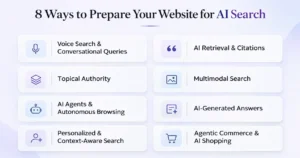
8 Ways to Prepare Your Website for the Next Generation of AI Search
Preparing for next-generation AI search requires improvements across content, technical SEO, website structure, and user experience.
The following eight strategies can help make your website more accessible and useful as search technology develops.
1. Optimize for voice search & conversational queries
Voice search and conversational AI encourage users to ask complete questions rather than enter short keywords.
For example, instead of searching for “SEO services,” someone might ask, “How do I choose an SEO agency for my small business?”
To optimize for conversational searches:
- Include natural questions in relevant content.
- Answer important questions directly.
- Use simple language that reflects how people speak.
- Include relevant long-tail keywords.
Focus on understanding the question behind each search rather than adding unnecessary question-based headings.
2. Structure content for AI retrieval & citations
AI systems need to identify relevant information before they can use it in generated responses.
Clear content organization helps search engines and retrieval systems understand individual sections and their relationships.
For better content structure:
- Organize information using descriptive H1, H2, and H3 headings.
- Provide direct answers before detailed explanations.
- Use lists to explain steps or compare options.
- Keep important information available as readable text.
- Add relevant internal links between related pages.
Structured data can provide additional context when appropriate, but it does not guarantee AI citations.
The key is making useful information easy to locate and understand.
3. Build topical authority for AI-driven discovery
Topical authority develops when a website consistently provides valuable information about a subject.
Instead of publishing unrelated articles, create connected resources that address different aspects of your primary expertise.
For example, an SEO website could cover:
- Technical SEO audits and website crawling.
- Keyword research and search intent.
- Content optimization and internal linking.
- AI search optimization and visibility measurement.
Connect related articles through meaningful internal links.
Original research, practical examples, and expert-reviewed information can further strengthen credibility.
Understanding how AI search engines evaluate content credibility helps businesses identify opportunities to improve their existing content.
4. Adapt to multimodal search across images, video, & voice
Multimodal search allows users to discover information through images, videos, text, and spoken questions.
A user might upload a product photograph, ask a question about its features, or search for a demonstration video.
To support multimodal discovery:
- Use descriptive image filenames and relevant alt text.
- Publish original, high-quality visuals.
- Provide captions or transcripts for useful videos.
- Explain important visual information in accompanying text.
- Ensure media works properly on mobile devices.
These practices improve accessibility and help search systems interpret visual content. Recognizing the growing role of visual discovery, Google added multimodal search data to Search Console on September 24, 2026, giving website owners more insight into how their content performs across visual search experiences.
5. Prepare your website for AI agents and autonomous browsing
AI agents are systems that can perform multiple steps to help users complete tasks, such as researching products or comparing services.
As agent-based browsing develops, websites with clear navigation and accessible information may be easier for these systems to interact with.
Improve your website’s readiness by:
- Keeping navigation and page structures consistent.
- Making product, pricing, and service details easy to find.
- Ensuring important pages load correctly.
- Testing forms and interactive elements.
- Reviewing crawler access and security restrictions.
However, AI agents don’t all browse websites in the same way. These improvements support general accessibility rather than guaranteeing agent compatibility.
6. Optimize content for AI-generated answers
AI-generated answers often combine relevant information retrieved from multiple sources.
Content that directly addresses user questions can be easier to interpret and reference.
For effective AI search optimization:
- Answer the main question early.
- Explain important concepts clearly.
- Include examples that demonstrate practical applications.
- Support factual claims with reliable evidence.
- Update outdated information when necessary.
Avoid publishing generic articles that simply repeat existing search results.
Google’s generative AI optimization guidance emphasizes unique, valuable content rather than special optimization tricks.
Originality and relevance should remain the foundation of website optimization for generative AI.
7. Prepare for personalized & context-aware search
Context-aware search can interpret queries using factors such as location, previous interactions, and information shared during a conversation.
This means two users asking similar questions may receive different responses.
Businesses can prepare by creating content for clearly defined audiences and situations.
For example, a financial planning website could provide separate information for business owners, working professionals, and people approaching retirement.
Use descriptive headings, accurate business information, and audience-specific examples.
Avoid creating numerous nearly identical pages targeting minor keyword variations. Each page should address a genuinely different user need.
8. Explore the shift towards agentic commerce and AI shopping
Agentic commerce refers to AI-assisted shopping experiences where systems can help users research, compare, and potentially complete purchases.
This creates new considerations for e-commerce websites.
Businesses should prioritize:
- Accurate product descriptions and specifications.
- Updated pricing and availability information.
- Clear delivery, return, and payment policies.
- Relevant product structured data.
- Accessible shopping and checkout experiences.
Keep product feeds synchronized with website information wherever applicable.
These improvements make product information more reliable for shoppers and automated systems, although they do not guarantee recommendations or purchases.
How to Measure Your Website’s Visibility in AI Search
Measuring AI search visibility requires tracking more than traditional keyword rankings.
Start by identifying relevant questions your audience asks and monitoring whether AI-powered platforms mention or reference your website.
Useful measurements include:
| Metric | What to Track |
| AI citations | Whether AI-generated answers reference your pages |
| Brand mentions | How frequently your business appears in relevant responses |
| Referral traffic | Visits from identifiable AI platforms |
| Organic performance | Search impressions, clicks, and conversions |
| Content engagement | Actions visitors take after arriving |
Use Google Search Console and analytics tools alongside repeatable AI visibility checks.
AI answers can change depending on the platform, query wording, and context. Therefore, individual citation checks should not be treated as permanent rankings.
Common Mistakes to Avoid When Optimizing for AI Search
AI search optimization works best when businesses avoid shortcuts and concentrate on useful improvements.
Common mistakes include:
- Ignoring technical SEO: Blocked pages, indexing problems, and inaccessible content can limit visibility.
- Publishing generic AI-generated content: Repeating widely available information offers little additional value.
- Overusing keywords: Forced phrases make articles harder to read.
- Depending entirely on schema markup: Structured data cannot replace quality content.
- Expecting guaranteed citations: No optimization method can ensure inclusion in AI-generated answers.
- Ignoring conversions: AI visibility matters most when it supports meaningful business outcomes.
Prioritize problems that affect real visitors before experimenting with emerging optimization tactics.
Conclusion
The future of AI search will reward websites that make information genuinely useful, accessible, and trustworthy.
Start with a technical audit, improve your most important pages, and build content around real audience questions. Then measure how visitors and AI-powered search platforms discover your business.
At Crawl Vision, the focus on SEO and evolving search behavior reflects an important principle: websites should adapt to new discovery methods without neglecting the fundamentals that make content valuable.