


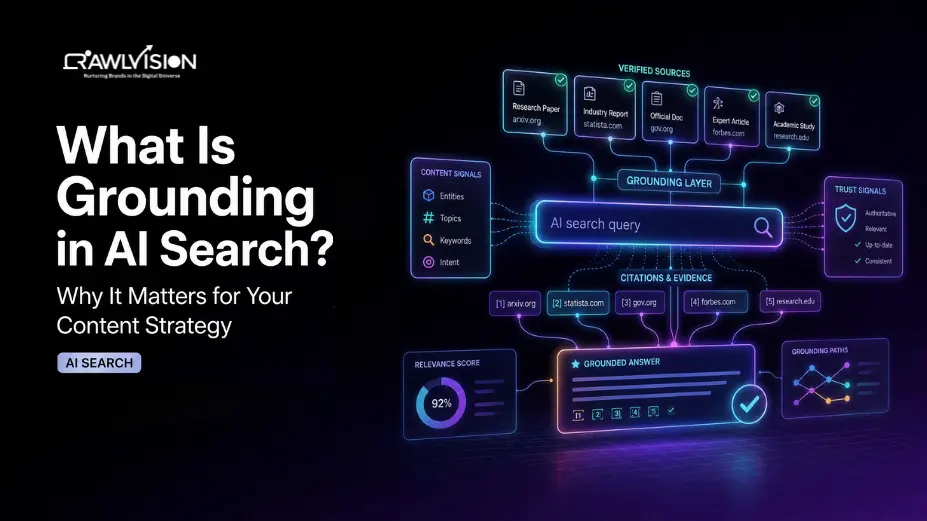
If you have been wondering why some websites keep showing up inside AI-generated answers while yours stays invisible, the answer probably comes down to one word: grounding. Grounding in AI search is the mechanism that determines which real-world sources an AI model pulls from when constructing its response. Understanding this concept is no longer optional for marketers and content creators it is the backbone of every smart content strategy built for 2026 and beyond.
In this guide, we will break down exactly what grounding in AI search means, how it works under the hood, and most importantly, how you can optimize your content to become a grounding source that AI models trust and cite.
What is grounding in AI search? a clear definition
At its core, grounding in AI search refers to the process of anchoring an AI model’s responses to verified, real-world information. Without grounding, a large language model (LLM) like the ones powering Google’s AI Overviews, ChatGPT Search, or Perplexity would generate answers purely from its pre-trained knowledge, which can be outdated, hallucinated, or simply wrong.
Grounding solves this problem by connecting the AI to a live or curated set of documents before generating an answer. When a user asks a question, the AI retrieves relevant pages, reads them, and then uses that retrieved content to build its response. This is why grounding in AI search is often described as the foundation of Retrieval-Augmented Generation (RAG) a technique now embedded in every major AI search engine.
Grounding vs. traditional indexing: what changed?
Traditional search engines ranked pages based on links, keywords, and authority. Grounding in AI search goes a step further. It is not just about whether your page ranks it is about whether an AI can extract a clean, credible, factual chunk of information from your page and use it in a synthesized answer. That is a fundamentally different challenge, and it requires a fundamentally different content approach.
How grounding in AI search actually works
To understand grounding in AI search at a technical level without needing a PhD, think of it as a three-step process:
- Retrieval: The AI search engine scans its index (or the live web) and pulls a set of candidate documents based on the user’s query.
- Reading & Ranking: The AI reads those documents, evaluates their relevance and trustworthiness, and identifies specific passages that are most likely to answer the question accurately.
- Generation with Citation: The model generates a response that is grounded in meaning directly sourced from those passages, often with citations or links back to the source.
The quality of grounding in AI search depends heavily on how clearly and authoritatively your content communicates facts. Pages filled with vague opinions, thin paragraphs, or keyword stuffing get skipped. Pages that answer questions directly, back up claims with data, and use a clear structure get grounded.
Why grounding in AI search matters for your content strategy
Here is the uncomfortable truth: a website can rank #1 on Google and still get zero citations in AI Overviews. That happens because ranking and grounding measure different things. Ranking is about relevance and authority signals. Grounding in AI search is about extractability: can the AI pull a clean, useful, trustworthy answer from your content?
This gap is where many content strategies fall apart in 2026. Here is why you need to care:
1. Ai overviews are eating click-through rates
When Google’s AI Overview answers a question at the top of the results page, many users never scroll down. If your content is not being used to ground that overview, you are invisible to a growing segment of searchers, even if you rank on page one.
2. Being a grounding source builds topical authority
When AI models consistently cite your content as a grounding source, it signals to both algorithms and users that your website is a trusted authority in your niche. That trust compounds over time, making it easier to get cited for more queries and more topics.
3. Geo is now as important as SEO
Generative Engine Optimization (GEO) is the discipline of optimizing content specifically for grounding in AI search engines. If your content strategy does not include GEO principles, clear definitions, factual density, and structured formatting, you are leaving a massive visibility opportunity on the table.
What makes content “groundable”? key signals AI looks for
Not all content is grounding-ready. Based on how retrieval-augmented generation systems work, here are the content signals most likely to make your pages a preferred grounding source:
- Direct answers in the first paragraph: AI models prefer content that answers the question in the opening lines without burying the lead.
- Clear definitions and explanations: Pages that define terms like “grounding in AI search” in plain English are far more extractable than pages that assume prior knowledge.
- Factual statements with data: Numbers, statistics, dates, and verifiable claims increase the trust score of your content.
- Structured headings and subheadings: Heading tags help AI models parse content into discrete topics, making it easier to extract specific answers.
- E-E-A-T signals: Experience, Expertise, Authoritativeness, and Trustworthiness remain the gold standard for whether AI models consider a page grounding-worthy.
- Schema markup: Structured data (FAQ, HowTo, Article schema) gives AI models machine-readable context about your content’s purpose and credibility.
How to optimize your content for grounding in AI search
Now that you understand what grounding in AI search is and why it matters, let us talk about action steps. These are not theoretical, they are practical changes you can make to existing and new content today.
Step 1: lead with the answer
Every piece of content targeting a question-based query should answer that question within the first 100 words. If a user (or AI) asks, “What is grounding in AI search?” your opening paragraph should define it immediately, cleanly, and completely. Save the nuance and elaboration for the body.
Step 2: build content that mirrors conversational queries
AI search engines process natural language questions, not just keyword strings. Structure your headings as questions people actually ask: “What is grounding in AI search?” “How does grounding affect AI Overviews?” “Why is my content not being grounded?” This alignment between your headings and natural queries is a core GEO and AEO (Answer Engine Optimization) practice.
Step 3: add depth, not just length
Long articles are not automatically better grounding sources. What matters is information density, how many useful, factual, and unique insights exist per paragraph. Trim padding, cut filler phrases, and replace generic statements with specific, verifiable claims that an AI would be confident citing.
Step 4: implement semantic SEO and lsi keywords
Grounding in AI search is closely tied to semantic understanding. AI models do not just match keywords; they understand concepts. Use LSI (Latent Semantic Indexing) keywords and semantically related terms throughout your content: retrieval-augmented generation, AI citations, generative engine optimization, knowledge grounding, contextual AI responses, and AI content sourcing. These terms signal to the AI that your content has comprehensive topical coverage.
Step 5: update content regularly
AI search engines prioritize freshness. A grounding source that was accurate six months ago might be deprioritized today if newer, more updated content exists. Build a content refresh schedule into your editorial calendar and update high-priority pages at least every quarter.
Common grounding mistakes that kill your AI visibility
- Writing for robots, not humans: Keyword-stuffed content that reads unnaturally is actively avoided by AI grounding systems.
- Using paywalls on key content: AI crawlers often cannot access paywalled pages, making them invisible as grounding sources.
- Ignoring structured data: Without schema markup, your content is harder for AI models to classify and trust.
- Publishing opinion-heavy content without factual backup: Opinions do not ground well. Facts do.
- Neglecting site speed and Core Web Vitals: Slow, broken pages are less likely to be crawled frequently and more likely to be deprioritized.

