


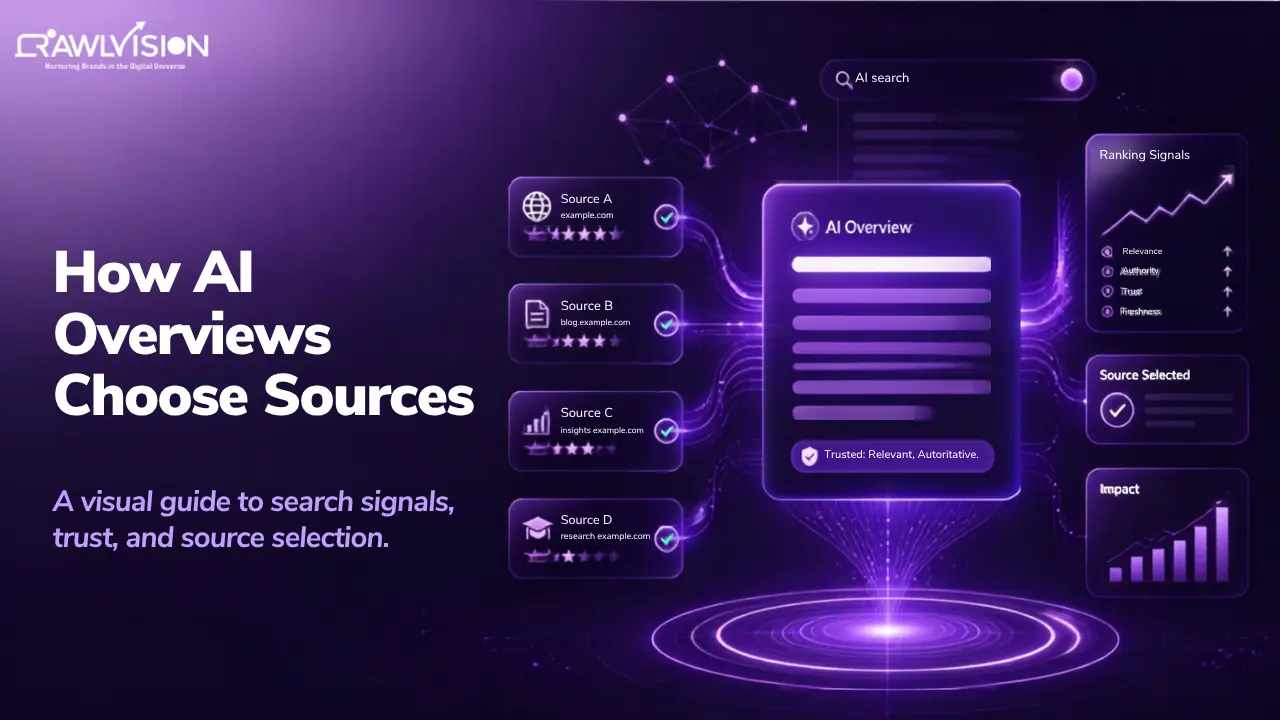
If you’ve searched Google recently, you’ve probably seen an AI-written summary sitting right at the top of the results page, above the usual blue links.
That’s an AI Overview: an AI‑generated summary at the top of Google Search that answers your question and cites multiple sources with links.
And if you run a website, getting cited inside these summaries is now one of the most valuable and competitive goals in search.
This blog breaks down exactly how Google’s AI Overviews pick their sources, why some well-ranked pages still get skipped, and what you can actually do about it.
What Are Google AI Overviews?
AI Overviews are AI-generated summaries that appear at the top of Google Search results. Instead of showing you ten blue links and letting you dig through them, Google’s system reads across multiple web pages, pulls out the most useful facts, and stitches them into one short answer.
Each fact in that answer is usually backed by a clickable citation, so you can jump straight to the source. Under the hood, these summaries are powered by Google’s Gemini model, which blends its own trained knowledge with fresh, real-time search results to keep answers current.
AI Overviews now show up on a huge share of everyday searches, from simple factual questions to more complex, multi-part queries. That makes them impossible for website owners and marketers to ignore.
How Do AI Overviews Choose Sources?
Google hasn’t published an exact formula, but patterns from independent research and Google’s own documentation make the process fairly clear. Here’s what actually matters.
1. Relevance to the Search Query
The starting point is always relevance. Google’s system runs what’s called a “query fan-out,” breaking one search into several smaller sub-questions and checking many pages at once. Pages that closely match the intent behind each sub-question move forward in the process.
2. Content That Directly Answers the Question
Ranking well isn’t the only requirement anymore. Content also has to give a direct, standalone answer, which is the same principle behind writing quotable content for AI search engines. Passages that can be understood on their own, without needing the rest of the article for context, are far more likely to get pulled into a summary.
Short, self-contained sections that fully answer one specific question tend to outperform long, sprawling pages that circle a topic without ever landing on a clear answer.
3. Expertise and Trustworthiness
This is where E-E-A-T comes in: Experience, Expertise, Authoritativeness, and Trustworthiness. Recent analysis suggests the vast majority of AI Overview citations come from sources with strong E-E-A-T signals, and this now applies well beyond “your money or your life” topics like health and finance.
Author bios, clear credentials, transparent sourcing, and a track record of accurate content all help a site clear this bar, and running a 30-min E-E-A-T audit is a fast way to identify the gaps.
4. Original Information and Firsthand Experience
Google’s system seems to favor pages that add something new. Original research, unique data, case studies, and genuine firsthand experience carry more weight than content that just repeats what’s already widely published elsewhere.
Spotting where your own site is thin on this front usually starts with learning how to find content gaps on your website and fix them.
If your article says the same thing as fifty other articles, there’s little reason for the AI to cite you specifically.
5. Freshness and Accuracy
AI Overviews blend real-time information with trained knowledge, so recency matters. Pages that are kept updated, with correct facts and current data, are more likely to be trusted as sources than stale pages that haven’t been touched in years.
6. Clear and Accessible Content
Finally, structure matters. Content that uses clear headings, short paragraphs, bullet points, and tables is easier for the AI to scan and extract from.
But none of that helps if the crawler can’t reach the page in the first place, which is why it’s worth checking whether AI search can crawl every page on your site. Dense walls of text, heavy sales language, or keyword stuffing tend to get passed over, even if the page ranks well.
Why Does Google Cite Multiple Sources in an AI Overview?
Most questions don’t have a single perfect answer sitting on one webpage. So instead of relying on just one source, Google typically pulls facts from three to five different sites and combines them into one cohesive summary, with each fact linked back to where it came from.
This also spreads the “risk” of being wrong. By cross-referencing multiple trustworthy pages, Google can present a more balanced, verified answer instead of leaning on a single opinion or dataset.
Does Ranking #1 Guarantee an AI Overview Citation?
No, and this surprises a lot of website owners. Ranking on page one is still a strong prerequisite, since a large share of AI Overview citations do come from pages that already rank in the top organic results.
But top-10 ranking alone is no longer enough. Some recent research has found that the overlap between top-10 rankings and AI Overview citations has actually been shrinking over time, meaning traditional SEO rankings are becoming a less reliable guarantee of AI visibility.
In short: ranking #1 gets you in the running. Being the clearest, most trustworthy, most directly useful answer on the page is what actually wins the citation.
How AI Overviews Differ From Traditional Search
Traditional search shows a ranked list of links and leaves the reading and comparing to you. AI Overviews skip that step and hand you a synthesized answer instead.
A few key differences:
| Aspect | Traditional Search | AI Overviews |
| Output | List of blue links | Direct answer + cited sources |
| Selection unit | Page-level ranking | Passage-level extraction |
| Query handling | Single query | Query + related sub-queries |
| Source count | One click goes to one site | 3-8 cited sources per overview |
| Freshness signal | Important | Heavily weighted (recent updates favored) |
| Schema impact | Helpful | Stronger lift (FAQ/HowTo can 2–3× citations) |
This is also different from Google’s AI Mode, which is a separate, conversational search experience that users actively switch into for deeper research, rather than an automatic summary shown for everyday queries.
What Types of Websites Get Cited in AI Overviews?
There’s no single “type” of site that dominates, but a few patterns show up again and again:
- Sites with clear author expertise and credentials.
- Established publishers and brands with a consistent trust track record.
- Niche sites that go deep on one topic instead of covering everything loosely.
- Pages built around original data, research, or real-world experience.
- Well-structured content using headings, lists, and schema markup.
Thin content, aggressive sales pages, and pages with no clear authorship tend to be filtered out early in the process, even if they technically rank.
How to Get Your Website Cited in Google AI Overviews
Here’s what you can do to get your brand mentioned in AI overviews and achieve better results for your business:
1. Match Search Intent
Start by identifying the real question behind a search, not just the keyword. Structure your content around that specific intent rather than trying to cover a broad topic.
What to do:
- Identify the exact question type (what-is, how-to, best X for Y, vs, steps, cost).
- Align your page’s H1 and opening lines to that intent.
2. Give Clear, Direct Answers
Open each section with a short, standalone answer to the question in the heading. Aim for tight, self-contained paragraphs near the top of the section, then expand with detail afterward.
What to do:
- Put the answer in the first 1-2 sentences. Then explain with steps, examples, and caveats.
- Use bullets, numbered steps, and short paragraphs for easy extraction.
3. Show Firsthand Expertise
Share original case studies or personal experience wherever possible. If you’re writing about something you’ve actually done, say so directly.
What to do:
- Add original data, screenshots, test results, or case studies.
- Include author bios with credentials and real experience.
4. Support Claims With Reliable Information
Back up important claims with credible sources or data. This builds the trust signals that E-E-A-T filtering is designed to detect.
What to do:
- Link to primary sources (studies, official docs, reputable news).
- Avoid vague statements like “studies show”; use specific numbers, dates, and named sources.
5. Keep Content Accurate and Up to Date
Revisit older content regularly. Freshness is one of the easier levers to pull, and it directly affects whether Google treats your page as trustworthy right now.
What to do:
- Refresh top pages at least quarterly; update stats, steps, and examples.
- Add “Last updated” dates and changelogs where relevant.
How to Track AI Overview Visibility
A few practical ways to monitor your AI overview visibility:
- Manual spot-checks: Search your target queries yourself and note whether your site appears in the AI Overview.
- Search Console signals: Google’s generative AI performance report shows how often your pages appeared inside AI Overviews and AI Mode, broken down by page, country, and date.
- Dedicated AI-visibility tools: A growing number of SEO platforms now track AI Overview and AI Mode citations specifically, similar to how rank trackers monitor traditional rankings.
- Branded search trends: A citation often leads to more branded searches afterward, so a lift here can be an indirect signal that your citation visibility is improving.
Conclusion
AI Overviews have changed what it means to rank on Google. Showing up in the top 10 still matters, but it’s no longer the finish line.
What decides the citation now is whether your content directly answers the question, demonstrates real expertise, and is structured in a way that’s easy for an AI system to extract and trust.
The sites that win here treat E-E-A-T, clear structure, and original insight as core parts of their content strategy, not an afterthought. It’s a pattern the team at Crawl Vision sees play out again and again: sites that invest early in these fundamentals are the ones showing up when it counts. That shift is what SEO, AEO, and GEO all have in common going forward.