


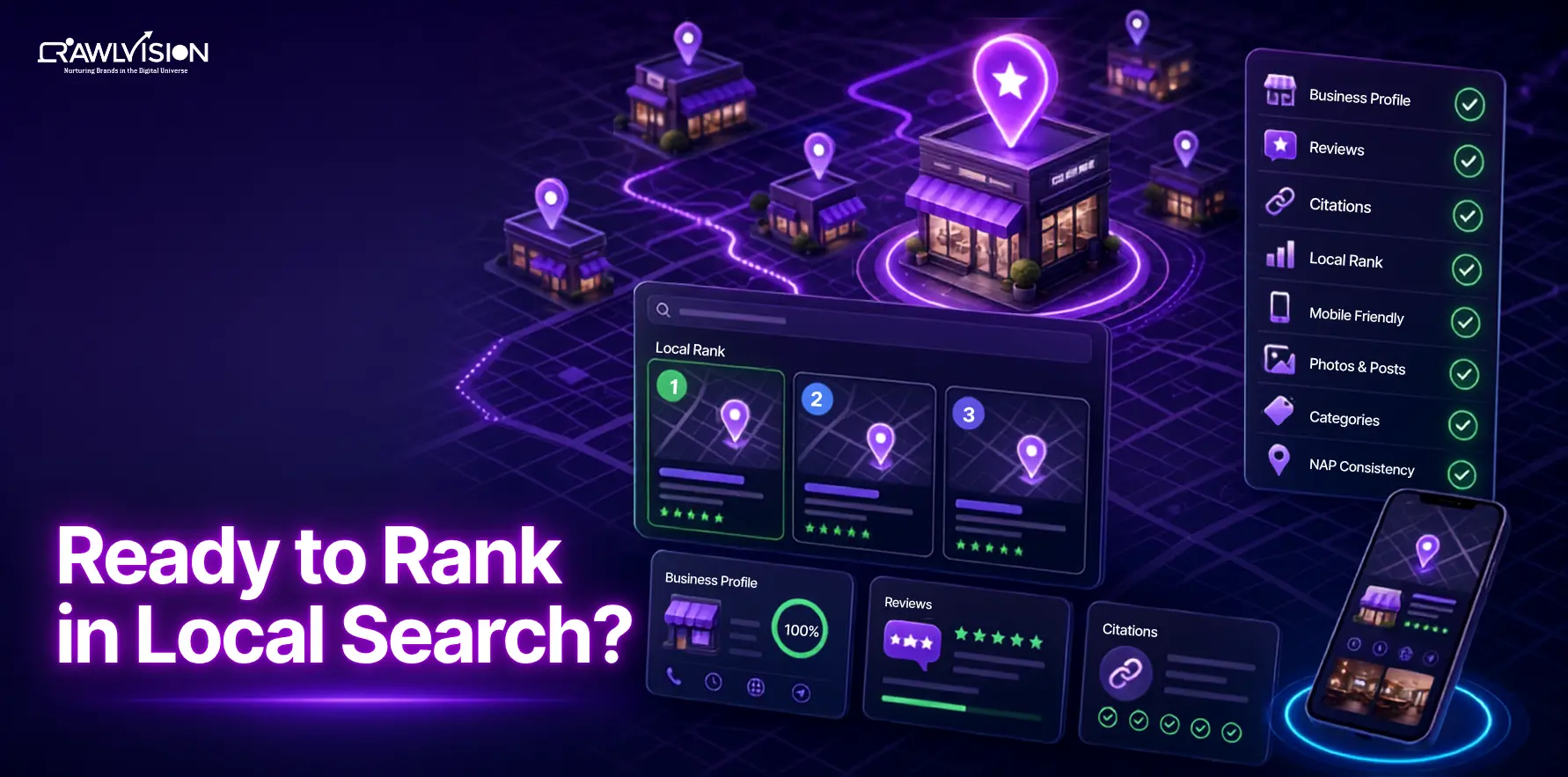
Whether you run a local cafe, dental clinic, law firm, or retail store, your customers are searching online before they visit or contact you. Billions of local searches happen every month, with “near me” queries continuing to grow as users rely on Google Search and Maps.
The challenge isn’t simply having a website. It’s making sure your business appears when local customers are ready to buy. That’s where a local SEO checklist becomes invaluable.
With over 80% of local searches triggering a map pack, getting your local SEO right isn’t optional. It’s essential. This guide walks you through 12 essential steps to attract more local customers and grow your business.
What Is a Local SEO Checklist? (Quick Answer)
A local SEO checklist is a step-by-step action plan to optimize your business for location-based searches. It covers Google Business Profile setup, NAP consistency, local citations, reviews, on-page SEO, schema markup, and localized content to improve visibility in Google Maps and local search results.
Why Is Local SEO Important for Businesses?
Local SEO helps your business reach customers who are actively searching for products or services in your area. Higher visibility in local search results often leads to more website visits, phone calls, store visits, and conversions.
People searching locally have strong purchase intent.
For example:
- “Best dentist near me”
- “Coffee shop nearby”
- “SEO agency in Mohali”
- “Electrician open now”
They’re not just browsing. They’re ready to buy. If you don’t optimize for local searches, your competitor wins those customers.
Local SEO Checklist: 12 Essential Steps
1. Claim and Optimize Your Google Business Profile
Your Google Business Profile (GBP) is the foundation of local SEO. It’s your digital storefront and the first thing customers see when searching for local businesses.
Essential GBP Optimization Steps
- Claim and verify your profile at business.google.com using the correct Gmail account.
- Choose specific primary and secondary categories that match your services.
- Upload 10+ high-quality photos: logo, cover photo, team, location, and work samples.
- Complete all business info: hours, phone, website, description, and attributes.
- Enable messaging and Q&A for direct customer engagement.
Pro tip: Match your GBP services to your website pages for better alignment and stronger ranking signals.
2. Keep Your NAP Information Consistent Everywhere
NAP stands for Name, Address, and Phone number. NAP consistency means your business information is identical across all platforms.
NAP Best Practices
- Use the same business name everywhere, no keyword stuffing.
- Format your address consistently (always “St.” or always “Street”).
- Add NAP in plain text on every page footer, not in images.
- Implement local schema markup to help search engines read your NAP.
- Audit your NAP quarterly using tools like Moz Local or BrightLocal.
Focus on high-impact directories like Google Business Profile, Bing Places, and Yelp.
3. Build Local Citations Across Trusted Directories
Citations are directory listings that validate your business to Google and provide external ranking signals.
Citation Checklist
- Claim profiles on major directories: Yelp, Yellow Pages, Bing Places, Apple Maps.
- Submit to industry-specific directories relevant to your niche.
- Get listed in local chambers of commerce and business associations.
- Aim for 40-60 high-quality citations with consistent NAP data.
- Monitor and fix duplicate or incorrect listings regularly.
Note: You need to build local citations even if you have a Google Business Profile; they’re separate ranking signals.
4. Collect and Respond to Customer Reviews
Reviews are a critical local SEO factor, with top-ranking businesses averaging 50+ reviews and 4.5+ stars.
Review Strategy That Works
- Set up automated review request emails after customer interactions.
- Respond to all reviews within 48 hours, positive and negative.
- Aim for 5-10 new reviews per month to maintain review velocity.
- Address negative reviews professionally: acknowledge, empathize, offer a solution.
- Display review widgets on your website for social proof.
Expert insight: Review velocity (consistent new reviews monthly) and response rate matter more than total quantity.
5. On-page SEO for Local Rankings
Your website needs to signal local relevance to both Google and AI search engines.
On-Page Local SEO Checklist
- Include city/region in title tags (e.g., “Best Dentist in Panipat | Your Clinic”)
- Add location to H1 and H2 headings throughout your site.
- Create location-specific landing pages for each area you serve.
- Embed a Google Map on your contact page.
- Include NAP in the footer on every page.
Match your GBP services to your website service pages for stronger ranking signals.
6. Add Local Business Schema Markup
The schema markup (structured data) helps Google and AI systems understand your business details.
Required Schema Types
- LocalBusiness schema: name, address, phone, hours, geo coordinates.
- Service schema: describe your offerings with structured data.
- FAQ schema: mark up common questions and answers.
- Review schema: display star ratings in search results.
- Use Google’s Schema Validator to ensure correct implementation.
Example: A restaurant adds LocalBusiness schema with menu items and hours, making it easier for AI Overviews to cite accurate information.
7. Build Local Content Strategy for 2026
Content that answers local questions and incorporates geographic signals performs better in search.
Local Content Ideas
- Write location-specific blog posts (e.g., “Top 5 Marketing Agencies in Panipat”)
- Create city/neighborhood guides for areas you serve
- Mention local landmarks and community references in your content
- Target “[service] + [city]” keywords naturally throughout
- Answer local FAQs in dedicated blog posts
GEO tip: Structure content with clear headings, FAQs, and direct answers to increase AI citation likelihood.
8. Make Your Website Fast and Mobile-Friendly
Technical SEO ensures search engines can crawl, understand, and rank your local pages effectively.
Technical Checklist
- Ensure mobile-friendly design (critical for local searches)
- Improve page load speed (under 3 seconds ideal)
- Fix broken links and 404 errors
- Submit XML sitemap to Google Search Console
- Ensure NAP is readable on mobile without zooming
Nearly half of all local searches happen on mobile devices; your site must be responsive.
9. Build Local Backlinks
Backlinks from local sources signal geographic prominence to Google and AI systems.
Link Building Tactics
- Partner with local organizations and sponsorships.
- Contribute to community platforms and local blogs.
- Get featured in local news outlets.
- Collaborate with complementary local businesses for cross-promotion.
- Ensure NAP uniformity when procuring backlinks.
A few high-authority local links beat dozens of low-quality ones.
10. Optimise for AI Search Engines
AI search engines like Google AI Overviews, ChatGPT, Perplexity, and Copilot are changing local search.
AI Search Optimization Strategies
- Structure content with clear headings and FAQs for easy AI parsing
- Write direct, factual answers to common questions
- Add FAQ schema to mark up questions and answers
- Create standalone factual paragraphs that AI models can easily quote
- Optimize for conversational queries (e.g., “best dentist near me”)
Use AI search strategies to identify what questions AI systems are already answering, then create content that fills those gaps.
11. Capture Social Media Search Traffic
Social platforms are increasingly used for local discovery; optimize your social presence to capture this traffic.
Social Media Optimization
- Claim and optimize profiles on Facebook, Instagram, LinkedIn, and TikTok.
- Add complete business info: name, address, phone, hours, website.
- Use consistent NAP across all social platforms.
- Post regularly with local content and community engagement.
- Link to your website and GBP from all social profiles.
Pro tip: Social signals (engagement, shares, reviews) indirectly support local SEO by building brand awareness.
12. Track and Measure Local SEO Performance
Monitoring your progress helps you identify what’s working and where to improve.
Key Metrics to Track
- Google Business Profile insights: clicks, calls, direction requests, photo views
- Local pack rankings for target keywords
- Organic traffic segmented by location
- Review velocity and sentiment over time
- Citation consistency score across directories
Key SEO Tools for Tracking
- Google Business Profile dashboard for GBP performance.
- Google Search Console for organic search data.
- Local SEO tools: BrightLocal, Moz Local, Local Falcon, Whitespark.
Common Local SEO Mistakes to Avoid
- Keyword stuffing in business name (Google penalizes this).
- Inconsistent NAP across directories.
- Ignoring negative reviews or responding defensively.
- Setting up GBP and forgetting it (inactive profiles rank lower).
- Duplicate listings that dilute NAP integrity.
Conclusion
Local SEO isn’t about checking off a list once and forgetting it. Search algorithms, user behavior, and AI-powered search experiences continue to evolve. By regularly revisiting these 12 steps, you can build a stronger local presence, attract more qualified customers, and create a sustainable strategy that performs across Google Search, Google Maps, and emerging AI search platforms.
Need expert help with local SEO or AI search optimization? Agencies like Crawl Vision help businesses navigate these changes with specialized local SEO, AEO, and GEO strategies.
Your local customers are searching right now. Make sure they find you.