

Google has launched a new Search ranking hub to make its ranking systems and update communication easier to understand. The hub brings Google’s ranking principles, ranking update notifications, and publisher feedback options together in one place.
The new documentation covers three areas: how Google ranks search results, how website owners can track ranking updates, and how publishers can report ranking-related concerns.
For SEO professionals, the announcement provides a clearer reference point for understanding Google’s ranking guidance and responding to significant search updates.
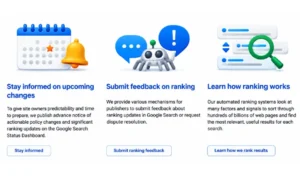
Google Explains Three Core Search Ranking Principles
Google has published a new documentation page titled “Our Principles for Ranking Results.” It explains three principles that guide how Google ranks search results.
These principles focus on user needs, consistent ranking standards, and continuous testing.
- Prioritizing users: Google’s ranking systems aim to show helpful and reliable information that satisfies users’ search needs.
- Applying consistent standards: Google evaluates different search result formats based on their usefulness to users. These formats include traditional web results, AI Overviews, images, and videos.
- Testing ranking changes: Google continuously tests changes to its ranking systems. These tests help Google evaluate whether a change improves search result quality.
Google also clarifies how its ranking principles apply to AI-powered search experiences. AI Overviews and AI Mode follow the same usefulness standards as traditional Google Search results.
This means website owners should not treat AI search visibility as a separate shortcut to rankings. Content must still provide useful, relevant, and reliable information to appear in Google’s search experiences.
Google Adds a Structured Process for Ranking Feedback
Google has introduced a dedicated feedback process for website owners, publishers, and content creators. The process allows them to report concerns about significant ranking changes.
Website owners can submit feedback when Google announces a major ranking update or an actionable policy change. Verified website owners can use Google Search Console to access this feedback process.
Google recommends including specific information in feedback submissions. This information can include Search Console performance data, affected search queries, countries, and languages.
Google also recommends using the relevant update hashtag when submitting feedback. For example, publishers reporting concerns about the November 2026 core update can use #NovemberCoreUpdate2026.
The new process gives publishers a more structured way to communicate ranking-related concerns to Google. However, submitting feedback does not guarantee a ranking recovery or a manual review of an individual website.
Google Explains How to Track Search Ranking Updates
Google has also published guidance on how website owners can stay informed about ranking updates.
Google communicates significant ranking changes through its Search Status Dashboard. The dashboard includes information about update announcements, rollout dates, and completion notices.
Google provides advance notice when a change introduces actionable policy requirements or could significantly affect search rankings across websites.
The documentation also explains when website owners should evaluate ranking changes. Google recommends waiting until a ranking update is complete before assessing its impact.
Google further recommends allowing at least one week after a rollout finishes before analyzing performance changes in Search Console. This gives website owners more time to collect stable post-update data.
What Google’s New Ranking Hub Means for SEO Professionals
Google’s new Search ranking hub does not announce a new ranking algorithm or introduce additional ranking factors. Instead, it makes existing ranking guidance and communication processes easier to access.
SEO professionals can use the documentation to better understand Google’s ranking principles and monitor significant search updates.
Website owners should also use Google Search Console to track traffic, impressions, clicks, and search queries. Comparing performance before and after a completed update can help identify which pages or search queries experienced changes.
The new feedback process provides another way to communicate concerns about significant ranking changes. However, long-term SEO performance still depends on creating useful content, maintaining a technically accessible website, and meeting users’ search needs.