


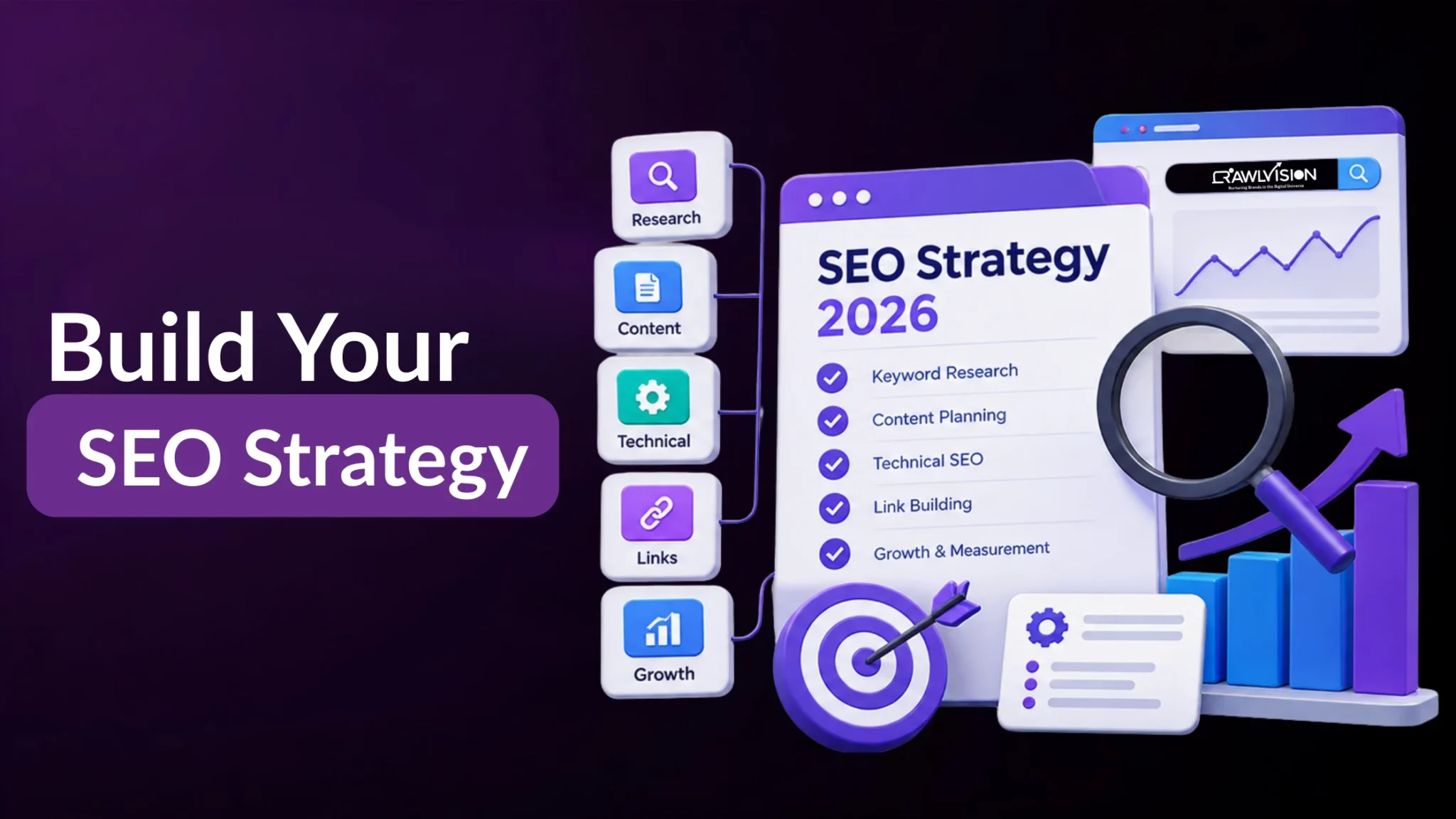
Build an SEO strategy by setting business goals, auditing your website, researching competitors and search intent, mapping keywords to pages, fixing technical issues, creating useful content, earning relevant links, and measuring results.
Why Businesses Need a Good SEO Strategy
A good SEO strategy helps businesses attract relevant organic traffic, reach potential customers at different stages of the buying journey, and turn search visibility into measurable business results.
Instead of treating keyword research, content creation, technical SEO, and link building as separate activities, it connects them through shared goals and priorities.
- Prioritize the right opportunities: Identify which pages, keywords, and technical improvements are most likely to support your business objectives.
- Reach the right audience: Target searches that reflect what potential customers need, whether they are researching a problem, comparing solutions, or preparing to buy.
- Build long-term search visibility: Improve your website’s accessibility, content quality, internal linking, and reputation through consistent work.
- Measure business impact: Track whether organic search contributes to qualified leads, sales, bookings, or other meaningful conversions.
In short: An SEO strategy gives every optimization task a purpose, a priority, and a way to measure progress.
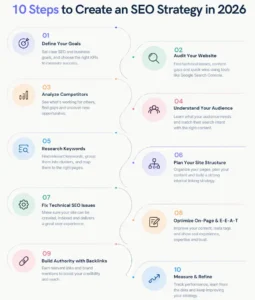
How to Build an SEO Strategy From Scratch
Building an SEO strategy from scratch involves understanding your business goals, assessing your website’s current performance, researching your audience and competitors, and creating a prioritized improvement plan.
Each step should inform the next: keyword research guides content planning, technical findings influence implementation priorities, and performance data refines future work.
1. Define SEO and business goals
SEO goals connect search visibility with business outcomes. Without clear objectives, a website might gain traffic from irrelevant queries without generating qualified enquiries or sales. Your goals should reflect what the business needs to achieve, not simply how many keywords it wants to rank for.
How to do it (practical steps):
- Identify your primary business objective, such as generating qualified leads, increasing online sales, or attracting more local customers.
- Choose relevant SEO KPIs, including organic clicks, non-branded search visibility, conversion rate, and organic leads or revenue.
- Record baseline performance and set realistic targets with a defined review period.
Pro Tip: Separate business outcomes from supporting SEO metrics. Rankings and impressions help diagnose visibility, while conversions show whether that visibility is contributing to business growth.
2. Audit current SEO performance
An SEO audit establishes your website’s starting point by identifying technical problems, underperforming pages, content gaps, and existing opportunities. It determines whether you should fix current issues, improve pages that already attract search impressions, or create new content to address unmet demand.
How to do it (practical steps):
- Review Google Search Console to understand search queries, clicks, impressions, indexing, and pages receiving organic visibility.
- Crawl the website to find broken links, redirect chains, duplicate URLs, missing metadata, and other technical issues.
- Evaluate important landing pages for search intent, content usefulness, internal links, and conversion performance.
Pro Tip: Prioritize issues by their likely impact. A page unintentionally blocked from indexing deserves attention before a minor metadata improvement on an already accessible page.
3. Analyze competitors
Competitor analysis helps you understand which websites are visible for your target searches, what types of content perform well, and where your business has realistic opportunities. The objective of competitor analysis is not to copy competing pages, but to identify gaps and develop a stronger, more relevant approach.
How to do it (practical steps):
- Identify direct business competitors and other websites appearing prominently for your important search queries.
- Compare their relevant landing pages, topic coverage, content formats, internal linking, and referring domains.
- Identify opportunities to create more useful resources, improve existing pages, or address questions competitors overlook.
Pro Tip: Assess competitors at the page and topic level, not just the domain level. A smaller website may have a particularly useful page that competes effectively for a specific search intent.
4. Research your audience and search intent
Audience research helps you understand what people are trying to accomplish when they search. Search intent describes the underlying purpose of the search, such as learning about a problem, comparing options, finding a website, or completing a purchase. Matching that intent makes your content more relevant to the reader.
How to do it (practical steps):
- Collect questions and concerns from customer conversations, sales calls, support requests, reviews, and relevant online discussions.
- Examine search results for target queries to understand whether users expect a guide, product page, comparison, local listing, or another format.
- Group audience needs by topic and buying stage, then decide what information each page should provide.
Pro Tip: Do not assume that similar keywords always need separate pages. If their intent and expected results overlap substantially, one comprehensive page may serve users better.
5. Conduct keyword research and clustering
Keyword research identifies the language people use to find information, products, and services. Keyword clustering groups related queries by topic and search intent, helping you decide which pages to create, which existing pages to improve, and how to avoid unnecessary overlap between URLs.
How to do it (practical steps):
- Gather relevant terms using keyword research tools, competitor pages, customer questions, and Google Search Console data where available.
- Group related queries according to meaning, intent, business relevance, and the type of content searchers expect.
- Assign each cluster to a suitable target URL and record its primary keyword, supporting terms, intent, and priority.
Pro Tip: Do not prioritize keywords on search volume alone. A lower-volume query closely related to your service may attract more qualified visitors than a broad term with little commercial relevance.
6. Build site structure and content plan
A clear website structure organizes information into logical categories and helps visitors discover related pages. A content plan turns keyword research into a manageable publishing and optimization schedule, ensuring that important topics receive appropriate coverage without creating repetitive or competing pages.
How to do it (practical steps):
- Organize key pages into logical categories, such as services, product pages, core guides, and supporting articles.
- Build topic clusters around important subjects, connecting comprehensive resources with relevant supporting pages through contextual internal links.
- Create a content calendar that prioritizes new pages, existing content updates, responsible owners, and planned review dates.
Pro Tip: Build your internal linking plan alongside your content calendar. A good internal linking strategy explains how relevant links can help users and search engines navigate related content.
7. Fix technical SEO issues
Technical SEO helps search engines access, crawl, interpret, and index the pages you want to rank. Even useful content can struggle to gain visibility if important URLs are blocked, canonicalized incorrectly, inaccessible, or affected by other technical problems.
How to do it (practical steps):
- Check robots.txt rules, noindex directives, server responses, and indexing reports to identify unintended access or indexing restrictions.
- Review sitemaps, canonical tags, redirects, HTTPS, internal links, and duplicate URL variations.
- Assess mobile usability, loading performance, and other page experience issues, prioritizing problems that affect users or search accessibility.
Pro Tip: Validate the cause before applying a fix. For example, a page missing from search results may be excluded intentionally, blocked from crawling, or considered a duplicate. Each situation requires a different response.
8. Optimize on-page SEO and demonstrate e-e-a-t
On-page SEO helps search engines and readers understand a page’s subject, purpose, and relevance to a query. Experience, expertise, authoritativeness, and trustworthiness, collectively known as E-E-A-T, provide a useful framework for evaluating content quality and credibility. Google does not treat E-E-A-T itself as a single ranking factor.
How to do it (practical steps):
- Write descriptive title tags, useful headings, and clear introductions that communicate the page’s main purpose.
- Answer the reader’s question thoroughly, include relevant examples, and support factual claims with reliable sources where appropriate.
- Provide accurate author information, demonstrate relevant first-hand experience when available, and keep business details and important claims transparent.
Pro Tip: Make experience visible through specific evidence, such as documented observations, original examples, or clearly explained methodology. Follow Google’s people-first content guidance rather than adding author details solely for appearance.
9. Build off-page authority through backlinks and brand mentions
Off-page SEO includes activities that strengthen a website’s reputation and help people discover its content beyond its own pages. Relevant editorial links can support discovery and provide useful context, while credible brand mentions can help establish recognition. Not every mention provides a ranking benefit, so quality and relevance matter more than raw counts.
How to do it (practical steps):
- Create useful resources, original research, expert commentary, or other material that relevant publishers have a genuine reason to reference.
- Develop relationships with industry publications, partners, and relevant communities through digital PR and legitimate outreach.
- Evaluate backlinks by topical relevance, editorial context, source quality, and the likelihood of reaching a relevant audience.
Pro Tip: Avoid buying links intended to manipulate rankings or participating in link schemes. Build relationships and resources that can earn legitimate references over time.
10. Measure results and refine your SEO strategy
SEO measurement shows whether your strategy is improving search visibility and contributing to business objectives. Regularly reviewing performance helps you distinguish implementation progress, changes in search demand, technical problems, and improvements in qualified traffic or conversions.
How to do it (practical steps):
- Use Google Search Console to monitor impressions, clicks, click-through rate, search queries, and page-level performance.
- Use analytics and CRM data, where available, to evaluate organic conversions, lead quality, sales, and revenue.
- Compare results with your baseline, investigate meaningful changes, and update priorities according to the evidence.
Pro Tip: Review metrics in context. A decline in clicks might reflect lower search demand, changing search-result features, or reduced visibility. Investigate the underlying cause before changing the entire strategy.
How to Prioritize These SEO Tasks
Prioritize SEO tasks by evaluating their potential business impact, implementation effort, urgency, and confidence in the available evidence. This approach helps teams address serious technical problems and valuable existing-page opportunities before spending resources on changes with uncertain benefits.
| SEO task | Impact | Effort | Priority |
| Fix an important page blocked from indexing unintentionally | High | Low to medium | High |
| Improve a relevant landing page with impressions but weak clicks | Medium to high | Low | High |
| Publish content for a validated topic gap | Medium | Medium | Medium |
| Redesign a page without evidence of a problem | Unclear | High | Low |
These priorities are illustrative. Your audit findings, business goals, and available resources should determine the final order.
Your First 90 Days of SEO: A Practical Roadmap
A 90-day SEO roadmap turns strategy into scheduled work, with early weeks focused on research and diagnosis, the middle period focused on implementation, and the final period focused on expanding improvements and reviewing results.
Days 1-30
- Define business goals, select KPIs, and record baseline performance.
- Audit the website, analyze competitors, and research audience needs and search intent.
- Build keyword clusters, map target URLs, and prioritize technical blockers.
Days 31-60
- Resolve critical crawling, indexing, and site-structure issues.
- Improve priority service pages and existing content.
- Start publishing content for validated gaps and strengthen internal linking.
Days 61-90
- Publish or refresh priority pages based on the content plan.
- Pursue relevant digital PR, industry relationships, and legitimate editorial backlinks.
- Review early performance, investigate changes, and set priorities for the next quarter.
Five Common SEO Strategy Mistakes to Avoid
Common SEO strategy mistakes include prioritizing vanity metrics, publishing without understanding search intent, overlooking technical barriers, measuring rankings without business outcomes, and expecting immediate results.
Avoiding these 5 problems helps keep SEO work focused on relevant opportunities and measurable progress.
- Chasing search volume alone: Choose keywords based on relevance, intent, and business value, not popularity alone.
- Publishing without a plan: Map topics and target URLs before creating content to reduce duplication and keyword cannibalization.
- Ignoring technical blockers: Check whether important pages can be crawled and indexed before scaling content production.
- Measuring rankings only: Track qualified traffic, conversions, and lead quality alongside visibility metrics.
- Expecting instant results: Allow time for implementation and evaluation, then refine the strategy using reliable performance data.
Conclusion
Building a complete SEO strategy from scratch means connecting business goals with website analysis, audience research, keyword mapping, technical SEO improvements, useful content, authority building, and ongoing measurement. Each activity should support a clear objective and fit into a prioritized plan.
At our AI-powered digital marketing agency, we help businesses approach SEO and AI-search visibility through structured optimization and practical strategy. We start by identifying your most important website issues and opportunities, then build a plan around what your audience and business need.